Who really invented the future?
Prompted by NerdSip Explorer #6116
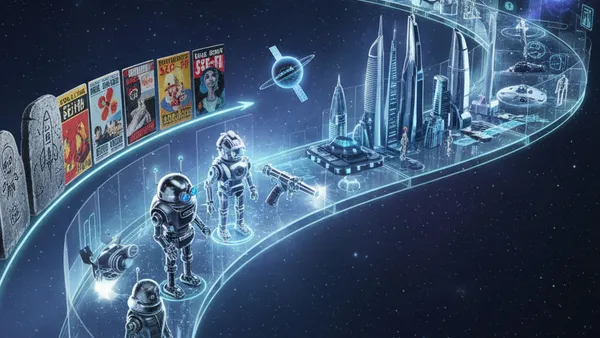
Trace the epic evolution of science fiction.
When did science fiction actually begin? While modern fans think of spaceships and lasers, the roots of the genre stretch back much further.
Some historians point to the ancient world. Lucian of Samosata’s *True History*, written in the 2nd century, features space travel and interplanetary warfare. However, most scholars agree that the first true science fiction novel was published in 1818: Mary Shelley’s Frankenstein.
What made *Frankenstein* so groundbreaking? Before Shelley, fantastical stories relied on magic, gods, or the supernatural to explain the impossible. Shelley shifted the paradigm by using science—specifically the newly discovered concepts of galvanism and electricity—to bring her monster to life.
This was a massive turning point. It established the core rule of sci-fi: the story’s premise, no matter how wild, must be rooted in scientific principles rather than pure magic. From a teenage girl's ghost story came a genre that would conquer the world.
Key Takeaway
Mary Shelley's Frankenstein is widely considered the first sci-fi novel because it used science, rather than magic, to explain the impossible.
Test Your Knowledge
Why is Frankenstein often considered the first true science fiction novel?
If Mary Shelley planted the seed of sci-fi, two Victorian authors grew it into a towering tree: Jules Verne and H.G. Wells. Often called the 'Fathers of Science Fiction,' they approached the genre from vastly different angles.
Jules Verne was the ultimate optimist. In novels like *Twenty Thousand Leagues Under the Sea* and *From the Earth to the Moon*, he focused on plausible engineering. Verne imagined how current technological trends might evolve, creating thrilling adventures centered around exploration and discovery.
H.G. Wells, on the other hand, was deeply concerned with societal issues. In works like *The Time Machine* and *The War of the Worlds*, he used sci-fi as a lens for social critique. He wasn't just predicting technology; he was exploring evolutionary anxieties, imperialism, and class divides.
Together, these two pioneers established the foundational tropes we still use today: time travel, alien invasions, and advanced transportation. They proved that sci-fi could be both a grand adventure and a mirror reflecting society's deepest fears.
Key Takeaway
Jules Verne focused on plausible engineering and adventure, while H.G. Wells used sci-fi for social critique.
Test Your Knowledge
What was a major difference between the storytelling of Jules Verne and H.G. Wells?
By the 1920s, science fiction found a new, highly accessible home: the pulps. These were cheap magazines printed on low-quality wood pulp paper, designed to be read by the masses.
The turning point came in 1926 when an eccentric inventor and publisher named Hugo Gernsback launched *Amazing Stories*. It was the first magazine dedicated entirely to what Gernsback called 'scientifiction.' He believed these stories should be 75% literature and 25% science, aiming to educate as well as entertain.
The Pulp Era was characterized by wild imagination over scientific accuracy. It gave us the classic tropes of bug-eyed monsters, daring space rangers, and shiny rocket ships. The cover art was bright, sensational, and unapologetically lurid.
While the writing quality in the pulps was often famously terrible, their impact was undeniable. They built the first dedicated community of sci-fi fans, connecting readers through lively letters columns. Today, the most prestigious award in science fiction is named 'The Hugo' in Gernsback's honor.
Key Takeaway
The 1920s Pulp Era popularized sci-fi for the masses through cheap, wildly imaginative magazines like Amazing Stories.
Test Your Knowledge
What format helped popularize science fiction for the masses in the 1920s?
As the 1930s drew to a close, readers began to demand more than just cheap thrills and bug-eyed monsters. This led to the Golden Age of Science Fiction, a period defined by rigorous logic and better writing.
The driving force behind this era was John W. Campbell, the editor of *Astounding Science Fiction* magazine. Campbell demanded that his writers treat science seriously. He wanted stories where characters solved problems using engineering, physics, and sociology, rather than pulling a magical space-ray out of nowhere.
Under Campbell's guidance, a legendary generation of writers emerged, most notably the 'Big Three': Isaac Asimov, Arthur C. Clarke, and Robert A. Heinlein. Asimov codified the rules of robotics, Clarke explored the mystical edges of space travel, and Heinlein examined military and political structures.
This era popularized Hard Sci-Fi, a subgenre where scientific accuracy is paramount. It transformed science fiction from a niche, sensationalist hobby into a respectable genre capable of exploring complex intellectual ideas.
Key Takeaway
The Golden Age of Sci-Fi brought a demand for logical, scientifically accurate stories, popularizing 'Hard Sci-Fi'.
Test Your Knowledge
What was the primary shift in storytelling during the Golden Age of Sci-Fi?
While novels and magazines built the foundation, it was the silver screen that made science fiction a global phenomenon. Early cinema experimented with the genre, most notably in Fritz Lang’s 1927 silent masterpiece *Metropolis*, which established the visual vocabulary for futuristic cities.
In the 1950s, sci-fi cinema exploded as a reflection of real-world anxieties. Movies about alien invasions and giant radioactive monsters were thinly veiled metaphors for Cold War paranoia and the fear of nuclear destruction. The atomic age had arrived, and Hollywood was cashing in on the terror.
The 1960s brought a more philosophical approach to screens. Television shows like *The Twilight Zone* used sci-fi and fantasy to sneak complex moral allegories past network censors.
Shortly after, *Star Trek* debuted. Unlike the fearful movies of the 50s, it presented a radically optimistic, post-scarcity future. It featured a diverse crew exploring the stars, proving that visual sci-fi could inspire just as effectively as it could terrify.
Key Takeaway
Early sci-fi film and TV reflected societal fears, like Cold War paranoia in the 50s, before evolving to show optimistic futures.
Test Your Knowledge
What real-world anxiety heavily influenced the alien invasion and monster movies of the 1950s?
By the 1960s, a new generation of writers was growing tired of the Golden Age's obsession with rivets, rocket ships, and rigid physics. They sparked a literary rebellion known as the New Wave.
Instead of the 'hard' sciences like physics and astronomy, New Wave authors turned their attention to the 'soft' sciences: psychology, sociology, and anthropology. They were heavily influenced by the counterculture movements of the 60s, experimenting with literary style, surrealism, and taboo subjects.
Legends emerged during this era. Ursula K. Le Guin challenged our understanding of gender and society in *The Left Hand of Darkness*. Frank Herbert explored ecology, religion, and power in his sweeping epic *Dune*. Meanwhile, Philip K. Dick wrote mind-bending stories that questioned the very nature of reality and human identity.
The New Wave shifted sci-fi's focus from the outer space of the universe to the inner space of the human mind. It proved the genre could be profoundly deeply literary and emotionally complex.
Key Takeaway
The New Wave of the 1960s shifted sci-fi's focus from physics and outer space to psychology, society, and 'inner space'.
Test Your Knowledge
What defines the 'New Wave' movement in science fiction?
In the 1980s, the future suddenly stopped looking like shiny rocket ships and started looking like neon-lit alleyways. Welcome to Cyberpunk, a subgenre that brilliantly anticipated the digital revolution.
Cyberpunk is famously summarized by the phrase: 'High tech, low life.' Authors envisioned dystopian futures where governments had collapsed, massive mega-corporations ruled the world, and society was heavily stratified.
William Gibson’s 1984 novel *Neuromancer* is the definitive Cyberpunk text. He famously coined the term 'cyberspace' before the modern internet even existed, imagining a virtual reality matrix that hackers 'jacked' into. Visually, the genre was defined by Ridley Scott's 1982 film *Blade Runner*, with its rainy, neon-drenched, overcrowded cityscapes.
Cyberpunk shifted the focus from astronauts and scientists to hackers, outcasts, and corporate mercenaries. It explored the fusion of humanity and machinery through cybernetics, reflecting growing anxieties about how rapid computing advancements might leave the poorest among us behind.
Key Takeaway
Cyberpunk emerged in the 1980s, focusing on dystopian futures dominated by advanced computers, mega-corporations, and gritty street life.
Test Your Knowledge
Which phrase is famously used to summarize the Cyberpunk subgenre?
While the New Wave and Cyberpunk were pushing literary boundaries, Hollywood was about to change the financial landscape of science fiction forever. The catalyst was a 1977 film you might have heard of: *Star Wars*.
Before *Star Wars*, mainstream sci-fi on screen was often seen as bleak, cerebral, or niche. George Lucas changed the formula by blending science fiction with classic fantasy and mythic storytelling. He gave audiences a sprawling Space Opera—a subgenre focused on grand scale, melodramatic romance, and epic battles rather than strict scientific accuracy.
The impact was monumental. *Star Wars* proved that sci-fi could be a massive, four-quadrant blockbuster hit. It shifted the industry's focus toward special effects, merchandising, and franchise-building.
This era blurred the lines between fantasy and sci-fi. Lasers and hyperspace were just window dressing for classic tales of good versus evil. It transformed sci-fi from a specialized literary genre into the most dominant and profitable force in global pop culture.
Key Takeaway
Star Wars popularized the Space Opera, proving that blending sci-fi with mythic fantasy could create massive global blockbusters.
Test Your Knowledge
How did Star Wars change mainstream science fiction cinema?
For much of its early history, mainstream science fiction was dominated by Western, male perspectives. But as the 20th century turned into the 21st, the genre underwent a massive, necessary expansion of voices.
A key part of this evolution is Afrofuturism, a cultural aesthetic that combines science fiction and technology with African diaspora culture and history. Pioneer Octavia Butler wrote foundational novels exploring race and power, while modern works like the *Black Panther* films brought Afrofuturism to billion-dollar global audiences.
Today, writers from all backgrounds are using sci-fi to explore their unique cultural intersections. N.K. Jemisin became the first author to win the Hugo Award for Best Novel three years in a row, breaking long-standing barriers.
Additionally, non-Western sci-fi has exploded in global popularity. Chinese author Liu Cixin’s *The Three-Body Problem* brought a distinctly Eastern philosophical approach to first contact and astrophysics. This diversity ensures that the future we imagine actually represents all of humanity.
Key Takeaway
Modern sci-fi is defined by diverse, global voices and movements like Afrofuturism, which ensure our imagined futures represent everyone.
Test Your Knowledge
What is Afrofuturism?
So, where does science fiction go from here? As our real world increasingly resembles a sci-fi novel, the genre continues to evolve to tackle our most pressing contemporary anxieties.
One of the fastest-growing modern subgenres is Cli-Fi (Climate Fiction). As global warming becomes an undeniable reality, authors are writing stories that explore ecological collapse, survival in extreme weather, and the societal shifts required to save our planet.
In response to the overwhelming bleakness of modern dystopias, a counter-movement called Hopepunk has emerged. Hopepunk stories reject pure cynicism, arguing that kindness, community building, and fighting for a better future are radical, rebellious acts.
Finally, as Artificial Intelligence becomes a daily reality, modern sci-fi is moving past the old 'killer robot' tropes to explore complex questions of algorithmic bias, digital sentience, and labor rights. Science fiction isn't just about predicting tomorrow; it remains our most powerful tool for understanding exactly where we are today.
Key Takeaway
Contemporary sci-fi uses movements like Cli-Fi and Hopepunk to process modern anxieties about climate, AI, and society.
Test Your Knowledge
What is the primary theme explored in the modern subgenre known as 'Cli-Fi'?
Track your progress, earn XP, and compete on leaderboards. Download NerdSip to start learning.