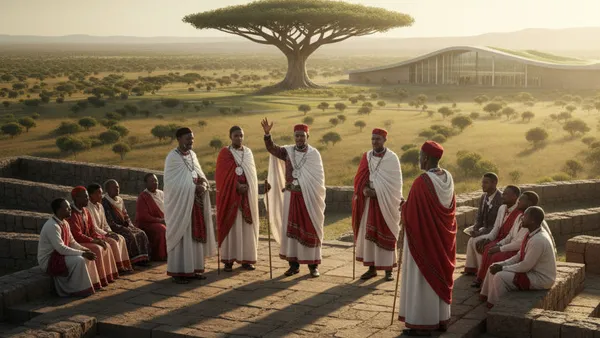
Discover the ancient African democracy that rotates power every eight years.
Prompted by NerdSip Explorer #6116
Master the principles of the Oromo Gadaa governance system.
Have you ever wondered if there are forms of democracy that predate modern Western systems? Enter the Gadaa system, an indigenous, centuries-old socio-political framework developed by the Oromo people of East Africa, primarily in Ethiopia and northern Kenya.
Far from a simple tribal council, the Gadaa is widely considered to be a highly complex and sophisticated democratic institution. It was operating as a fully-fledged system by the 16th century, though its roots are believed to stretch back much further. It acts as an "unwritten constitution" that governs nearly every aspect of life.
Rather than relying on kings or inherited nobility, the Gadaa system distributes power among the people. It regulates political stability, economic development, social activities, and cultural obligations, making it a holistic way of life rather than just a government.
As we dive into this curriculum, you'll see how this system offers uniquely African solutions to the challenges of governance, power-sharing, and community building.
Key Takeaway
The Gadaa system is a sophisticated, centuries-old indigenous democracy created by the Oromo people.
Test Your Knowledge
What best describes the Gadaa system?
At the heart of the Gadaa system is a profound philosophy of time and rotation. Power is never held indefinitely. Instead, the system is built around strict eight-year cycles.
There are five main political parties—often referred to as *miseensa*. These five parties rotate through the responsibilities of leadership. When one party takes power, it governs for exactly eight years before peacefully passing the baton to the next group.
Because there are five parties, a single party will complete its term and then wait 40 years before it is their turn to govern the polity again. This cyclical nature ensures that power is continually shared and never monopolized by one faction.
This built-in term limit is a cornerstone of Oromo democracy. It structurally prevents the rise of dictatorships, as the transition of power every eight years is a deeply respected and non-negotiable cultural mandate.
Key Takeaway
Power in the Gadaa system rotates among five parties, with each serving a strict eight-year term.
Test Your Knowledge
How long does a single political party hold leadership power in the Gadaa system?
In many societies, your role is determined by your biological age or your wealth. In the Gadaa system, your responsibilities are determined by your Gadaa grade, which is based on generations rather than just how old you are.
Oromo males traditionally pass through a series of eleven grades, each lasting eight years. These grades represent different stages of life, from childhood and learning, to military service, to full political leadership, and finally to advisory retirement.
Because the system is generational, a boy enters the system exactly five grades (or 40 years) behind his father. This means a young child and a grown man could technically be in the same Gadaa grade if their fathers were in the same generation-set!
This brilliant structure ensures that every individual is educated, prepared, and mentored for leadership long before they ever take office. It creates a stable, predictable roadmap for personal development and civic duty.
Key Takeaway
Gadaa uses generation-based grades to mentor individuals through different stages of civic responsibility.
Test Your Knowledge
How is a person's Gadaa grade primarily determined?
If the Gadaa system has no kings, who leads the government during those eight years of power? The executive branch is led by an elected official known as the Abbaa Gadaa (which roughly translates to "Father of Gadaa").
The Abbaa Gadaa acts as the president or prime minister of the Oromo people. He is elected democratically from the party that is currently entering the leadership grade. He serves as the chief spokesman, leading civil matters and representing the assembly.
However, the Abbaa Gadaa does not rule alone. He is supported by a cabinet of officials, including the *Abbaa Duulaa* (commander of the army) and the *Abbaa Seeraa* (chief of laws).
Crucially, the Abbaa Gadaa is not above the law. If he or his cabinet fails to serve the people properly, the system allows for them to be challenged or even removed. When their eight years are up, they seamlessly return to being regular citizens.
Key Takeaway
The Abbaa Gadaa is an elected, term-limited leader who governs alongside a cabinet of specialized officials.
Test Your Knowledge
What happens to an Abbaa Gadaa after his eight-year term ends?
Every great democracy needs a parliament or a congress. For the Gadaa system, this legislative branch is known as the Gumii or Caffee (the General Assembly).
Traditionally, this assembly does not meet in a stone building. Instead, they gather outdoors under the sprawling branches of a sacred sycamore tree known as the Odaa. The Odaa tree is a powerful symbol of peace, shade, and democratic dialogue in Oromo culture.
During these assemblies, representatives from all over the region come together to review existing laws, pass new legislation, and evaluate the performance of the current Abbaa Gadaa and his executive team.
The Gumii holds the ultimate authority in the Gadaa system. Even the highest-ranking leaders must answer to the assembly. It is here, under the shade of the Odaa, that the true voice of the people is heard and the "unwritten constitution" is updated.
Key Takeaway
The General Assembly (Gumii/Caffee) is the ultimate legislative authority, traditionally gathering under the sacred Odaa tree.
Test Your Knowledge
What is the significance of the Odaa tree in the Gadaa system?
One of the most impressive features of the Gadaa system is how it prevents tyranny. Long before modern political scientists wrote about "checks and balances," the Oromo people embedded them directly into their culture.
The system structurally divides power. The executive branch (the Abbaa Gadaa and his cabinet) is completely separate from the legislative branch (the General Assembly). The leaders can only execute the laws that the assembly creates.
Furthermore, power is distributed across different levels of society. It balances opposition between the five political parties, ensuring that no single group can dominate the narrative.
If a leader attempts to seize permanent power or act against the community's interest, the assembly has the ultimate authority to hold them accountable. This constant rotation, divided authority, and strict accountability make the Gadaa a remarkably stable anti-authoritarian system.
Key Takeaway
Gadaa utilizes divided branches of government and strict accountability to prevent anyone from holding absolute power.
Test Your Knowledge
How does the Gadaa system primarily prevent dictatorships?
Historically, the formal age-sets and Gadaa grades were exclusively for men, leading to critiques regarding gender inclusivity. However, Oromo women were not left without political power. They utilized a powerful parallel institution known as Siqqee.
The Siqqee was both a physical staff carried by married women and a socio-political institution that protected women's rights. It served as a direct check on male dominance within the Gadaa system.
If women felt their rights were being violated, or if men abused their power, women could mobilize through the Siqqee institution. They had the power to halt community activities, curse wrongdoers, and demand justice. Men were culturally and legally obligated to respect the Siqqee and resolve the women's grievances.
While the formal Gadaa grades were male-dominated, historians point out that the Siqqee functioned as an essential balancing force, ensuring that women had a collective voice and structural protection in society.
Key Takeaway
The Siqqee was a powerful parallel institution that allowed Oromo women to protect their rights and check male power.
Test Your Knowledge
What was the primary purpose of the Siqqee institution?
The Gadaa system is not just about making laws and electing leaders; it is deeply intertwined with the survival and prosperity of the community. It actively regulates economic life and environmental conservation.
Historically, the Oromo were semi-nomadic pastoralists, relying heavily on cattle and the land. The Gadaa system provided strict normative standards for how to use and care for the natural environment, ensuring resources were not depleted.
The system designated specific grazing lands, protected certain tree species, and managed water sources. Because the community viewed themselves as stewards of the earth for the next generation-set, sustainable practices were practically built into the law.
By rotating responsibilities every eight years, the system also ensured that economic duties—like managing herds or defending territory—were shared equitably. It was a holistic approach that recognized that a healthy democracy requires a healthy environment.
Key Takeaway
The Gadaa system included strict rules for environmental conservation and sustainable resource management.
Test Your Knowledge
How did the Gadaa system view the natural environment?
When conflicts arise, how does the Gadaa system handle them? Unlike many modern legal systems that focus primarily on punishment and imprisonment, the Gadaa justice system heavily emphasizes reconciliation and restoring harmony.
Disputes, whether over land, resources, or personal grievances, are brought before traditional elders or the Gadaa courts. The goal of the *Abbaa Seeraa* (chief of laws) is not just to penalize the wrongdoer, but to repair the social fabric.
This process often involves deep community dialogue. Both parties are encouraged to speak, and resolutions usually require the offender to compensate the victim and ask for forgiveness.
By focusing on restorative justice, the Gadaa system prevents long-lasting feuds between families or clans. It treats a crime not just as a broken rule, but as a tear in the community web that must be carefully woven back together.
Key Takeaway
Gadaa justice focuses on restorative practices, emphasizing reconciliation and compensation over strict punishment.
Test Your Knowledge
What is the main goal of the Gadaa justice system when a dispute occurs?
During the late 19th century, the expansion of the Ethiopian empire led to the suppression of the Gadaa system. Its practices were officially banned, and its political power was severely restricted.
Despite this intense pressure, the Gadaa system did not disappear. The Oromo people secretly preserved their traditions, adapting the system to survive as a cultural and social framework even when its political authority was outlawed.
Today, the Gadaa system is experiencing a powerful resurgence. In 2016, UNESCO officially recognized it as an Intangible Cultural Heritage of Humanity, cementing its status as a vital piece of global history.
Modern scholars and activists frequently study the Gadaa as a profound model for participatory democracy, conflict resolution, and sustainable governance. It stands as a powerful reminder that Africa has deep, indigenous roots of democratic thought.
Key Takeaway
Despite historical suppression, the Gadaa system survives today and is recognized by UNESCO as a vital democratic heritage.
Test Your Knowledge
What happened to the Gadaa system in 2016?
Track your progress, earn XP, and compete on leaderboards. Download NerdSip to start learning.