Did you know humans instinctively look at floor numbers to avoid eye contact in tight spaces?
Prompted by A NerdSip Learner
An exploration of the unwritten spatial rules governing shared public spaces.
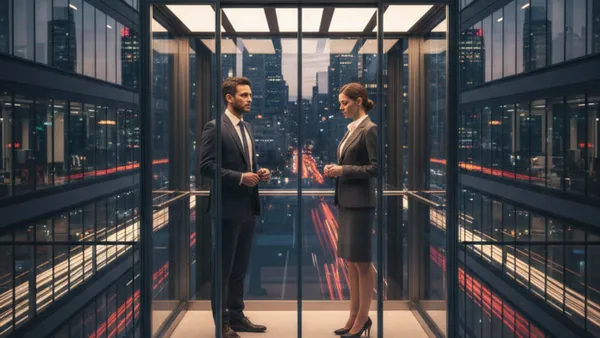
Have you ever noticed the immediate transformation that occurs the moment you step into a crowded elevator? Outside, in the lobby, people are animated, chatting, and making eye contact. But the second the doors close, a heavy silence descends. Everyone suddenly becomes fascinated by the ceiling, their shoes, or the glowing floor numbers.
This sudden shift isn't just random awkwardness. It is a highly coordinated, unconscious social dance that humans perform to navigate the sudden collapse of our physical boundaries. In an elevator, we are forced into a tight, enclosed box with strangers, stripping away our ability to control our surroundings.
Throughout this course, we will decode the unwritten rules of these shared public spaces. We will explore the psychology of personal boundaries, why our brains treat elevators as unique social puzzles, and how avoiding eye contact is actually a brilliant evolutionary strategy rather than just a quirky habit.
Key Takeaway
Elevator silence is a highly coordinated, unconscious response to a sudden loss of physical boundaries, not just random awkwardness.
Test Your Knowledge
What typically happens to people's behavior immediately after stepping into a crowded elevator?
To understand elevator behavior, we first need to understand "proxemics." Coined by anthropologist Edward T. Hall in the 1960s, proxemics is the study of how humans use physical space to communicate.
Hall identified four distinct invisible bubbles we carry around with us: the Intimate Zone (0 to 1.5 feet), the Personal Zone (1.5 to 4 feet), the Social Zone (4 to 12 feet), and the Public Zone (12 feet and beyond). We typically reserve our Intimate Zone for close friends, romantic partners, and family members.
When you step into a crowded elevator, strangers are suddenly thrust into your Intimate and Personal zones. Because physically moving away is impossible, our brains have to find another way to create distance. If we cannot create physical space, we create psychological space. By shutting down our facial expressions and avoiding eye contact, we mentally push others back into the Social Zone.
Key Takeaway
Proxemics is the study of human space, and in elevators, strangers are forced into our Intimate Zone, prompting us to create psychological distance.
Test Your Knowledge
According to Edward T. Hall's theory of proxemics, which spatial zone is typically reserved for close friends and family?
Have you ever locked eyes with someone as you both walked down a hallway, only to politely look away just before passing? This widespread social phenomenon is known as "civil inattention."
First described by sociologist Erving Goffman, civil inattention is the act of acknowledging a stranger's presence while simultaneously showing that you have no intention of interacting with them. It is a way of saying, "I see you, but I am not a threat, and I will respect your privacy."
In an elevator, civil inattention is working in overdrive. Studies have shown that when people board a lift, they typically give other passengers a brief, fraction-of-a-second glance. This quick scan fulfills the social contract of acknowledging the other person. Immediately after, gazes are diverted to the floor numbers or a smartphone. Staring too long violates this unspoken rule, turning polite awareness into perceived aggression or unwanted intimacy.
Key Takeaway
Civil inattention is the social norm of briefly acknowledging someone's presence before looking away to signal respect and non-threat.
Test Your Knowledge
What is the primary purpose of "civil inattention" in a public space like an elevator?
It turns out that our awkward elevator habits might be deeply rooted in our evolutionary history. Researchers studying non-human primates have noticed striking similarities between human elevator riders and monkeys placed in confined spaces.
When rhesus macaques are temporarily placed together in a small cage, their behavior mirrors a crowded elevator ride. They immediately stop vocalizing, retreat to opposite corners, and painstakingly avoid looking at one another. Instead, they stare blankly at imaginary spots outside their enclosure.
For primates—including humans—direct, prolonged eye contact can be interpreted as a challenge or a threat. When trapped in close quarters with no escape route, the safest strategy is to signal complete submission and disinterest. So, the next time you find yourself intensely studying the elevator door panels, remember that you are tapping into an ancient survival instinct designed to keep the peace.
Key Takeaway
Avoiding eye contact in confined spaces is an evolutionary instinct shared with other primates to prevent aggression and signal non-threat.
Test Your Knowledge
How do rhesus macaques behave when placed in a confined space together, mirroring human elevator behavior?
Elevator riders don't just stand randomly; they follow a strict, unwritten spatial choreography. If you are the first person to enter an empty elevator, you will almost certainly walk to the back corner.
When the second person enters, they will instinctively take the diagonally opposite corner, maximizing the physical distance between the two of you. A third person will form a triangle, and a fourth will complete the square, taking up the remaining corners. It is a subconscious geometric dance designed to keep everyone as far apart as mathematically possible.
As more people pile in, the space shrinks, and the rules shift. Everyone turns to face the door. Facing the door serves a dual purpose: it prepares you for an easy exit and, more importantly, ensures that nobody is breathing directly onto anyone else's face. This unified orientation minimizes uncomfortable face-to-face encounters and maintains the illusion of solitude.
Key Takeaway
People unconsciously arrange themselves in elevators to maximize physical distance, typically filling corners first and always facing the door.
Test Your Knowledge
What happens to the spatial arrangement as an elevator becomes more crowded?
When physical space is compromised, humans employ a variety of "compensatory behaviors" to regain a sense of equilibrium. The equilibrium theory of nonverbal communication suggests that intimacy is a balance of physical proximity, eye contact, smiling, and topic of conversation.
If one of these factors increases unexpectedly—like physical proximity in an elevator—we instinctively decrease the others to compensate. Because the space is so tight, we dial down our eye contact, wipe the smiles off our faces, and completely stop talking.
Smartphones have become the ultimate tool for compensatory behavior. Staring at a screen provides a socially acceptable excuse to completely withdraw from the shared environment. It builds an invisible wall. Even if your phone has no signal in the elevator shaft, simply holding it and looking at the blank screen is often enough to protect your psychological bubble.
Key Takeaway
When physical proximity is forced upon us, we compensate by decreasing other intimate behaviors like eye contact and conversation.
Test Your Knowledge
According to the equilibrium theory of nonverbal communication, what do people do when physical proximity suddenly increases?
Because the rules of the elevator are unspoken, we rarely notice them until someone breaks the script. Have you ever been in an elevator where someone stood facing the back wall, or turned around to face the rest of the passengers? The discomfort in the air becomes instantly palpable.
Psychological experiments have actually tested this. When actors step into elevators and violate civil inattention by making prolonged eye contact with strangers, the other passengers report feeling highly anxious, threatened, and eager to escape.
These rule-breakers highlight how much we rely on implicit social contracts. We depend on the collective agreement that, for the brief duration of the ride, we will all pretend we are completely alone. Understanding these spatial rules doesn't just explain why we act weird in elevators; it reveals the profound, silent cooperation that allows human beings to successfully navigate modern urban life.
Key Takeaway
Violating the unspoken rules of elevators, such as making prolonged eye contact or facing the wrong way, causes immediate psychological discomfort for others.
Test Your Knowledge
What happens when someone violates the unspoken rules of an elevator, such as facing the passengers instead of the door?
Track your progress, earn XP, and compete on leaderboards. Download NerdSip to start learning.