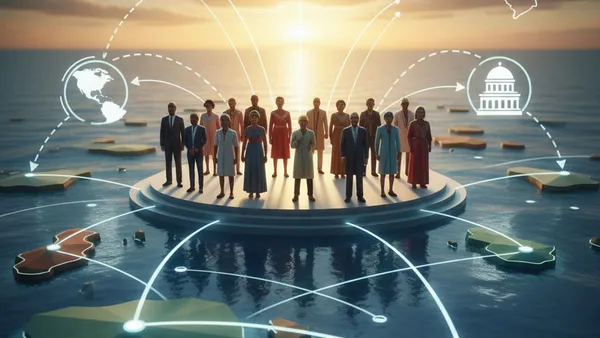
Why do neighboring Caribbean islands speak completely different languages?
Prompted by NerdSip Explorer #5918
Understand the Caribbean's geology, history, and diverse cultures.
Imagine the stunning Caribbean Sea as a giant, underwater mountain range. When you relax on a Caribbean island, you might actually be standing on the very top of an ancient, submerged volcano!
Millions of years ago, the Earth's tectonic plates crashed into each other deep underwater. This incredible pressure forced hot magma to the surface. Over time, these eruptions built towering mountains of lava that eventually peeked above the ocean waves, forming rugged, mountainous islands like St. Lucia and Grenada.
But not all islands are born from fire. Some, like the Bahamas or Barbados, are made of coral and limestone. Over hundreds of thousands of years, tiny sea creatures left behind their shells and skeletons, gradually building flat, beautiful landmasses right up to the surface.
So, the Caribbean isn't just one type of land. It is actually a fascinating mix of rugged volcanic peaks and flat coral reefs. It’s a spectacular geological patchwork that created paradise!
Key Takeaway
Caribbean islands were created either by underwater volcanic eruptions or the slow buildup of ancient coral reefs.
Test Your Knowledge
If you are standing on a very flat Caribbean island like the Bahamas, what is the land most likely made of?
If you take a boat and island-hop across the Caribbean, you'll notice something fascinating: the languages completely change! You might hear Spanish in Cuba, French in Martinique, English in Jamaica, and Dutch in Aruba.
Why is this? Think of the Caribbean as a giant historic chessboard. Starting in the late 1400s, European empires—mainly Spain, Britain, France, and the Netherlands—sailed over and claimed different islands. They brought their own languages, legal systems, and architecture with them.
Tragically, these empires also brought enslaved African people to work on brutal sugar and tobacco plantations. This forced migration forever changed the demographic and cultural fabric of the region, introducing rich African traditions that blended with European customs.
Today, an island's official language and culture usually reflect whichever European power colonized it last. This is why two islands sitting just a few miles apart can feel like entirely different worlds!
Key Takeaway
The diverse languages and cultures in the Caribbean are a result of different European empires colonizing specific islands.
Test Your Knowledge
Why do Caribbean islands have so many different official languages?
Becoming an independent nation didn't happen all at once for the Caribbean. The timeline stretches across two centuries, and the methods were vastly different from island to island.
The most dramatic story belongs to Haiti. In the late 1700s, enslaved people rose up against the French Empire. Against all odds, they won a brutal war, making Haiti the world's first free Black republic in 1804. It was a violent, revolutionary struggle for freedom.
However, for many other islands, independence came much later and more peacefully. Throughout the 1960s and 1970s, countries like Jamaica, Trinidad and Tobago, and Barbados negotiated their freedom from Great Britain. They achieved self-rule through laws, voting, and treaties rather than war.
Interestingly, some islands never became fully independent! Places like Puerto Rico (connected to the USA) and Martinique (connected to France) are still territories or overseas departments of their former colonizers today.
Key Takeaway
Caribbean independence ranges from Haiti's early armed revolution to the peaceful treaties of the 1960s and 1970s.
Test Your Knowledge
How did Jamaica and Barbados primarily achieve their independence in the 20th century?
Behind every newly independent nation is a visionary leader. In the Caribbean, these leaders were often brilliant scholars, passionate organizers, or brave generals who inspired their people to finally stand on their own two feet.
In Haiti, a formerly enslaved man named Toussaint Louverture became a legendary military genius. He organized and led the fierce fight against the French Empire. Though he didn't live to see the final victory, he is remembered as the heroic 'Father of Haiti.'
In the 20th century, leaders used words and laws instead of swords. Eric Williams, the first Prime Minister of Trinidad and Tobago, was a brilliant historian. He famously told his people that their nation's future relied on building schools and education, not just exporting raw materials.
These 'Founding Fathers' of the Caribbean helped their nations transition from exploited colonies into proud, self-governing societies with their own distinct voices.
Key Takeaway
Caribbean independence was driven by leaders ranging from revolutionary generals to brilliant modern scholars.
Test Your Knowledge
Who was Toussaint Louverture?
Because of their varied histories, geology, and colonial pasts, Caribbean countries today are a beautiful mix of similarities and striking differences. They all share a warm climate, a history of overcoming colonization, and a vibrant spirit, but the local flavors are entirely unique.
Take the music, for example. Jamaica gave the world Reggae, a genre born from its specific social struggles. Trinidad and Tobago actually invented the Steelpan instrument and the lively sounds of Calypso. Meanwhile, the Dominican Republic pulses to the fast-paced, energetic beat of Merengue.
The economies differ wildly, too. Some flat, sandy islands, like the Bahamas, rely heavily on global tourism and banking. Others, like Trinidad, have strong oil and natural gas industries.
Ultimately, the Caribbean isn't just one big, identical beach. It is a diverse, colorful neighborhood of independent nations, each with its own rhythm, recipe, and incredibly proud identity!
Key Takeaway
Despite sharing a region, Caribbean nations have highly unique musical styles, economies, and cultural identities.
Test Your Knowledge
Which of the following best describes the Caribbean today?
Track your progress, earn XP, and compete on leaderboards. Download NerdSip to start learning.