Why is the human brain perfectly wired to believe in the supernatural?
Prompted by A NerdSip Learner
Master the cognitive architecture behind global religious belief systems.
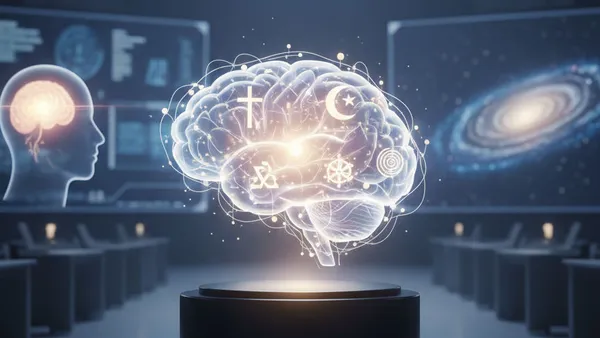
The Cognitive Science of Religion (CSR) radically shifts how we study faith and spirituality. Instead of analyzing historical texts or debating whether religious claims are objectively true, CSR asks a fundamentally different question: *Why are human minds so perfectly primed to generate, absorb, and transmit religious ideas across every known culture?*
Scholars in this interdisciplinary field—bridging cognitive psychology, anthropology, and evolutionary biology—propose what is known as the naturalness of religion thesis. They argue that belief in supernatural agents isn't necessarily the result of cultural brainwashing, sheer ignorance, or complex theological reasoning. Instead, it arises effortlessly from the ordinary, everyday functioning of human cognitive architecture.
Our brains evolved specific mental tools to navigate the social and physical world, such as detecting predators or interpreting other people's hidden intentions. CSR suggests that religious concepts essentially piggyback on these standard cognitive pathways. By treating religion as a natural biological phenomenon, researchers can precisely map the mental shortcuts that make supernatural thinking so deeply intuitive to our species.
Key Takeaway
Religious belief arises naturally from the everyday cognitive tools our brains evolved for survival.
Test Your Knowledge
What is the core premise of the 'naturalness of religion' thesis?
Imagine our ancient ancestors walking through a dense, primeval forest. Suddenly, a nearby bush rustles. Is it just the wind, or is it a hidden predator stalking its prey? From a strict evolutionary standpoint, making a 'false positive' error (assuming a tiger when it's just the wind) costs you a few calories of running away. But making a 'false negative' (assuming the wind when it's actually a tiger) is instantly fatal.
Because of this severe survival asymmetry, cognitive scientists propose that humans evolved a Hyperactive Agency Detection Device (HADD). This mental module is hypersensitive by design, automatically attributing agency, intent, and conscious design to ambiguous stimuli in our environment. We are biologically wired to detect minds, even when none are actually present.
In the framework of CSR, HADD provides the fundamental psychological bedrock for animism and theism. When ancient humans heard thunder, saw shifting shadows, or experienced sudden illness, their HADD intuitively detected an invisible agent pulling the strings. Over time, these fleeting, spontaneous intuitions of invisible agents were culturally solidified into shared concepts of ghosts, forest spirits, and eventually, powerful gods.
Key Takeaway
Our evolutionary survival relied on over-detecting hidden agents, hardwiring us to perceive invisible intentional forces.
Test Your Knowledge
Why did HADD evolve despite causing humans to perceive agents that aren't actually there?
Closely linked to HADD is our extraordinarily sophisticated capacity for Theory of Mind (ToM), also known as mentalizing. This is the cognitive ability to attribute independent mental states—such as beliefs, intents, desires, and emotions—to other people. It allows us to predict how others will behave, which is absolutely essential for surviving and thriving in complex human social hierarchies.
In the Cognitive Science of Religion, researchers argue that we seamlessly and unconsciously extend this Theory of Mind to supernatural agents. Because our brains are so highly adapted to model the invisible thoughts of our peers, we easily conceptualize deities who have their own distinct personalities, subjective desires, and emotional reactions to our earthly behavior.
This cognitive extension explains why gods across virtually all cultures are overwhelmingly anthropomorphic in their psychology, even if they explicitly lack physical bodies. We intuitively assume these supernatural minds care about human social dynamics, can be appeased through ritual prayer, and actively monitor our moral transgressions, utilizing the exact same neural circuitry we use to navigate human relationships.
Key Takeaway
We use the same neural circuitry designed to understand human psychology to conceptualize the minds of supernatural deities.
Test Your Knowledge
How does Theory of Mind (ToM) relate to religious concepts?
Why do clouds exist? If you ask an atmospheric scientist, they will explain the mechanics of the water cycle. But if you ask a young child, they are highly likely to say, 'So it can rain and give water to the thirsty plants.' This pervasive human tendency to see purpose and intentional design in natural phenomena is known as promiscuous teleology.
Developmental psychologists have found that young children naturally default to these teleological explanations. They spontaneously assume that everything—from the sharpness of river rocks to the majestic elevation of mountains—was intentionally designed for a specific purpose. Because of this robust cognitive bias, some researchers have famously described children as 'intuitive theists.'
While adults generally learn to suppress these biases through formal scientific education, promiscuous teleology never completely vanishes; it remains a default cognitive setting under the surface. This inherent bias toward seeing purpose in randomness makes the concept of a grand cosmic designer feel deeply intuitive, rendering creationist narratives cognitively frictionless compared to the mathematically driven, counter-intuitive mechanics of Darwinian evolution.
Key Takeaway
Humans possess an inherent cognitive bias to view natural phenomena as intentionally designed for a specific purpose.
Test Your Knowledge
What does it mean when researchers describe children as 'intuitive theists'?
Not all supernatural ideas survive the relentless test of time. Cognitive anthropologists propose that the religious concepts most likely to be remembered and culturally transmitted are Minimally Counterintuitive (MCI). These are concepts that conform to the vast majority of our standard expectations about the world, but strategically violate just one or two core ontological categories.
Consider a mythological tree that speaks. It possesses all the expected physical properties of a normal plant (it has roots, bark, and leaves), but it dramatically violates our expectations by possessing human-like agency and speech. Or consider a ghost: it has standard human psychology, but violates our expectations of intuitive physics because it can pass effortlessly through solid walls.
If an idea is completely ordinary (a talking human), it simply isn't memorable. Conversely, if an idea is maximally counterintuitive (an invisible, timeless, non-spatial entity that experiences all moments simultaneously), it overloads our memory and fails to transmit easily. MCI concepts hit a precise cognitive 'sweet spot'—they are just weird enough to grab our attention, but structured enough to be easily processed.
Key Takeaway
Ideas that violate only one or two intuitive expectations are perfectly calibrated to be highly memorable and culturally contagious.
Test Your Knowledge
Why are Minimally Counterintuitive (MCI) concepts so culturally sticky?
Within the evolutionary study of religion, a major theoretical debate centers on whether religion is a direct evolutionary adaptation or merely a cognitive byproduct. The byproduct camp, favored by many early CSR pioneers, argues that religion is essentially a cognitive spandrel. It provides no direct survival advantage itself, but emerges as an accidental, inevitable side-effect of other highly useful mechanisms like HADD and Theory of Mind.
Conversely, adaptationists argue that while religious *concepts* may originate as cognitive byproducts, complex religious *behavior* evolved because it offered distinct, measurable evolutionary advantages. They suggest that shared religious rituals, costly signals, and synchronized beliefs fostered immense group cohesion, allowing religious tribes to out-cooperate and ultimately out-compete their secular neighbors.
Today, many researchers seek to bridge this theoretical divide. A popular modern synthesis suggests that human cognition spontaneously generates supernatural concepts as an unavoidable byproduct of our neural architecture. However, cultural evolution subsequently hijacked and refined these very concepts because of the powerful prosocial and cooperative benefits they provided to scaling human societies.
Key Takeaway
Scholars debate if religion is just a side-effect of brain evolution or a direct adaptation that helped ancient tribes cooperate.
Test Your Knowledge
What is the primary difference between the byproduct and adaptation views of religion?
For most of evolutionary history, humans lived in small hunter-gatherer bands where everyone knew each other intimately. Freeloaders and rule-breakers were easily policed through gossip, reputation, and direct social monitoring. But as agricultural populations expanded into massive, anonymous societies, this intimate monitoring system broke down. How did thousands of strangers learn to cooperate without tearing each other apart?
The Big Gods hypothesis, championed by researchers like Ara Norenzayan, posits that the cultural evolution of large-scale societies was facilitated by the invention of powerful, moralizing deities. These 'Big Gods' act as omniscient supernatural monitors who care deeply about human morality and severely punish selfish behavior. If you genuinely believe a divine eye is always watching, you are significantly less likely to cheat.
According to this framework, societies that adopted belief in Big Gods experienced much higher levels of internal trust and economic cooperation among strangers. Through the mechanics of cultural group selection, these highly prosocial religious groups successfully expanded, conquered, and assimilated smaller groups, explaining why moralizing, monotheistic religions absolutely dominate the modern global landscape today.
Key Takeaway
Belief in omniscient, moralizing deities may have allowed ancient human societies to cooperate on a massive, anonymous scale.
Test Your Knowledge
According to the 'Big Gods' hypothesis, how did moralizing deities facilitate the growth of massive societies?
How do monumental religious institutions maintain their structural integrity over centuries? Anthropologist Harvey Whitehouse proposed the Modes of Religiosity theory to explain how distinct ritual forms shape religious transmission. The first of these is the Doctrinal Mode, which characterizes most major world religions today, such as orthodox Islam, Christianity, and Buddhism.
The Doctrinal Mode relies heavily on high-frequency, low-arousal rituals. Think of weekly congregational sermons, daily scheduled prayers, and the methodical, repetitive recitation of sacred texts. Because these rituals are highly routine and relatively low in emotional intensity, the information is processed and stored in the brain's semantic memory—our vast, logical database for general, abstract knowledge.
This cognitive mode is incredibly effective for scaling religions. By standardizing complex beliefs into easily repeatable dogmas, leaders can ensure strict orthodoxy across vast, geographically dispersed populations. However, the inherent risk of the Doctrinal Mode is the 'tedium effect.' If rituals become too repetitive and emotionally flat, followers may lose their intrinsic spiritual motivation, requiring institutional hierarchies to enforce participation.
Key Takeaway
Major world religions rely on frequent, low-emotion rituals to store standardized dogmas in followers' semantic memory.
Test Your Knowledge
What type of memory does the Doctrinal Mode of religiosity primarily rely on?
In stark contrast to the quiet routine of the Doctrinal Mode, the Imagistic Mode of religiosity is characterized by incredibly low-frequency, exceptionally high-arousal rituals. These include intense rites of passage, painful bodily initiations, or emotionally overwhelming visionary experiences that might only occur once or twice in a believer's entire lifetime.
Because these rituals are often shocking, physically traumatic, or profoundly euphoric, they bypass semantic storage and directly trigger the brain's episodic memory—our evolutionary system for vivid, flashbulb autobiographical events. Participants do not just passively learn abstract doctrines; they undergo a profound, visceral psychological transformation that leaves a permanent, indelible mark on their identity.
The Imagistic Mode fosters what cognitive anthropologists call identity fusion. The shared trauma or intense emotional arousal binds the participants together with extreme relational solidarity, making them viscerally willing to sacrifice their own lives for the group. While this mode struggles to scale to massive global populations, it is uniquely effective at maintaining small, fiercely loyal, and uncompromising tribal units.
Key Takeaway
Rare, highly emotional rituals trigger episodic memory, creating unbreakable psychological bonds known as identity fusion.
Test Your Knowledge
What psychological phenomenon is frequently generated by the high-arousal rituals of the Imagistic Mode?
Have you ever noticed a glaring discrepancy between what a major religion officially teaches and how its everyday followers actually think and behave? In the Cognitive Science of Religion, this pervasive phenomenon is called theological incorrectness. It occurs because humans process information using a dual-process cognitive system: slow, reflective reasoning versus fast, intuitive reflexes.
Theologically, a devout believer might endorse a highly complex doctrine—for example, that God is strictly non-physical, exists outside of space and time, and knows all things simultaneously. Holding this belief requires slow, reflective, and highly demanding cognitive effort. However, when faced with a sudden personal crisis, that same believer's fast, intuitive cognitive systems automatically take over.
In real-time processing, believers unconsciously revert to their intuitive Theory of Mind. They suddenly treat the deity as an anthropomorphic person who exists in a specific spatial location (like 'up in heaven'), processes information sequentially, and has fluctuating emotional reactions. CSR demonstrates that regardless of official theology, our underlying cognitive architecture continuously anchors everyday religion in basic, evolved biases.
Key Takeaway
In daily life, our fast cognitive reflexes often override complex theology, causing us to treat deities as human-like agents.
Test Your Knowledge
Why does 'theological incorrectness' frequently occur in believers' everyday lives?
Track your progress, earn XP, and compete on leaderboards. Download NerdSip to start learning.