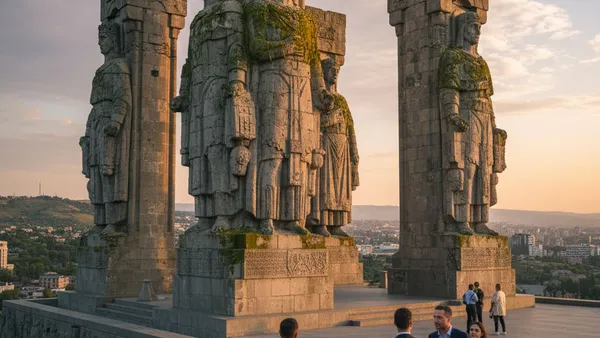
What massive "Stonehenge" hides in plain sight just outside Tbilisi?
Prompted by A NerdSip Learner
Decode the history of Georgia's colossal pillars.
Perched atop Mount Keeni overlooking the vast, shimmering waters of the Tbilisi Sea, the Chronicles of Georgia is one of the most imposing monuments you’ve probably never heard of. Often nicknamed the "Georgian Stonehenge," this massive structure dominates the landscape in the northern suburbs of Georgia's capital city.
Construction of this colossal memorial began in 1985 under the direction of the renowned, though often controversial, Georgian-Russian sculptor Zurab Tsereteli. The sheer scale of his vision is staggering. The site consists of 16 massive pillars, each standing approximately 30 to 35 meters (over 100 feet) tall, heavily adorned with bronze and copper reliefs.
Interestingly, despite decades of intermittent work, the monument remains largely unfinished. When the Soviet Union collapsed in the early 1990s, funding for the ambitious project dried up. Yet, this incomplete status only adds to its rugged, mysterious allure, allowing it to stand as a quiet, timeless sentinel over the city.
Key Takeaway
The Chronicles of Georgia is a massive, unfinished 1985 monument by Zurab Tsereteli overlooking the Tbilisi Sea.
Test Your Knowledge
Why is the Chronicles of Georgia sometimes referred to as the "Georgian Stonehenge"?
If you stand at the base of the Chronicles of Georgia and look up, you are essentially reading a massive stone and bronze history book. The monument was built to commemorate two significant milestones: 3,000 years of Georgian statehood and 2,000 years of Christianity in the country.
To tell this dual story, the architect ingeniously divided the massive 16 pillars into distinct horizontal sections. The bottom half of the pillars features intricate reliefs depicting scenes from the Bible and the life of Jesus Christ, representing the deep, enduring roots of the Georgian Orthodox faith.
Meanwhile, the top half is dedicated to secular history and national pride, serving as a timeline of the nation's triumphs. It showcases larger-than-life carvings of Georgia's most revered kings, queens, and historical heroes, such as the legendary Queen Tamar and King Vakhtang Gorgasali. Together, these towering canvases create a literal merging of spiritual devotion and national identity.
Key Takeaway
The pillars depict the life of Christ on the bottom and Georgian royalty on the top to celebrate the nation's spiritual and secular history.
Test Your Knowledge
What do the bottom sections of the monument's pillars primarily depict?
Despite its breathtaking scale and historical depth, the Chronicles of Georgia remains a surprisingly off-the-beaten-path destination. While most tourists flock to the sulfur baths, winding alleys, and ancient fortresses in Old Tbilisi, this monument sits quietly in a residential, Soviet-era suburb.
The site is a fascinating clash of architectural vibes. It heavily embodies the sheer scale of Soviet brutalist monumentalism—massive, imposing, and concrete—yet its subject matter is entirely dedicated to deeply traditional Georgian nationalism and religious devotion. Right next to the towering pillars, visitors will find a small, traditional Georgian Orthodox chapel and the grapevine cross of St. Nino.
For those who make the trek, the reward isn't just the detailed carvings. The hilltop location offers a sweeping, panoramic view of the Tbilisi Sea (a huge, man-made reservoir) and the surrounding urban sprawl. It is a peaceful, wind-swept spot to reflect on millennia of history without the typical crowds.
Key Takeaway
Located away from usual tourist spots, the site offers a unique blend of Soviet-era scale, traditional Georgian heritage, and stunning views.
Test Your Knowledge
In addition to the towering pillars, what else can visitors find right next to the main monument?
Track your progress, earn XP, and compete on leaderboards. Download NerdSip to start learning.