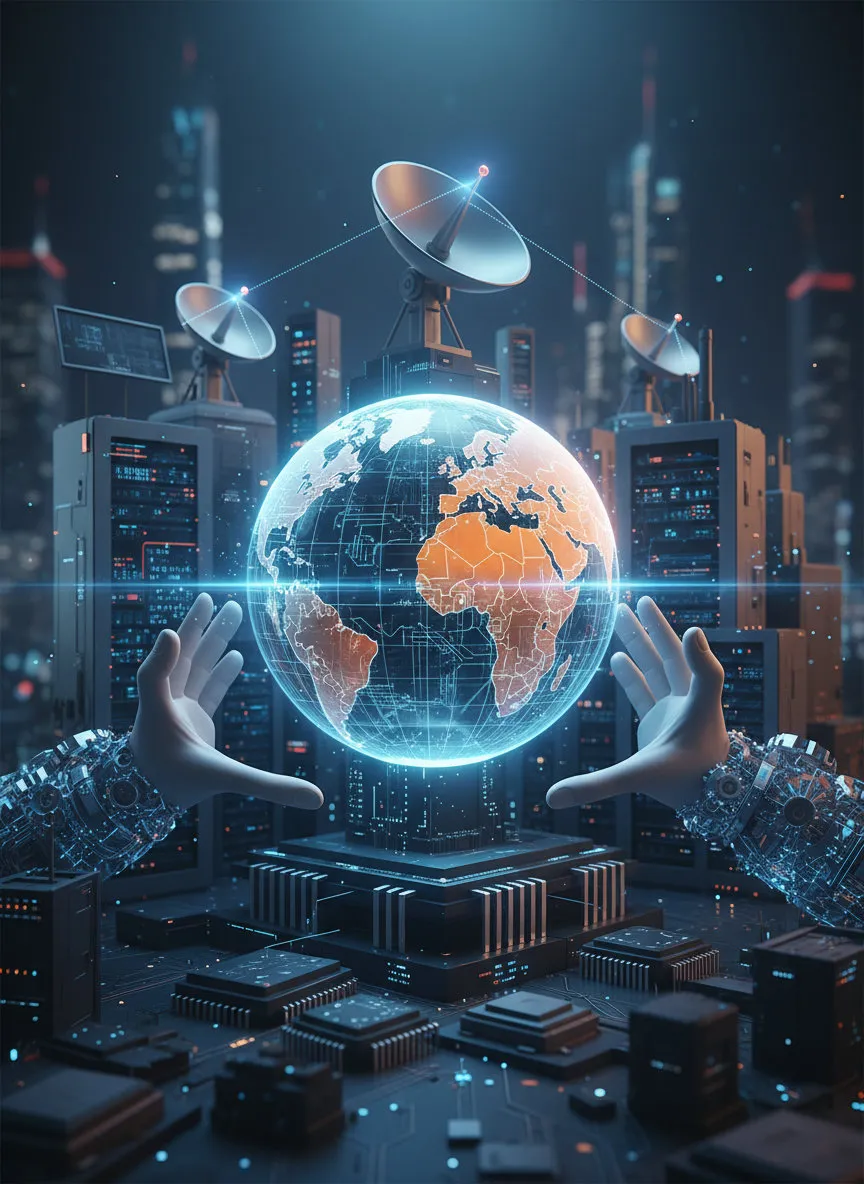
Why is a tiny piece of silicon deciding the fate of global superpowers?
Prompted by A NerdSip Learner
Decode the high-stakes geopolitical battle for semiconductor dominance.
Welcome to the 21st century's biggest battlefield! You’ve probably heard the phrase "Data is the new oil." If that's true, then semiconductors (chips) are the internal combustion engine. They process that oil and turn it into value. From the phone in your hand to advanced military missile systems, *nothing* modern works without them.
But here is the twist: unlike oil, which can be found in many places, the ability to manufacture advanced chips is incredibly concentrated. We aren't just talking about generic electronics here; we are talking about the cutting-edge logic chips that power Artificial Intelligence and supercomputers.
Control over this technology isn't just about selling iPhones; it’s about military and economic supremacy. The country that controls the chips controls the future of computing, and by extension, global power.
Key Takeaway
Semiconductors are the physical foundation of the modern economy and military power, making them a strategic asset rivaling oil.
Test Your Knowledge
Why are semiconductors compared to the 'engine' rather than the 'oil' in this analogy?
You might think, "If chips are so important, why doesn't every country just build their own factories?" Great question! The answer lies in extreme complexity. Manufacturing a modern chip is likely the most complex engineering feat humans have ever achieved.
Here is the shocking reality: The global supply chain has massive "choke points." For example, a single company in the Netherlands, ASML, makes 100% of the extreme ultraviolet (EUV) lithography machines needed to print the most advanced chips. These machines are the size of a bus and cost over $150 million each!
If ASML stops shipping, the entire world's ability to advance computing stops. This isn't a free market; it's a highly specialized, fragile ecosystem where a few key players hold the keys to the kingdom.
Key Takeaway
The chip supply chain relies on monopolies like ASML, meaning one bottleneck can halt global tech progress.
Test Your Knowledge
What makes the semiconductor supply chain particularly vulnerable?
Now, let's look at the fighters in the ring. On one side, we have the United States, which still designs the world's best chips (think NVIDIA, Apple, Intel) and controls the core software. On the other side is China, the world's factory, which consumes huge amounts of chips and is racing to build its own domestic industry.
The conflict? The US fears that if China gains access to the most advanced AI chips, they will use them for cyber warfare and advanced weaponry. To stop this, the US has weaponized export controls.
Imagine a digital blockade. The US has banned companies from selling specific high-end chips and chip-making tools to China. It is a move to freeze China’s tech development in place. It’s not a trade war anymore; it’s a technology containment strategy.
Key Takeaway
The US is using export controls to cut China off from advanced AI hardware to maintain military and economic superiority.
Test Your Knowledge
What is the primary goal of the recent US export controls regarding chips?
If this war has a 'Ground Zero,' it is the island of Taiwan. Specifically, a single company called TSMC (Taiwan Semiconductor Manufacturing Company). TSMC is a manufacturing juggernaut, producing roughly 90% of the world's most advanced chips.
This creates a unique geopolitical situation known as the "Silicon Shield." The theory goes that Taiwan is so vital to the global economy that the world (including the US) *must* protect it, and even China relies on it too much to risk destroying it in an invasion.
However, this concentration is also terrifying. A blockade or natural disaster in Taiwan wouldn't just delay your new PlayStation; it would crash the global economy instantly. The world creates designs, but Taiwan is the forge where they become real.
Key Takeaway
Taiwan's near-monopoly on advanced chip manufacturing makes it the most strategically important island on Earth.
Test Your Knowledge
What is the 'Silicon Shield' theory?
So, how does the world fix this anxiety? By spending billions to bring factories home. This is called "reshoring." Governments in the US, Europe, and Japan are passing massive acts (like the CHIPS Act) to pay companies to build fabrication plants (fabs) on their own soil.
The goal is supply chain resilience. We are moving away from "Just-in-Time" efficiency (cheapest possible production) to "Just-in-Case" security (safest possible production).
What does this mean for you? We might see higher prices for electronics as the cost of manufacturing goes up, but we also gain insurance against geopolitical shocks. The era of globalization is shifting; we are entering an era of technological sovereignty.
Key Takeaway
Nations are now prioritizing national security over economic efficiency, spending billions to build local chip factories.
Test Your Knowledge
What is the main objective of the CHIPS Act and similar policies?
Track your progress, earn XP, and compete on leaderboards. Download NerdSip to start learning.