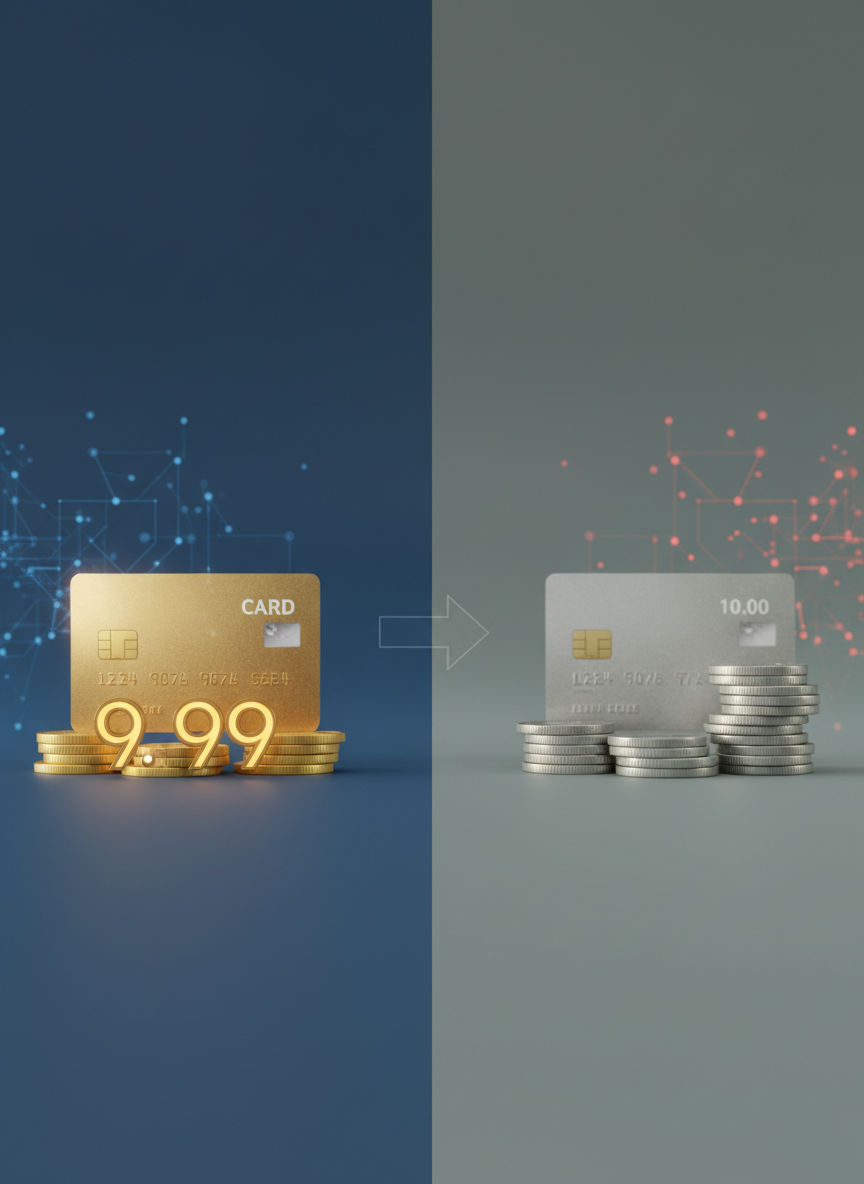
Why does $9.99 feel so much cheaper than $10? Uncover the mind trick.
Prompted by A NerdSip Learner
Master the psychology of charm pricing.
Have you ever noticed that almost everything you buy ends in .99? From a quick coffee on your morning commute to a brand-new car at the dealership, prices like $9.99 are absolutely everywhere. But why do massive businesses care so much about a single, tiny penny?
It all comes down to a neat little mind trick called charm pricing. Retailers aren't just trying to save you one cent out of the kindness of their hearts. Instead, they are trying to completely change how you *feel* about the price tag.
Think of that one penny as a magic wand. By dropping the price from a flat $10.00 down to $9.99, the cost suddenly looks much friendlier. To our brains, ten dollars feels like a serious commitment, while nine dollars and some spare change feels like a casual, easy purchase.
In fact, studies over the years have consistently shown that prices ending in .99 can sell significantly more items than prices rounded up to a whole number. It is one of the oldest and most successful tricks in the retail book!
Key Takeaway
Dropping a price by one single cent changes how we emotionally feel about buying it.
Test Your Knowledge
What is the main goal of "charm pricing"?
So, why exactly does $9.99 feel so much cheaper than $10.00? The secret lies in the simple way we read. In English and many other languages, we read numbers from left to right. Because of this fast-paced reading habit, our brains lock onto the very first number we see.
This psychological quirk is known as the left-digit effect. When you look at the price $9.99, your brain immediately shouts, 'Nine!' before it even bothers to process the ninety-nine cents at the end. It anchors your thoughts to the lower number.
Imagine you are looking at a shiny new car priced at $29,999 instead of $30,000. Your brain sees the '2' first and instantly places it in the twenty-something-thousand category. The actual difference is only one single dollar, but the psychological distance feels absolutely huge.
Our brains are always trying to take quick shortcuts to save energy. Instead of doing the exact math, we just glance at the first digit and make a snap judgment. That quick mental shortcut is exactly what businesses are counting on!
Key Takeaway
We judge a price primarily by its first number because we read from left to right.
Test Your Knowledge
What does our brain naturally do when it sees $9.99?
There is another sneaky reason why $9.99 works so incredibly well on us. Over time, as consumers, we have been subtly trained to associate prices ending in .99 with sales, discounts, and amazing deals.
When we see a flat, round $10.00, it feels highly standard. It feels like the regular, everyday price that anyone would pay. But when we see $9.99, it looks precise and calculated. Our brains assume the store owner must have crunched the numbers to give us the absolute lowest price possible.
Think about the clearance racks at your favorite clothing store. You rarely see clearance items marked with flat numbers. They almost always end in .99, .97, or .95. Retailers intentionally use these messy, odd numbers to signal to your brain that the item is heavily discounted.
Even if the product has *never* actually been cheaper, simply slapping a .99 on the tag triggers a little rush of excitement in your mind. You feel like you are beating the system and scoring a rare bargain!
Key Takeaway
Prices ending in .99 trick our brains into thinking we are getting a special, calculated discount.
Test Your Knowledge
Why do odd prices like $9.99 feel like a bargain to us?
If $9.99 is such a powerful and effective trick, why don't fancy, five-star restaurants charge $49.99 for a nice steak? Why do expensive, designer watches cost exactly $5,000 instead of $4,999?
The answer is all about perceived quality. While prices ending in .99 loudly signal a great deal, round numbers like $10 or $100 signal luxury, confidence, and premium quality.
When you walk into a high-end luxury boutique, the owners do not want you thinking about bargains, discounts, or saving pennies. They want you thinking about supreme craftsmanship and elegance. Round numbers feel clean, simple, and entirely honest. They send a clear message: 'This premium item is worth exactly what we are asking.'
So, if a business wants to sell a massive amount of everyday items quickly, they will absolutely use charm pricing like $9.99. But if they want you to feel like a VIP buying something truly special, they will drop the pennies and stick to a solid, impressive round number.
Key Takeaway
Round numbers signal luxury and premium quality, while .99 signals a quick bargain.
Test Your Knowledge
If a store wants a new product to feel like a high-end luxury item, how should they price it?
Now that you know the hidden secrets of the left-digit effect and charm pricing, how do you stop falling for it? The great news is that simple awareness is your absolute best weapon.
The next time you are walking down a grocery store aisle or doing some late-night online shopping, try a fun mental exercise. Whenever you see a price tag ending in .99, immediately force your brain to round up to the next whole number.
If a streaming subscription is $14.99 a month, say '$15' out loud. If a pair of sneakers is $49.99, firmly tell yourself they are $50. By actively changing that crucial first digit in your mind, you break the psychological spell.
Retailers will always use these little pricing tricks because basic human psychology rarely changes. But by taking just one extra second to do the honest math, you take back full control of your wallet and make much smarter, intentional buying decisions.
Key Takeaway
Protect your wallet by always forcing yourself to round up to the nearest whole dollar.
Test Your Knowledge
What is the best way to outsmart charm pricing while shopping?
Track your progress, earn XP, and compete on leaderboards. Download NerdSip to start learning.