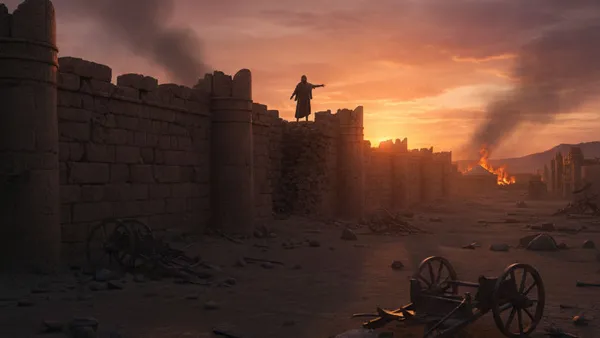
Did internal revolts and earthquake storms really destroy the ancient world?
Prompted by NerdSip Explorer #3982
Master the advanced theories behind the Late Bronze Age collapse.
Imagine trying to fight off a societal collapse while the ground beneath you is literally tearing itself apart. Welcome to the Earthquake Storm Hypothesis, championed by geophysicist Amos Nur.
While famine and invaders usually get the historical spotlight, geologists have noted a highly suspicious pattern: many major Late Bronze Age sites—including Troy, Mycenae, and Megiddo—sit directly atop active tectonic fault lines in the Eastern Mediterranean.
Nur theorized that between roughly 1225 and 1175 BCE, this region experienced a violent 'unzipping' of plate boundaries. A massive earthquake on one fault line transferred immense stress to the next, triggering a terrifying 50-year domino effect of catastrophic seismic events.
These earthquakes wouldn't have destroyed entire civilizations entirely on their own. However, by repeatedly shattering defensive palace walls, crushing vital infrastructure, and deeply traumatizing populations, the 'storm' likely left these empires incredibly vulnerable. When external raiders arrived and famines peaked, the shattered cities simply could not mount a defense.
Key Takeaway
A rapid-fire sequence of major earthquakes may have severely weakened Bronze Age defenses, accelerating their downfall.
Test Your Knowledge
How did 'earthquake storms' theoretically contribute to the Bronze Age Collapse?
What did the collapse actually feel like for the people living through it? We don't have to guess. Archaeologists have uncovered baked clay tablets with cuneiform script that capture the real-time panic and chaos of the era.
One of the most famous pieces of epigraphic evidence is a desperate letter from Ammurapi, the last king of the wealthy Syrian port city of Ugarit. Writing to the ruler of Alashiya (modern-day Cyprus), he begged for immediate military assistance.
Ammurapi wrote: 'My father, behold, the enemy's ships came; my cities were burned, and they did evil things in my country.' Tragically, he explains that his own troops and chariots had already been deployed to aid his overlords in the Hittite Empire, leaving his own city completely undefended.
The ultimate tragedy of this historical snapshot? The letter was found in the charred, ruined administrative buildings of Ugarit. It was baked solid by the very fires that destroyed the city, meaning this frantic cry for help was likely never even dispatched.
Key Takeaway
Recovered clay tablets provide a terrifying, real-time glimpse into the desperation of leaders who watched their undefended cities burn.
Test Your Knowledge
What tragic detail makes the letter from King Ammurapi of Ugarit particularly haunting?
To understand why these massive, sophisticated empires vanished so rapidly, we have to look closely at how they managed their resources. Late Bronze Age societies generally operated on a highly centralized Palace Economy (often called a redistributive economy).
Instead of relying on free markets where villagers traded goods independently, agricultural surplus and crafted luxury items flowed directly into the central palace. The ruling elite stored the wealth, kept meticulous records on clay tablets, and then rationed it back out to the population.
This hyper-centralized command structure was incredibly efficient during times of stability. It allowed kings to fund massive professional armies, build monumental architecture, and control vast international trade networks.
But it was also dangerously brittle. If the central palace was physically destroyed by an earthquake or raiders, the entire local economic network instantly disintegrated. There was no decentralized, resilient backup system. Once the central distribution node fell, the entire surrounding civilization simply starved.
Key Takeaway
The hyper-centralized 'Palace Economy' made empires rich but incredibly fragile, as destroying the central hub collapsed the entire system.
Test Your Knowledge
Why was the 'Palace Economy' so vulnerable during the Bronze Age Collapse?
We often picture the Bronze Age Collapse as a dramatic story of mysterious outside invaders tearing down the city gates. But what if the violent destruction was actually coming from inside the house?
Many modern archaeologists argue for the Internal Rebellion Theory. Decades of severe, climate-driven drought, crippled international trade routes, and devastating famines would have put immense, crushing pressure on the working classes, who were already heavily taxed by the ruling elite.
Archaeological excavations reveal a fascinating, telling clue: in some destroyed Late Bronze Age cities, only the opulent palatial centers and administrative buildings were burned to the ground. The surrounding, lower-class residential neighborhoods were sometimes left entirely untouched!
This incredibly selective destruction strongly suggests that starving peasant populations—or perhaps rival elite political factions—may have violently overthrown their own rulers. The 'invaders' might have simply been local citizens who had finally reached their breaking point under a rigid, failing palace system.
Key Takeaway
Archaeological evidence of selective destruction suggests that starving lower classes may have violently overthrown their own elites.
Test Your Knowledge
What archaeological evidence supports the theory of internal rebellion?
Did every single Bronze Age society completely disappear into the subsequent Dark Age? Not quite. While the mighty Hittite Empire collapsed entirely and the Mycenaean Greeks lost the ability to write, one major player managed to weather the storm: Assyria.
The Middle Assyrian Empire, located in northern Mesopotamia (modern-day Iraq), faced the exact same catastrophic pressures—famine, shifting trade routes, and relentless invasions from nomadic Aramean tribes.
However, instead of suffering a total systems collapse, the Assyrian state executed a strategic, brutal contraction. They intentionally abandoned their vulnerable outer territories and shrank down to a highly militarized, easily defensible core homeland. They essentially pulled up the drawbridge and waited out the centuries-long regional chaos.
Though greatly weakened and forced to constantly defend their borders, this survival tactic preserved their culture, military structure, and administrative knowledge. Centuries later, they would leverage this surviving foundation to erupt outward again as the Neo-Assyrian Empire.
Key Takeaway
By strategically abandoning territory and fiercely militarizing their core homeland, the Assyrians survived the collapse and eventually rose again.
Test Your Knowledge
How did the Middle Assyrian Empire survive the Bronze Age Collapse?
Track your progress, earn XP, and compete on leaderboards. Download NerdSip to start learning.