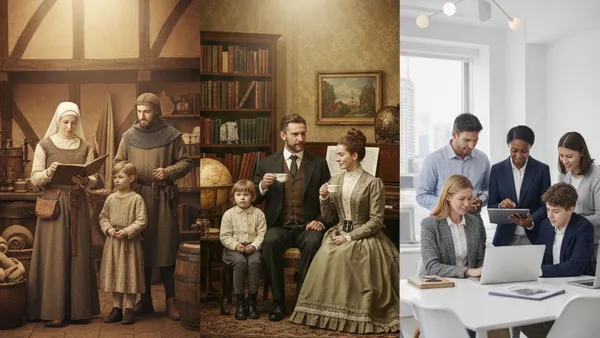
How did teacups, trains, and servants invent the modern British middle class?
Prompted by A NerdSip Learner
Understand 1,000 years of British social history.
Imagine medieval England as a giant sandwich. At the top, you have the thick crust of the wealthy nobility—kings, lords, and knights. At the bottom, forming the vast majority of the bread, are the peasant farmers who worked the land. For a long time, there wasn't much in between!
But slowly, as towns grew, a new filling started to appear. These were the highly skilled craftsmen, merchants, and guild masters. They didn't own vast castles, but they weren't tied to the muddy fields either. They made their living through trade and skill.
This small group was the very first seed of the British middle class. They were town-dwellers who formed guilds to protect their businesses and set prices. They began to build comfortable homes and hold local power as mayors and aldermen.
While the term "middle class" wouldn't be invented for centuries, this medieval "filling" proved that you didn't need a fancy title or a royal bloodline to build a comfortable life.
Key Takeaway
The first seeds of the middle class were medieval merchants and craftsmen who lived between the nobility and the peasants.
Test Your Knowledge
What was the main difference between the medieval 'middling sort' and the peasants?
Fast forward to the Tudor period (think of the era of Henry VIII and Shakespeare), and our societal sandwich is getting much thicker. Historians call this growing group the "middling sort."
The "middling sort" included wealthy farmers (called yeomen), successful shopkeepers, lawyers, and doctors. What made them special wasn't just their money, but their mindset. They realized that the key to moving up in the world was education.
They started sending their sons to grammar schools. They bought printed books, which were becoming cheaper thanks to the newly invented printing press. They learned to read, write, and manage complex business accounts.
This was a huge cultural shift! Previously, reading and writing were mostly reserved for monks and the super-rich. By arming themselves with knowledge, the middling sort began to take on important roles in local government and the church, proving that brains could be just as powerful as noble birth.
Key Takeaway
During the Tudor era, the 'middling sort' used education and literacy as primary tools to improve their social standing.
Test Your Knowledge
What was a key tool the Tudor 'middling sort' used to move up in society?
Welcome to the 1700s, the Georgian era! This is when the middle class truly fell in love with shopping.
Thanks to global trade, exciting new goods were pouring into Britain: silk, sugar, and most importantly, coffee and tea. But you couldn't just drink tea out of a wooden bowl. You needed a delicate porcelain teacup, a matching saucer, and a fancy teapot!
This sparked a massive wave of consumerism. The middle classes wanted their homes to look refined. They bought matching dinner sets, clocks, and fashionable clothes. Enterprising businessmen built huge fortunes by selling beautifully designed pottery to this eager new market.
To show off their new goods and ideas, middle-class men gathered in coffeehouses. These were the internet forums of the 18th century—places where businessmen, writers, and lawyers drank caffeine, read newspapers, and debated politics. The middle class was now actively defining British culture.
Key Takeaway
The Georgian middle class drove a massive boom in consumerism, using goods like tea sets to show off their refinement.
Test Your Knowledge
Where did Georgian middle-class men gather to read the news, drink caffeine, and debate?
In the late 1700s and 1800s, Britain changed the world with the Industrial Revolution. Factories popped up across the country, powered by coal and steam, mass-producing goods at lightning speed.
This created an entirely new type of middle-class person: the industrialist. These were factory owners, engineers, and bankers who made staggering amounts of money. For the first time, a self-made factory owner could be just as rich—or richer—than a duke who had inherited centuries-old land.
But it wasn't just the factory owners who benefited. Someone had to manage the accounts, organize the shipping, and oversee the workers. This created a massive boom in middle-management and clerical jobs.
The middle class split into layers. The "upper-middle" class were the wealthy factory owners who sent their kids to fancy boarding schools. The "lower-middle" class were the hardworking clerks and managers who kept the administrative wheels of industry turning.
Key Takeaway
The Industrial Revolution created immense wealth for factory owners and birthed a vast new layer of middle-management jobs.
Test Your Knowledge
How did the Industrial Revolution change the wealth structure of Britain?
If the Georgian era was about shopping, the Victorian era (1837-1901) was all about respectability. The middle class wanted to prove they were morally superior to both the partying aristocrats above them and the rowdy working classes below them.
Respectability meant having a pristine public image. It meant going to church on Sunday, dressing modestly, and paying your debts on time. The home became a sacred, peaceful retreat from the dirty, noisy industrial world outside.
This created the idea of the "angel in the house." Middle-class men went out to work in the harsh business world, while middle-class women were expected to stay home. Their job was to create a cozy, perfectly decorated haven and raise polite, well-behaved children.
While this sounds cozy, it could also be a golden cage for women, who were heavily restricted from working or entering politics. But this strict moral code defined British society for nearly a century!
Key Takeaway
The Victorian middle class was obsessed with 'respectability' and strictly separated the harsh world of work from the peaceful home.
Test Your Knowledge
What was the main expectation for a middle-class Victorian woman?
How did a Victorian family prove they were officially "middle class"? It wasn't about the type of horse carriage you drove—it was about who scrubbed your floors. The ultimate status symbol was keeping a servant.
Even a lower-middle-class family, like a junior bank clerk and his wife, would scrape together enough money to hire at least one young girl, known as a "maid-of-all-work." She would cook, clean, and light the heavy coal fires before the family woke up.
If you were richer, you had a whole team: a cook, a housemaid, a nanny, and maybe even a butler. Having servants meant the lady of the house didn't have to dirty her hands with physical labor, preserving her precious "respectability."
It was a highly unequal system. Young girls from poor country villages provided the cheap, exhausting labor that allowed the middle class to enjoy their comfortable, elegant lifestyles. It was the absolute backbone of middle-class home life!
Key Takeaway
Employing at least one domestic servant was the ultimate dividing line that proved a family was truly middle class in the Victorian era.
Test Your Knowledge
What was the minimum requirement for a Victorian family to be seen as middle class?
As the 19th century ended, industrial cities like London and Manchester were heavily polluted, incredibly crowded, and noisy. The middle classes desperately wanted out! Luckily, a new invention saved them: the commuter train.
Railways allowed people to live miles away from their dirty city offices. Builders quickly bought up cheap farmland on the edge of cities and built rows of comfortable, spacious houses with private gardens.
This was the birth of the suburbs. The suburbs were a middle-class paradise. They offered fresh air, privacy, and safety, completely separated from the smokestacks of the industrial factories.
Every morning, middle-class men in bowler hats would board the train to the city to work in their offices. Every evening, they would retreat to their quiet suburban gardens. This daily commute completely reshaped the geography of Britain, creating the sprawling commuter towns we still see today.
Key Takeaway
The invention of commuter trains allowed the middle class to escape polluted cities and invent the modern suburban lifestyle.
Test Your Knowledge
Why did the middle class move to the newly built suburbs?
The cozy, servant-filled world of the middle class was shattered by the two World Wars (1914-1945). These massive global conflicts acted as giant social equalizers in Britain.
During wartime, bombs fell on rich neighborhoods and poor neighborhoods alike. The government introduced strict rationing, meaning a wealthy factory owner was allowed the exact same amount of butter, sugar, and meat as a factory worker.
Furthermore, the "servant problem" became permanent. The young women who used to work as cheap housemaids took better-paying, patriotic jobs in munitions factories or joined the armed forces. After the wars ended, very few wanted to go back to scrubbing someone else's floors for pennies.
The middle class suddenly had to learn to cook and clean for themselves! New gadgets like vacuum cleaners and washing machines slowly replaced human servants. The extreme gaps between the rich, the middle, and the poor began to shrink.
Key Takeaway
The World Wars brought rationing and the end of cheap domestic labor, forcing classes to share the same struggles.
Test Your Knowledge
Why did the middle class stop having live-in servants after the World Wars?
After World War II, Britain built the Welfare State. The government introduced free healthcare (the NHS) and free secondary education for everyone. This totally changed the game for the middle classes!
Because education was now free and widely accessible, a bright child from a working-class family could pass exams, go to university, and get a professional job. The middle class exploded in size!
By the 1960s and 70s, Britain saw a massive rise in "white-collar" jobs—office workers, teachers, advertising executives, and government bureaucrats. Meanwhile, traditional "blue-collar" manual factory jobs began to slowly decline.
Homeownership became the new ultimate dream. Getting a mortgage from a bank and buying your own suburban house became the biggest marker that you had "made it" into the middle class. The middle class was no longer a small, exclusive club; it was becoming the largest group in the country.
Key Takeaway
Post-war free education and a boom in office jobs allowed millions to move into the rapidly expanding middle class.
Test Your Knowledge
What post-WWII development allowed many working-class children to enter the middle class?
So, what does it mean to be middle class in Britain today? It's much more confusing than it used to be!
In the past, your class was mostly based on your job and your income. Today, it’s also highly dependent on cultural capital. A self-employed plumber (traditionally working-class) might earn significantly more money than a junior university researcher (traditionally middle-class).
Sociologists recently ran a massive study called the "Great British Class Survey" and found that there aren't just three traditional classes anymore, but *seven*! They look at who you know, what kind of food you eat, what music you listen to, and how you spend your free time.
Today's middle class might be defined by going to university, shopping at specific high-end supermarkets, or drinking artisanal coffee. While the strict top hats and maids of the Victorian era are gone, the invisible rules of British class are still very much alive—they’ve just changed their outfit!
Key Takeaway
Modern British class is no longer just about income; it is heavily influenced by education, tastes, and 'cultural capital.'
Test Your Knowledge
According to modern sociologists, what is 'cultural capital'?
Track your progress, earn XP, and compete on leaderboards. Download NerdSip to start learning.