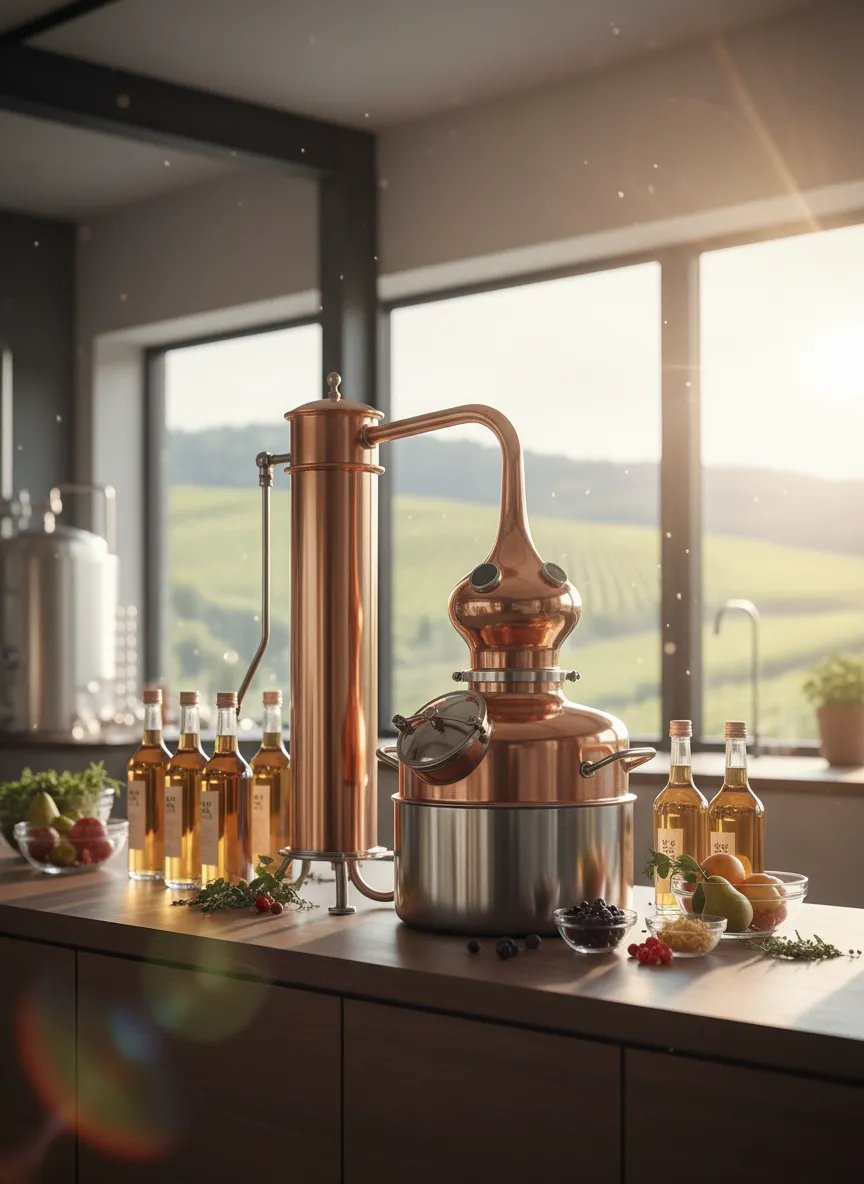
How do you turn a basket of apples into crystal-clear fire?
Prompted by A NerdSip Learner
Understand the 3 stages of crafting spirits.
Before you can distill anything, you need alcohol! This stage is called fermentation, and it is where biology does the heavy lifting. To make Schnaps (fruit brandy), you start by crushing high-quality, ripe fruit into a pulp called the mash. You can’t use rotten fruit; garbage in means garbage out!
Once the fruit is mashed, we introduce our microscopic best friends: yeast. These tiny organisms feast on the natural sugars in the fruit. As they digest the sugar, they produce two things: carbon dioxide (bubbles!) and ethanol (alcohol). This process can take weeks.
Think of the mash tun as a bubbling cauldron of biological activity. We aren't cooking anything yet; we are just letting nature convert sweet fructose into the alcohol we will later harvest. Without a successful fermentation, there is nothing to distill. It is the foundation of flavor!
Key Takeaway
Fermentation is the biological process where yeast converts fruit sugar into alcohol.
Test Your Knowledge
What is the primary role of yeast in the mash?
Now that we have an alcoholic mash, how do we separate the alcohol from the water and fruit solids? We use distillation. This process relies on a simple rule of physics: different liquids boil at different temperatures. Water boils at 100°C (212°F), but ethanol boils at a much cooler 78.37°C (173°F).
When you gently heat the mash in a copper vessel known as a still, the alcohol turns into vapor *before* the water does. This alcohol-rich vapor rises up the neck of the still, leaving the water and solids behind. It travels through a tube until it hits a cooling system, usually a condenser coil submerged in cold water.
Upon contact with the cold surface, the vapor turns back into a liquid (condensation). This liquid drips out into a collection vessel. It is like magic, but it is actually just managing boiling points! The copper also plays a vital role by reacting with sulfur compounds to clean up the taste.
Key Takeaway
Distillation separates alcohol from water by exploiting their different boiling points.
Test Your Knowledge
Why does the alcohol vaporize before the water?
Here is the most critical part for safety and quality: not everything that drips out of the still is good to drink. The distiller must make cuts to separate the liquid into three parts: Heads, Hearts, and Tails.
The first liquid to come out is the Heads. It smells like nail polish remover and contains dangerous compounds like methanol, which can cause blindness. You *must* discard this! Next comes the Hearts. This is the sweet spot—pure, clean ethanol with the aroma of the fruit. This is the Schnaps you keep.
Finally, as the temperature rises, you get the Tails. These smell like wet dog or cardboard and contain heavy fusel oils. While not instantly toxic like the Heads, they taste terrible and cause bad hangovers. A master distiller uses their nose and a thermometer to capture only the Hearts, leaving the dangerous and gross parts behind.
Key Takeaway
You must discard the 'Heads' (methanol) and 'Tails' (fusel oils) to keep only the safe, tasty 'Hearts'.
Test Your Knowledge
Which part of the distillation run contains dangerous methanol?
Track your progress, earn XP, and compete on leaderboards. Download NerdSip to start learning.