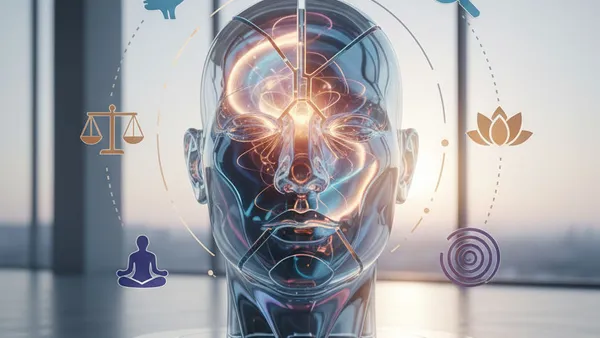
How does your brain construct reality before you even perceive it?
Prompted by NerdSip Explorer #1236
Master advanced frameworks of cognitive philosophy.
The Hard Problem of Consciousness, articulated by philosopher David Chalmers, asks why physical processing in the brain is accompanied by subjective, phenomenal experience—the *qualia* of existence. While neurobiology maps the 'easy problems' of sensory integration, the explanatory gap between matter and subjective feeling remains profound.
Modern cognitive science attempts to bridge this through Predictive Processing and the Free Energy Principle (pioneered by Karl Friston). This model posits that the brain is not a passive receiver of sensory inputs, but an active, Bayesian inference engine. It constantly generates top-down predictions about the world to minimize 'surprise' or entropy.
In this view, perception is essentially a controlled hallucination. Our conscious experience is simply the brain's best guess, updating its internal models only when it encounters bottom-up prediction errors. Understanding this fundamentally shifts our view of human behavior: we do not react to objective reality; we react to our continuously updated, probabilistic simulations of it.
Key Takeaway
Consciousness can be conceptualized as an ongoing cycle of Bayesian inferences actively minimizing sensory surprise.
Test Your Knowledge
What does the 'Hard Problem of Consciousness' specifically refer to in philosophy of mind?
Traditional cognitive psychology often relies on a computational metaphor, viewing the mind as abstract software running on the brain's wetware. However, Embodied Cognition fundamentally rejects this Cartesian dualism, asserting that cognition is deeply rooted in the body's sensorimotor interactions with its environment.
This closely aligns with James Gibson's theory of Ecological Psychology, which introduces the critical mental model of affordances. Affordances are actionable properties between the world and an actor. A chair 'affords' sitting not because of an objective geometric property, but relative to the biomechanical capacities of the human body perceiving it.
From this perspective, human behavior is not merely the output of isolated semantic processing. It is structurally coupled with our physical state and localized environment. This framework forces us to analyze decision-making not as an internal neural monologue, but as a dynamic, real-time coupling between an organism and its ecological niche.
Key Takeaway
Cognition is not localized solely in the brain, but emerges from dynamic, actionable interactions between the physical body and its environment.
Test Your Knowledge
In the context of ecological psychology, what is an 'affordance'?
To navigate highly ambiguous realities, sophisticated thinkers utilize rigorous epistemic mental models. At the forefront is Bayesian Updating, a mathematical and philosophical framework for revising one's beliefs in light of new evidence. Unlike static dogmatism, a Bayesian approach requires assigning a probabilistic *prior* to a hypothesis, and dynamically calculating a *posterior* probability as novel data arrives.
This epistemic model pairs powerfully with First Principles Thinking, a reductionist method favored in philosophy and deep tech. Rather than reasoning by analogy—which assumes current paradigms and societal norms are absolute—you deconstruct a problem down to its most fundamental, non-reducible axioms.
By synthesizing Bayesian inference with first principles, you effectively neutralize the cognitive trap of Confirmation Bias. You learn to treat your current worldview not as a fixed identity to defend, but as a provisional map, constantly subjected to falsification and iterative refinement. This represents the pinnacle of intellectual agility.
Key Takeaway
Optimal cognitive agility requires treating beliefs as probabilistic priors that must be dynamically updated with new, unassailable evidence.
Test Your Knowledge
How does First Principles Thinking differ structurally from reasoning by analogy?
Track your progress, earn XP, and compete on leaderboards. Download NerdSip to start learning.