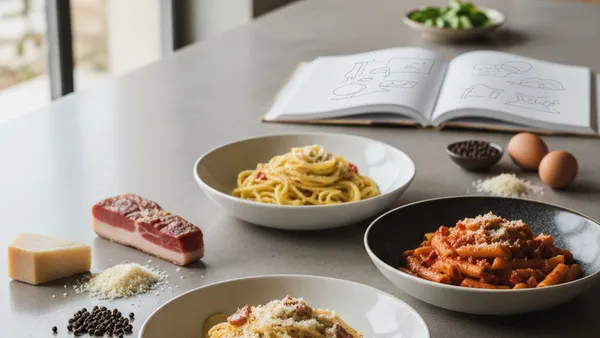
Why do your traditional Roman pasta sauces keep breaking?
Prompted by NerdSip Explorer #5254
Master the chemical emulsions of the Roman quartet.
Welcome to the masterclass on the 'Holy Quartet' of Roman pastas: Cacio e Pepe, Gricia, Amatriciana, and Carbonara. As an experienced cook, you already know these aren't just recipes; they are a masterclass in modular culinary architecture. Each dish builds sequentially on the previous one, utilizing a minimalist pantry of *guanciale*, *Pecorino Romano*, black pepper, eggs, and tomatoes.
The true secret to these dishes lies in the pasta itself. You must use high-quality, dried semolina pasta—specifically bronze-extruded (*trafilata al bronzo*). The rough, porous surface created by the bronze die is crucial. It drastically increases the surface area, allowing the pasta to release maximum surface starch into the cooking water.
This starchy water is your liquid gold. It acts as the primary binding agent, providing the hydrophilic foundation necessary to create stable, velvety emulsions with pure fats. Without high-starch water, your sauces will break, split, or become greasy. We aren't just boiling noodles; we are extracting a highly functional culinary binder.
Key Takeaway
Bronze-extruded pasta yields the critical starch required to build stable sauce emulsions.
Test Your Knowledge
Why is bronze-extruded pasta critical for authentic Roman pasta dishes?
Cacio e Pepe is arguably the most deceptively simple dish in existence. With only cheese, pepper, and pasta, failure usually stems from a breakdown in emulsification. When you mix melted *Pecorino Romano* with hot water, you are forcing a suspension of fat molecules within a water matrix.
The critical variable here is temperature control. Pecorino Romano is a hard, aged sheep's milk cheese with a high propensity to clump. If your pan is too hot (above 65°C / 150°F), the proteins in the cheese will coagulate and separate from the fat, resulting in a stringy, greasy disaster instead of a creamy sauce.
To achieve the perfect emulsion, you must rely on starch gelatinization. Vigorously toasting the black pepper in a dry pan blooms its fat-soluble piperine compounds. Then, off the heat, slowly stream your heavily starchy pasta water into finely grated cheese to create a concentrated paste. This paste tempers the cheese, stabilizing the emulsion before it even hits the pan.
Key Takeaway
Precise temperature control prevents cheese proteins from coagulating and breaking your emulsion.
Test Your Knowledge
What happens if you introduce Pecorino Romano to water that is too hot?
Pasta alla Gricia is the historical foundation of Roman meat-based pastas, predating the introduction of the tomato to Italy. The star here is guanciale, a cured pork jowl coated in black pepper. Unlike pancetta (pork belly), guanciale boasts a higher fat-to-meat ratio and a deeper, more complex porcine funk due to its specific curing process.
Mastering Gricia requires precise fat rendering. You must start the cubed guanciale in a cold pan. As the temperature slowly rises, the fat gently melts out without scorching the meat, allowing the exterior to undergo the Maillard reaction. This creates deeply savory, crispy morsels while leaving the interior tender.
The rendered liquid fat is then aggressively agitated with your starchy pasta water. This mechanical shearing action, combined with the starch acting as a surfactant, binds the pork fat and water into a luscious, cloudy sauce that clings to every rigatoni or tonnarelli strand. It is a triumph of single-ingredient manipulation.
Key Takeaway
Starting guanciale in a cold pan ensures optimal fat rendering without burning the meat.
Test Your Knowledge
Why is it important to start rendering guanciale in a cold pan?
Bucatini all'Amatriciana introduces acid to the Roman equation. Originating from the town of Amatrice, this dish takes the rich, pork-fat base of Gricia and elevates it with the vibrant acidity of tomatoes. Some traditionalists deglaze the crispy guanciale with a splash of dry white wine, introducing tartaric and malic acids that cut through the heavy lipid profile.
The tomato element—typically San Marzano or peeled plum tomatoes (*pelati*)—must be cooked rapidly. You want to preserve the bright, fresh pectin structure of the tomato rather than reducing it into a heavy, oxidized ragù. The acidity alters the pH of the sauce, slightly changing how the starch and fat interact, requiring careful reduction.
Because the sauce is looser and highly acidic, the traditional pasta choice is bucatini. The hollow center of this extruded noodle captures the bright, fatty tomato emulsion perfectly. The dish is then finished with an aggressive shower of sharp, salty *Pecorino Romano*, bridging the gap between the sweet fruit and the savory cured pork.
Key Takeaway
The rapid cooking of tomatoes in Amatriciana introduces bright acidity that balances the heavy animal lipids.
Test Your Knowledge
How does the addition of tomatoes alter the architectural balance of the Gricia base?
Carbonara is the final evolution of the quartet, famously introducing eggs to the Gricia base. At a high culinary level, you know that cream has absolutely no place here. The luxurious texture is solely the result of manipulating the thermal coagulation of egg proteins.
Whole eggs and extra yolks provide water, fat, and lecithin (a powerful natural emulsifier). However, egg yolks begin to set and scramble at roughly 65°C (149°F). If you add them directly to a blazing hot pan of pasta and pork fat, the proteins will instantly denature and bond tightly together, squeezing out the fat and leaving you with scrambled eggs.
The technique requires rigorous tempering. Whisk the eggs and Pecorino Romano into a thick slurry in a separate bowl. Once the pasta is coated in the rendered guanciale fat, remove the pan entirely from the heat. Introduce the egg mixture and toss frantically. The residual heat of the pasta gently warms the eggs just enough to thicken the sauce into a stable, custard-like matrix without breaking the delicate protein structure.
Key Takeaway
Utilizing residual heat to temper eggs prevents protein denaturing, resulting in a creamy custard rather than scrambled eggs.
Test Your Knowledge
What is the primary role of the lecithin found in the egg yolks for Carbonara?
Track your progress, earn XP, and compete on leaderboards. Download NerdSip to start learning.