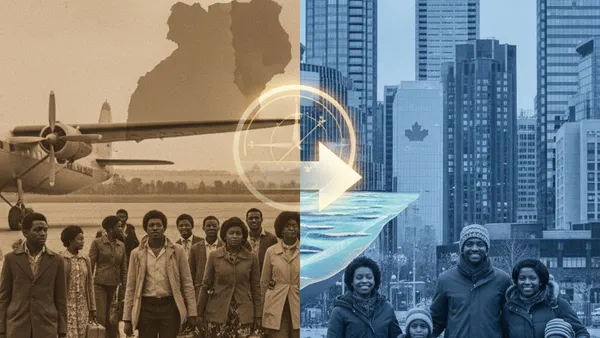
Why did 7,000 Ugandan Asians suddenly flee to Canada in 1972?
Prompted by NerdSip Explorer #5918
Understand Canada's first non-European refugee rescue.
In August 1972, the president of Uganda, Idi Amin, made a sudden and shocking announcement. He declared that all Ugandans of South Asian descent had exactly 90 days to leave the country.
Amin, who had recently seized power in a military coup, claimed that this minority group was sabotaging the economy. In reality, it was a sudden act of mass expulsion fueled by political scapegoating and a desire to redistribute their wealth.
Overnight, tens of thousands of people were stripped of their homes, their businesses, and their sense of safety. They were suddenly stateless, facing a terrifying ticking clock to find a new country that would take them in.
This abrupt decree sparked an urgent international humanitarian crisis. The global community had to quickly decide who would step up to help these displaced families before the 90-day timer ran out and they faced severe consequences.
Key Takeaway
In 1972, dictator Idi Amin abruptly expelled tens of thousands of Ugandan Asians, giving them 90 days to leave.
Test Your Knowledge
What did Idi Amin order in August 1972?
Why was there a large South Asian population in Uganda in the first place? The story goes all the way back to the days of the British Empire.
In the late 1800s and early 1900s, the British brought thousands of laborers from India to East Africa to construct the massive Uganda Railway. After the railway was finished, many of these workers decided to stay and build new lives.
Over the generations, this community flourished and grew. They became highly educated professionals, skilled tradespeople, and very successful business owners. They built schools, hospitals, and rich cultural centers. In fact, they became a crucial pillar of Uganda's economy, deeply woven into the daily fabric of East African society.
When Idi Amin's expulsion order was given in 1972, it wasn't just a simple political move—it was the sudden, traumatic uprooting of families who had considered Uganda their rightful home for multiple generations.
Key Takeaway
The Ugandan Asian community, originally brought over by the British, had lived and thrived in East Africa for generations.
Test Your Knowledge
How did a large South Asian population originally end up in Uganda?
With the 90-day clock ticking loudly, the international community scrambled to respond. So, how did thousands of these refugees end up choosing Canada?
A major turning point came down to a powerful personal connection. The Aga Khan, the spiritual leader of the Ismaili Muslims (many of whom lived in Uganda), directly reached out to his close friend, Canadian Prime Minister Pierre Elliott Trudeau. He urgently pleaded with Canada to provide a safe haven for his community.
Canada saw this as a pivotal historical moment. The country had recently signed the UN Refugee Convention and was eager to prove its new, modern commitment to multiculturalism and global humanitarianism.
Additionally, the Canadian government pragmatically recognized that these refugees were highly educated and deeply entrepreneurial. Officials knew these were people who would undoubtedly help strengthen the Canadian economy while escaping a terrible fate in East Africa.
Key Takeaway
Canada opened its doors due to a personal plea from the Aga Khan and a desire to prove its humanitarian values.
Test Your Knowledge
Who personally reached out to Prime Minister Pierre Trudeau to help the Ugandan Asians?
Once Prime Minister Trudeau officially agreed to help, Canada had to move incredibly fast. The 90-day deadline imposed by Idi Amin was rapidly approaching, and the stakes were life or death.
Canada immediately dispatched a specialized team of immigration officers and military medical staff directly to Kampala, the capital of Uganda. They set up a makeshift processing office and worked around the clock.
The logistics were utterly chaotic. The team had to conduct personal interviews, perform thorough medical checks, and issue visas while navigating a highly tense, unpredictable, and dangerous political environment patrolled by armed guards.
Despite the intense pressure, the Canadian team managed to process thousands of applications in a matter of weeks. They successfully chartered dozens of commercial flights to safely transport the refugees across the world just before the dictator's deadline officially expired. It was a frantic race against time that tested the limits of Canada's immigration system.
Key Takeaway
Canada sent a dedicated team to Uganda to rapidly process visas and charter flights within the strict 90-day deadline.
Test Your Knowledge
How did Canada manage to bring the refugees over so quickly?
By the end of 1973, Canada had successfully welcomed roughly 7,000 Ugandan Asian refugees. They arrived in major cities like Montreal, Toronto, and Vancouver, where local volunteers warmly greeted them with winter coats and hot meals.
This event was a massive historical milestone. It marked Canada's very first major resettlement of non-European refugees.
The Ugandan Asians adapted incredibly quickly to their new freezing climate. They used their deep professional skills and entrepreneurial spirit to build thriving businesses and lives in Canada. Today, their descendants are deeply embedded in every level of Canadian society.
Most importantly, this highly successful resettlement proved that Canada could rapidly absorb diverse, non-European refugee populations. It permanently paved the way for future humanitarian efforts—like welcoming the Vietnamese "Boat People" years later—forever changing the face of Canadian immigration. It transformed Canada into a truly multicultural refuge on the global stage.
Key Takeaway
The arrival of Ugandan Asians was Canada's first major non-European refugee resettlement, shaping future immigration policies.
Test Your Knowledge
Why was the resettlement of Ugandan Asians a milestone for Canada?
Track your progress, earn XP, and compete on leaderboards. Download NerdSip to start learning.