Why is this Polish gem known as the 'Paris of the North'?
Prompted by A NerdSip Learner
Master 1,000 years of Baltic history, architecture, and modern flair.
Szczecin (historically Stettin) is a fascinating port city with a geographical twist. Despite being one of the region's major maritime hubs, it isn’t actually on the Baltic Sea. It sits on the banks of the Oder River, about 65 kilometers inland, separated from the open sea by the Szczecin Lagoon.
Its location is geopolitically unique. As Poland's westernmost major city, it’s actually closer to Berlin (approx. 120 km) than to the Polish capital, Warsaw. This proximity has shaped its identity for centuries as a bridge between cultures.
Walking through the city center today, you might feel a sudden French vibe. In the 19th century, the city was redesigned following the model of Paris. Instead of narrow medieval alleys, you'll find wide boulevards and star-shaped squares like Grunwald Square, earning it the nickname "Paris of the North."
Key Takeaway
Located on the Oder, Szczecin surprises visitors with Parisian-style urban planning and a unique inland port.
Test Your Knowledge
Why is Szczecin often compared to Paris?
Long before modern borders were drawn, Szczecin was ruled by the powerful House of Griffins. From the 12th to the 17th century, these dukes governed the city, turning it into the political heart of Pomerania.
The true economic boom arrived in 1278 when the city joined the Hanseatic League. This elite alliance of merchants dominated trade across the North and Baltic Seas. Local traders shipped grain, timber, and salt on a massive scale, bringing immense wealth to the city's docks.
This was a true golden age. Magnificent warehouses and proud patrician houses lined the riverbanks. The Ducal Castle became a symbol of this power. Today, the red griffin’s head on the city's coat of arms remains a proud reminder of this era of prosperity and seafaring.
Key Takeaway
As the seat of the Griffin Dukes and a Hanseatic power, Szczecin flourished as a medieval trade giant.
Test Your Knowledge
Which alliance brought great wealth to the city in the 13th century?
The medieval prosperity came to a crashing halt in the 17th century. The Thirty Years' War (1618–1648) devastated much of Europe, and Pomerania was no exception. When the last Griffin Duke died without an heir in 1637, a fierce struggle for the strategic city began.
Following the Peace of Westphalia in 1648, the city was handed to the Kingdom of Sweden. For about 70 years, the port served as a Swedish bridgehead on the European mainland. However, life for the local population was far from easy.
Sweden was primarily interested in military security and high customs duties. Consequently, trade collapsed, the harbor fell into disrepair, and the local economy stagnated. Despite the decline, this often-forgotten era left a permanent mark on the city's complex historical DNA.
Key Takeaway
After 1648, Szczecin spent 70 years under Swedish rule, a period marked by military focus and economic decline.
Test Your Knowledge
Which country took control of Szczecin after the Thirty Years' War in 1648?
The tide turned again in 1720. Following the Great Northern War, the Prussian King Frederick William I acquired the city through the Treaty of Stockholm. Szczecin became the capital of the Province of Pomerania and underwent a massive transformation.
Prussia initially fortified the city into a massive military fortress. But its new economic role was even more vital: Szczecin rapidly became the primary seaport for nearby Berlin. Almost everything imported to or exported from the Prussian capital passed through the docks on the Oder.
In the late 19th century, the restrictive fortress walls were finally demolished. This sparked an era of unprecedented urban expansion. Industries moved in, massive shipyards were built, and Szczecin grew into one of the most important metropolises of the German Empire.
Key Takeaway
Under Prussian rule, Szczecin evolved into a major industrial hub and the essential seaport for Berlin.
Test Your Knowledge
Why was Szczecin economically vital to Prussia?
By the 1930s, Szczecin had grown into the third-largest city in Germany by land area. However, the outbreak of World War II brought unimaginable suffering and destruction to this thriving metropolis.
As a major industrial and armaments hub with vast shipyards, Szczecin became a primary target for Allied forces. In 1944, the city endured devastating air raids. The historic old town, the massive port area, and numerous grand buildings were reduced to rubble.
By the war's end, an estimated 70 percent of the city lay in ruins. The magnificent medieval and Prussian architecture that had defined Szczecin for centuries was almost completely wiped out. In 1945, the surviving population faced the smoking remains of a former world-class city.
Key Takeaway
Massive Allied air raids in 1944 destroyed 70% of the city, including almost the entire historic center.
Test Your Knowledge
Why was Szczecin heavily bombed during World War II?
1945 marked the most dramatic turning point in the city's history. With the end of WWII, the Allies redrew the borders of Europe at the Potsdam Conference. Poland's territory was effectively shifted westward.
The new border between Germany and Poland was set at the Oder-Neisse line. Although central Szczecin lies west of the river, strategic planners decided to hand the entire city to Poland to ensure the vital port area remained unified.
This led to a tragic and unprecedented population exchange. The remaining German residents were expelled or fled. In their place, Polish settlers arrived—many of whom were themselves displaced from former Polish eastern territories. German *Stettin* officially became Polish *Szczecin*.
Key Takeaway
In 1945, the city became Polish, leading to a total population exchange and a new national identity.
Test Your Knowledge
Why was Szczecin given to Poland despite being west of the Oder?
If you enter Szczecin by boat or car across the Oder today, you are met with a truly majestic sight: the Wały Chrobrego (historically known as the *Haken Terrace*).
This spectacular 500-meter-long observation terrace was built in the early 20th century under Mayor Hermann Haken. Perched on a slope directly above the river, the massive architectural complex survived the war remarkably well and is now the city's most iconic landmark.
Monumental historic buildings line the terrace, including the National Museum, the Maritime University, and the Provincial Office. Walking along the promenade, visitors can admire the grand architecture while enjoying a direct view of the bustling harbor islands across the water.
Key Takeaway
The Wały Chrobrego is a monumental architectural ensemble and the city's most famous riverside promenade.
Test Your Knowledge
Which building is NOT located on the Wały Chrobrego?
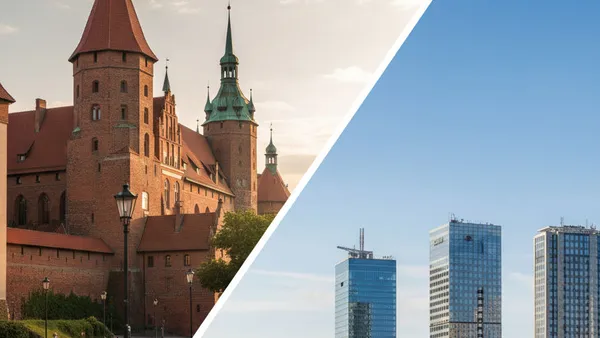
Another landmark embodying the city’s turbulent history is the Pomeranian Dukes' Castle (Zamek Książąt Pomorskich). Once the grand Renaissance residence of the powerful Griffin dynasty, it stands as a testament to local heritage.
During the 1944 air raids, the historic castle was almost leveled. However, rather than clearing the ruins, a bold decision was made after the war: the castle would be meticulously reconstructed in the delicate Renaissance style of its 16th-century heyday.
Today, the bright facades and imposing bell tower shine once again. The castle has become the cultural heart of Szczecin, housing museums, galleries, and even the only opera house in Poland located directly within a castle complex.
Key Takeaway
Totally destroyed in WWII, the castle was rebuilt in its Renaissance style and now serves as a cultural hub.
Test Your Knowledge
What architectural style defines the rebuilt castle today?
Szczecin doesn't just live in the past; it makes bold statements in the present. The prime example is the Mieczysław Karłowicz Philharmonic, which opened its doors in 2014 to international acclaim.
The building is a breathtaking architectural masterpiece. With its glowing white, jagged glass facade, it resembles a giant iceberg or a futuristic crown in the city center. Designed by a Spanish firm, it won the 2015 *Mies van der Rohe Award*, Europe's highest architectural honor.
Inside lies a spectacular golden concert hall with world-class acoustics. The building creates a fascinating link to history, as it stands on the exact site where the city's original concert house stood before the war.
Key Takeaway
Opened in 2014, the Philharmonic looks like a white iceberg and won Europe's top prize for architecture.
Test Your Knowledge
Which prestigious award did the Philharmonic win in 2015?
In recent years, Szczecin has rediscovered its massive aquatic heritage. Under the visionary "Floating Garden" concept, the city is transforming into a green, water-focused metropolis of the future.
The epicenter of this development is the harbor island of Łasztownia. Once a gritty industrial zone, it is now the city’s trendiest hangout. Old brick slaughterhouses have been converted into chic cultural centers, while historic cargo cranes—dubbed "Cranosaurs" by locals—dot the skyline.
The island is also home to the Maritime Science Center, a modern building shaped like a ship’s hull. Through these projects, Szczecin has successfully turned its face back toward the water, blending industrial history with a vibrant, modern lifestyle.
Key Takeaway
Through the "Floating Garden" vision, Szczecin is reinventing itself as a modern, green waterfront metropolis.
Test Your Knowledge
What is the name of Szczecin's visionary urban concept?
Track your progress, earn XP, and compete on leaderboards. Download NerdSip to start learning.