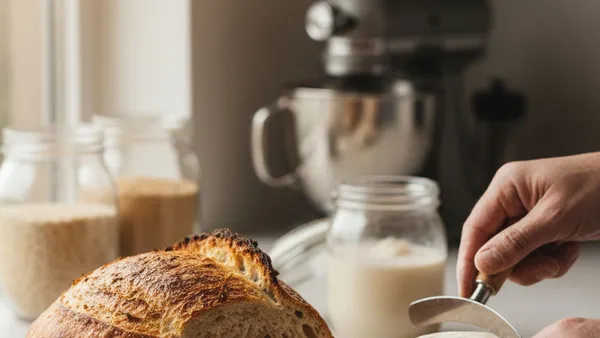
Can flour and water become a living, breathing, edible masterpiece?
Prompted by A NerdSip Learner
Bake your first homemade sourdough
Most bread you buy uses commercial baker's yeast—a fast-acting ingredient designed for speed. Sourdough is completely different. It relies on a starter, a bubbly mixture of flour and water that captures wild yeast and natural bacteria from the environment.
Think of commercial yeast like a fast-food drive-thru: quick, predictable, but lacking complex flavor. Sourdough is like a slow-cooked stew. The wild yeast works slowly to make the bread rise, while Lactic Acid Bacteria (the same good bacteria in yogurt) create that signature tangy flavor.
Because it uses these natural microbes, sourdough is actually one of the oldest ways to bake bread, dating back thousands of years. It takes more time, but the resulting loaf is easier to digest, stays fresh longer, and tastes incredible!
You don't need fancy equipment to begin. Sourdough requires just three humble ingredients: flour, water, and salt. The magic happens through patience and understanding how this living dough behaves in your kitchen.
Key Takeaway
Sourdough relies on wild yeast for rising and natural bacteria for its signature tangy flavor.
Test Your Knowledge
What ingredient is responsible for giving sourdough bread its signature tangy flavor?
Before you can bake, you need a healthy, active sourdough starter. This bubbly jar of flour and water is the heart of your bread. Because it is full of living microbes, you have to treat it a bit like a houseplant or a low-maintenance pet!
To keep your starter alive, you have to feed it. Feeding simply means discarding a portion of the mixture and stirring in fresh flour and water. The wild yeast and bacteria consume the fresh starches, producing carbon dioxide gas. This gas is what makes your starter bubble and rise.
A healthy starter will roughly double in size within a few hours of being fed. It will smell pleasantly sour, sweet, or even slightly fruity. If you bake often, you keep it on the counter and feed it daily.
If you only bake occasionally, you can keep your starter in the refrigerator. The cold temperature puts the yeast to sleep, meaning you only need to feed it about once a week. When you want to bake, just take it out, feed it, and watch it wake up!
Key Takeaway
A sourdough starter is a living culture that needs regular feedings of flour and water to survive and grow.
Test Your Knowledge
What happens to a sourdough starter when you store it in the refrigerator?
Making sourdough dough is not like traditional bread-making where you aggressively knead the dough on a counter. Sourdough relies on a gentler, slower process. You start by mixing your active starter with water, flour, and a pinch of salt until a shaggy dough forms.
Instead of kneading, we build strength using a technique called stretch and fold. Every half hour or so, you grab the edge of the dough, stretch it up gently, and fold it over itself. This aligns the gluten—the stretchy protein network that traps gas bubbles and gives bread its chewy texture.
After a few stretch and folds, the dough enters bulk fermentation. This is simply a long, uninterrupted resting period where the wild yeast does its heavy lifting. As the yeast eats, it releases gas, slowly inflating the dough like a balloon.
This process cannot be rushed. Depending on the temperature of your kitchen, bulk fermentation can take anywhere from four to twelve hours. Warmer kitchens mean a faster rise, while cooler kitchens require a bit more patience!
Key Takeaway
Instead of rough kneading, sourdough is gently stretched and folded before being left to slowly ferment and rise.
Test Your Knowledge
How do sourdough bakers typically build strength in their dough?
Once your dough has become puffy and grown in size, it is time to give it a shape. Shaping creates surface tension on the outside of the dough. This tight 'skin' ensures that your bread springs upward in the oven rather than spreading out like a flat pancake.
Using your hands or a tool called a bench scraper, you gently pull the dough into a tight round ball or an oval. It takes a little practice to be gentle enough not to pop the beautiful gas bubbles you just spent hours building!
After shaping, the dough goes into a floured bowl or a special basket called a banneton for its final rest, known as the proof. For the best results, many bakers place the basket in the refrigerator overnight.
This overnight cold proof slows down the yeast, but allows the bacteria to keep working. This is the secret step that develops the deep, complex, sour flavor that makes sourdough so famous. It also makes the dough firmer and much easier to score before baking!
Key Takeaway
Shaping creates surface tension for an upward rise, and resting the dough in the fridge overnight builds deep sourdough flavors.
Test Your Knowledge
What is the primary benefit of the overnight 'cold proof' in the refrigerator?
Baking is the grand finale where all your patience pays off! But before the dough goes into the oven, you must perform one final step: scoring. This means using a razor blade or a very sharp knife to make a shallow cut across the top of the dough.
Scoring isn't just for beautiful patterns. When the dough hits the hot oven, it expands rapidly. Without a score, the crust would tear open randomly. By scoring, you are creating a 'chimney' that tells the bread exactly where to expand safely.
To get that thick, crunchy, bakery-style crust, sourdough needs steam. Most home bakers achieve this by baking their bread inside a pre-heated cast iron pot or Dutch oven with the lid on. The moisture escaping from the dough is trapped inside, keeping the crust soft enough to rise.
Halfway through the bake, you remove the lid. This lets the steam escape and allows the dry heat of the oven to deeply caramelize the crust. Let the bread cool completely before slicing, and enjoy your amazing homemade sourdough!
Key Takeaway
Scoring controls the dough's expansion, while baking with trapped steam creates a beautifully crunchy, bakery-style crust.
Test Your Knowledge
Why do many home bakers bake their sourdough inside a closed Dutch oven?
Track your progress, earn XP, and compete on leaderboards. Download NerdSip to start learning.