What did medieval London actually smell, look, and sound like?
Prompted by A NerdSip Learner
Experience the gritty, vibrant reality of London in 1400.
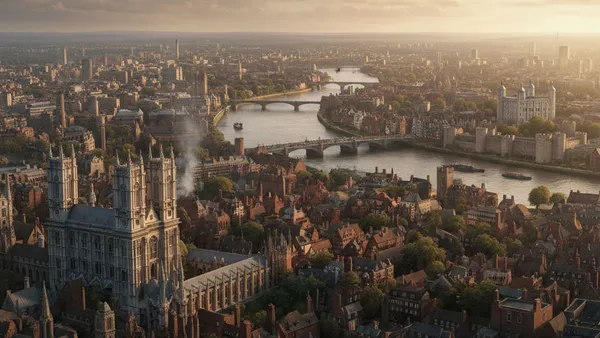
Imagine stepping into London in the year 1400. You are joining roughly 40,000 to 50,000 other people crammed inside ancient Roman walls. The first thing that hits you isn't the sight of knights in shining armor—it's the smell.
Without a modern sanitation system, waste ran through open gutters directly down the center of the narrow streets, flowing straight into the River Thames. Animals like pigs and dogs roamed freely, scavenging for scraps in the mud.
Above you, the sky is barely visible. Because space inside the city walls was incredibly expensive, builders used a technique called jettying. Each successive floor of a timber-framed house was built jutting out over the street below. By the third story, houses on opposite sides of the alleyway nearly touched, creating dark, shadowy tunnels.
Inside these homes, the air was just as thick. Most ordinary families lived in a single room with a central hearth. Because early homes lacked proper chimneys, the smoke simply drifted upward, coating the rafters, clothes, and lungs of Londoners in a permanent layer of black soot.
Key Takeaway
Medieval London was densely packed, with overhanging timber houses that blocked out the sun and trapped smoke and smells.
Test Your Knowledge
Why were London's streets in 1400 so dark, even during the daytime?
If the streets were crowded and filthy, the River Thames was the medieval equivalent of a grand, bustling superhighway. Wealthy citizens rarely rode horses through the muddy alleys; instead, they hired watermen to row them up and down the river in small wooden boats called wherries.
But the true marvel of the city was Old London Bridge. Unlike the modern bridges we see today, this was the *only* bridge crossing the Thames, and it was an entire neighborhood suspended over the water.
Built of stone with 19 massive arches, the bridge was completely packed with multi-story timber houses, shops, and even chapels. The arches were so thick that they acted like a dam, restricting the tide and causing the river to roar through the narrow gaps like a treacherous waterfall.
Navigating the bridge was a sensory overload. You would hear the deafening rush of the Thames below, the shouts of merchants selling their goods, and the clatter of carts. It was a buzzing commercial ecosystem that could take over an hour to cross during rush hour!
Key Takeaway
The Thames was London's main highway, and Old London Bridge was a massive, heavily populated structure covered in houses and shops.
Test Your Knowledge
How did wealthy citizens typically travel to avoid the muddy, crowded streets?
The year 1400 wasn't just another year in the medieval calendar; it marked a major turning point for English culture. In October of 1400, Geoffrey Chaucer—often called the "Father of English Literature"—passed away.
At a time when law and courtly life were dominated by Latin and French, Chaucer chose to write his masterpiece, *The Canterbury Tales*, in Middle English. He proved that the everyday language of the London streets was rich and beautiful enough for great poetry. Because he lived on the grounds of Westminster Abbey, he was buried there, becoming the very first resident of what is now famous as "Poets' Corner."
Meanwhile, the city’s politics were shifting. King Henry IV had just taken the throne, and power in London was increasingly held not just by royals, but by wealthy merchants.
Take Richard "Dick" Whittington, for example. Long before he became a fairytale legend with a fictional cat, the real Whittington was a wildly successful merchant dealing in luxury fabrics. He served as Mayor of London multiple times around this era, using his immense wealth to fund public works, proving that in 1400, trade was becoming the true king of London.
Key Takeaway
The year 1400 saw the death of Geoffrey Chaucer, who legitimized English literature, during a time when wealthy merchants were gaining immense political power.
Test Your Knowledge
Why is Geoffrey Chaucer's work considered so historically significant for London and England?
Track your progress, earn XP, and compete on leaderboards. Download NerdSip to start learning.