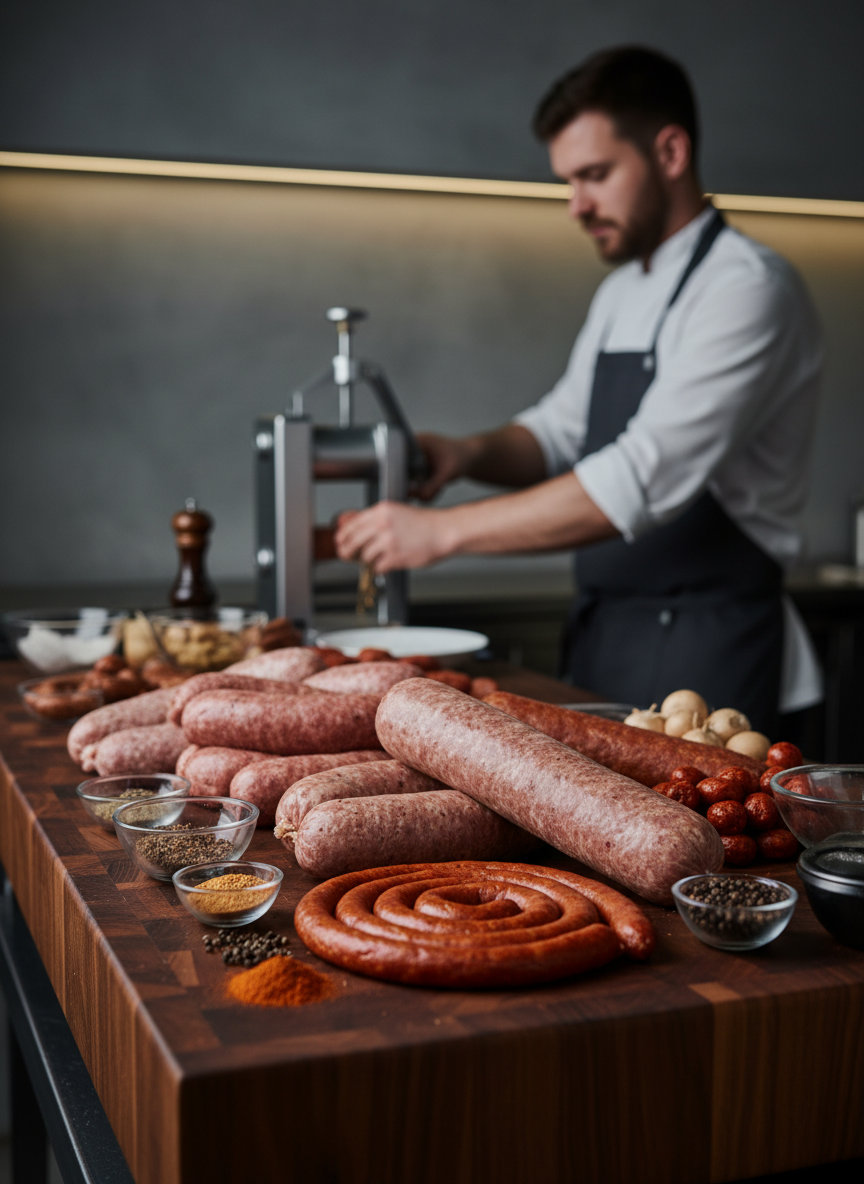
Does your sausage have the perfect snap, or is it just another link?
Prompted by A NerdSip Learner
Craft professional-grade artisanal sausages with the perfect snap.
So, you've made a burger before, but sausage is a whole different beast. The number one rule in advanced sausage making is simple: keep everything freezing cold. We aren't just talking about food safety here; we are talking about texture! If your fat gets soft and melts during the grinding process (a disaster called smearing), your final sausage will be dry and crumbly rather than juicy and snappy.
Before you even look at the meat, put your grinder metal parts, bowls, and even the meat itself into the freezer. You want the meat to be partially frozen—crunchy on the outside but soft in the middle. This allows the grinder to cut the fat cleanly into distinct little pebbles rather than mushing it.
Think of the fat as the structural integrity of your sausage. If you keep it solid now, it will melt *only* when you cook it, basting the meat from the inside out. If you see grease building up on your grinder plate, stop immediately and chill out—literally!
Key Takeaway
Keeping your meat and equipment near-freezing prevents fat 'smearing' and ensures a juicy, snappy texture.
Test Your Knowledge
What is the term for when fat melts and coats the meat during the grinding process?
Now that you have your perfectly ground, cold meat, it's time for the magic trick that separates a sausage from a hamburger. It's all about the Primary Bind. When you mix ground meat with salt and agitate it (either by hand or a mixer), you are actually performing chemistry. You are extracting a sticky protein called myosin.
As you mix, you'll notice the meat changing. It will go from looking like loose ground beef to a sticky, furry paste that clings to your hand. This is crucial! That sticky matrix traps the fat and water, creating a stable emulsion.
If you skip this step or under-mix, the fat will leak out during cooking (we call this 'breaking'), leaving you with a sad, dry link floating in a pool of grease. You want to mix until the meat creates sticky threads when you pull it apart. This is what gives a sausage its satisfying 'snap' when you bite into it.
Key Takeaway
Vigorous mixing with salt extracts myosin, creating a sticky bind that traps fat and moisture.
Test Your Knowledge
What is the specific protein we are trying to extract to create the 'primary bind'?
You've got the perfect emulsion; now let's get it into a casing. For advanced sausages, we usually ditch the synthetic stuff and go for natural casings—hog casings for thick sausages (like Bratwurst) and sheep casings for thin ones (like breakfast links). These provide that classic 'pop' when you bite down.
When stuffing, gravity is your friend, but air is your enemy. You need to apply consistent pressure to avoid air pockets, which fill with grease during cooking. However, be careful not to overstuff! If the sausage is rock hard, it will burst the moment you try to twist it into links.
Once stuffed, pinch the sausage to define your link length, then twist. A pro tip: alternate your twist directions (clockwise for one, counter-clockwise for the next) so they don't unravel. Finally, use a sterilized needle or a 'sausage pricker' to pop any visible air bubbles. This saves your sausage from exploding on the grill!
Key Takeaway
Use natural casings for the best snap, and prick air pockets to prevent the sausage from bursting during cooking.
Test Your Knowledge
Why is it important to alternate the direction you twist each link?
Track your progress, earn XP, and compete on leaderboards. Download NerdSip to start learning.