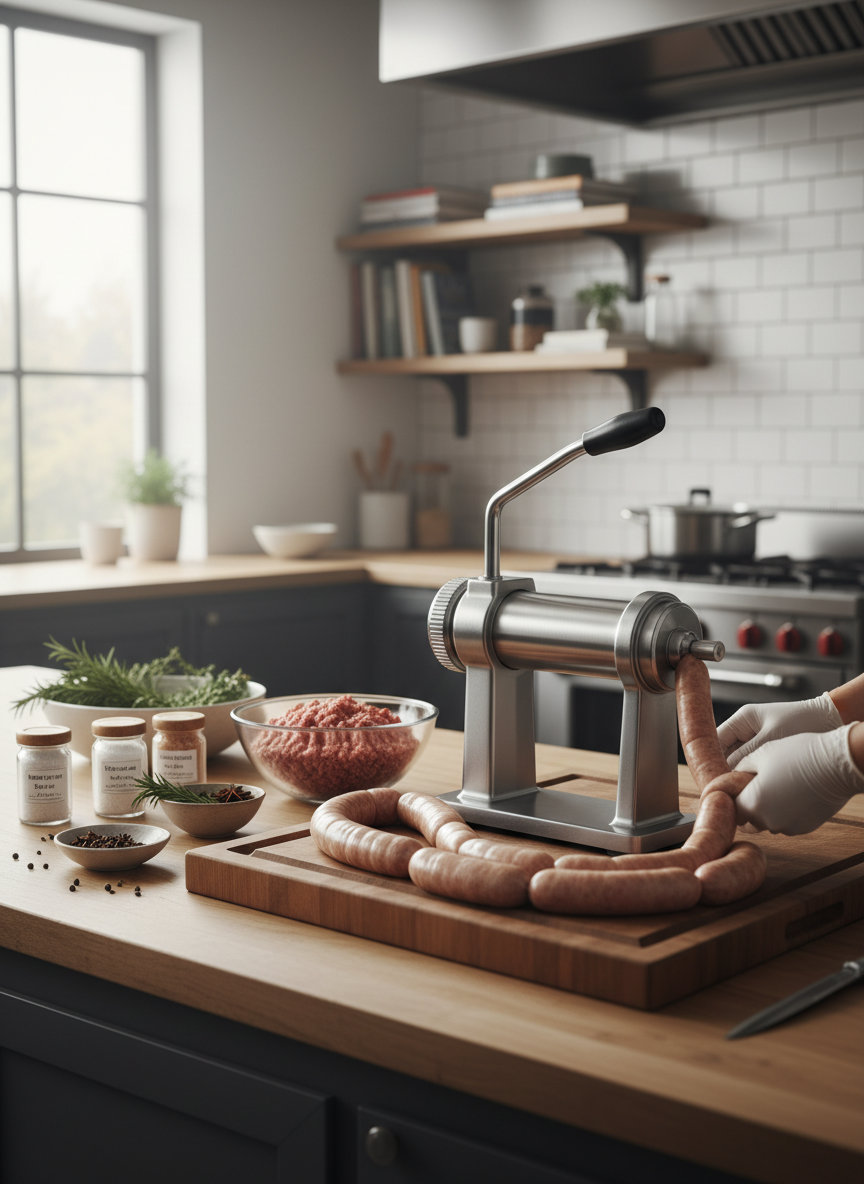
Do you actually know what’s inside your store-bought breakfast links?
Prompted by A NerdSip Learner
Hand-craft your first batch of custom-seasoned sausages.
Welcome to the tasty world of sausage making! Before we touch a grinder, we need to talk about the most important rule: Fat is flavor. If you just grind up a lean steak, you'll end up with a dry, crumbly mess. To make a juicy, bouncy sausage, you need a specific balance. The magic number is usually 70% lean meat and 30% fat. Think of the fat like the 'glue' that holds a snowball together; without it, everything falls apart!
Your second best friend is cold temperature. Heat is the enemy of good sausage because it melts the fat too early, turning your mixture into a greasy paste (this is called 'breaking').
To prevent this disaster, professional butchers keep their meat, fat, and even their grinder parts in the freezer before they start. If your hands feel like they are freezing while working the meat, you are doing it exactly right! Keep it chilly to keep it silly (and delicious).
Key Takeaway
Sausage requires a 70/30 meat-to-fat ratio and must be kept ice-cold during preparation to prevent a dry texture.
Test Your Knowledge
Why is it important to keep your meat and equipment very cold?
Now that you have your cold, ground meat, it’s time for the science part—but don't worry, it's easy! We aren't just stirring ingredients together like a salad; we are creating a structure. When you add salt and mix the meat vigorously, a chemical reaction happens. The salt extracts a protein called myosin, which acts like a natural adhesive.
You need to mix the meat, fat, and spices until the texture changes from 'ground meat' to a sticky paste. This is known as the primary bind.
How do you know when you're done? Grab a handful of the meat mixture, turn your hand upside down, and open your palm. If the meat sticks to your hand without falling off, you've nailed it! If it falls, keep mixing. This sticky quality is what gives a sausage its satisfying 'snap' when you bite into it, rather than it feeling like loose hamburger meat inside a skin.
Key Takeaway
Salt and vigorous mixing create a 'primary bind,' making the meat sticky so the sausage holds together.
Test Your Knowledge
What is the 'primary bind' test?
You've got the perfect mix; now it needs a jacket! We call these jackets casings. Traditionally, these are made from natural animal intestines (which sounds gross, but it's natural!), but you can also buy collagen or plant-based casings. The goal here is to fill the casing without creating an explosion.
When using a stuffer, you want to fill the casing firmly but not too tight. Think of it like a water balloon—if you overfill it, it will burst when you try to twist it into links or when the heat expands the juices during cooking.
As the meat fills the casing, watch out for air pockets. Air is bad because it can harbor bacteria and ruin the look. If you see a bubble, simply use a sanitized needle or a sausage pricker to pop it. Once stuffed, you can twist them into links. Congratulations, you just made your first batch of artisan sausage!
Key Takeaway
Stuff casings firmly but leave enough room for twisting and expansion to avoid bursting.
Test Your Knowledge
What happens if you stuff the sausage casing too tightly?
Track your progress, earn XP, and compete on leaderboards. Download NerdSip to start learning.