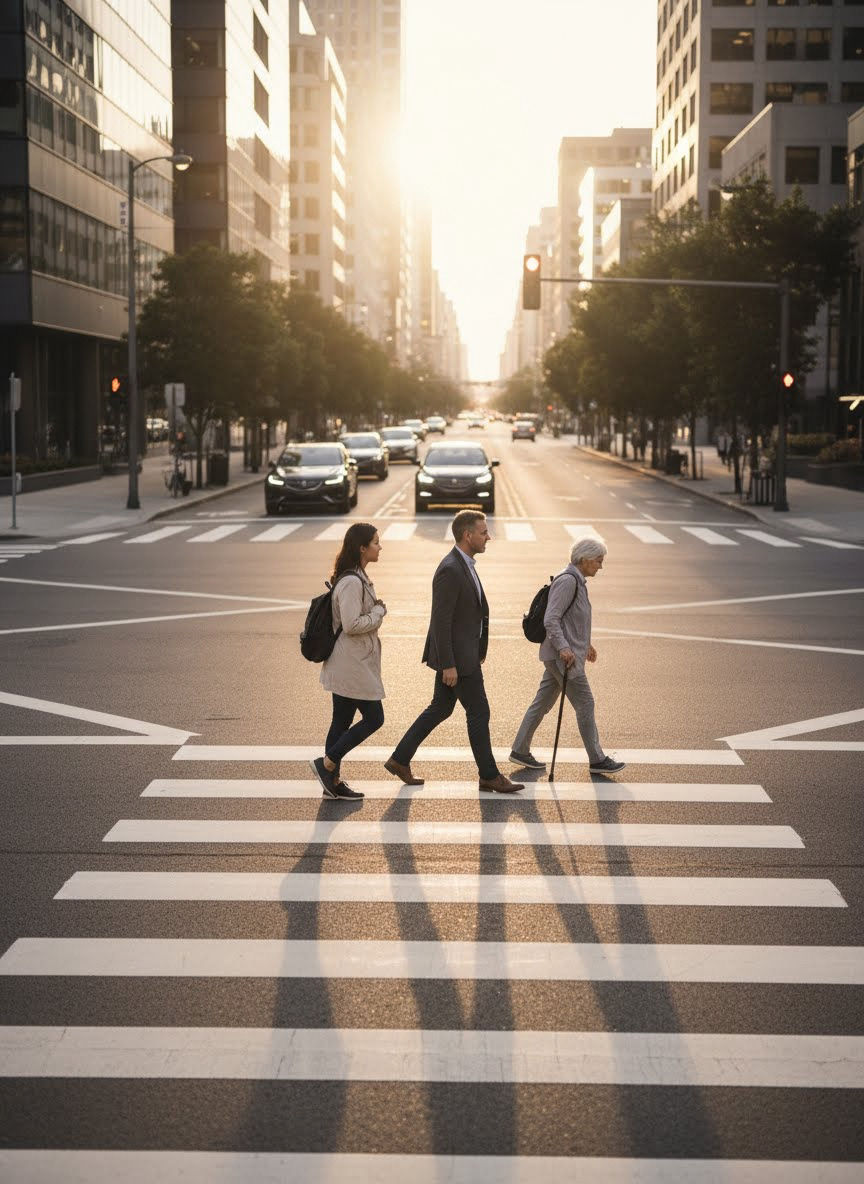
Do you feel rushed or anxious when crossing the street?
Prompted by A NerdSip Learner
Master 3 habits for safer walking
Welcome! Let’s start with the most important moment of your walk: arriving at the curb. In our rush to get to the shops or visit friends, it is easy to step off the sidewalk too quickly. But today, we are going to learn the power of the Golden Pause. Think of the curb as your personal stop sign. When you reach the edge, stop completely. Plant both feet firmly on the ground and take a deep breath.
Why is this pause so magical? It gives your brain time to switch from "walking mode" to "scanning mode." As we get older, it can take us just a split second longer to process fast-moving objects. That is perfectly normal! By stopping, you reset your focus. Now, perform the classic scan: Look Left, Look Right, and then Look Left again. That second look to the left is crucial because that is the lane closest to you.
Never feel pressured to rush because of traffic lights or other pedestrians. If you don't feel sure, wait for the next gap. Your safety is worth the extra minute. You are in control of when you step off that curb!
Key Takeaway
Always come to a complete stop at the curb and look Left-Right-Left before moving.
Test Your Knowledge
What is the most important thing to do the moment you reach the curb?
Now that you have paused, let’s talk about connection. Did you know that just because you can see a car, it doesn't mean the driver can see you? Modern cars have blind spots, and drivers can be distracted. To keep yourself safe, you need to use your secret weapon: Eye Contact.
Before you step in front of a stopped or slowing vehicle, look right at the driver. Try to catch their gaze. If they are looking at their lap, they might be on a phone. If they are looking the other way, they aren't looking at you! Do not step out until you are sure they see you. A simple wave or nod from them confirms that you are safe to proceed.
Visibility is a two-way street. Wearing bright colors or carrying a light bag helps drivers spot you sooner. If it is dusk or dawn, this is even more critical. Remember, never assume a car will stop just because you are in the right. By seeking eye contact, you are actively communicating and ensuring your own safety. It is a confident, smart way to navigate your neighborhood.
Key Takeaway
Never step in front of a car until you have made eye contact with the driver.
Test Your Knowledge
Why should you try to make eye contact with a driver?
You have paused, and you have made eye contact. Now it is time to cross! The goal here is a steady, consistent pace. You do not need to run—rushing can lead to trips and falls, which are often more dangerous than the traffic itself. Walk at a speed that feels stable and comfortable for you. Keep your head up and your eyes moving.
A vital rule for this stage is to stay on the path. Always use designated crosswalks or pedestrian crossings whenever they are available. These areas are where drivers expect to see people. Crossing in the middle of a block (jaywalking) is risky because you appear where you are least expected. If the crosswalk is a little further down the road, view that extra walk as a bonus for your health!
Finally, stay alert until you are fully on the other side. Do not look at your phone or dig for keys in your pocket while you are in the street. Keep scanning left and right as you walk. Once your foot hits the opposite curb, you have made a successful, professional crossing. You did great!
Key Takeaway
Cross at designated crosswalks at a steady pace, staying alert until you reach the other side.
Test Your Knowledge
What is the safest way to walk across the street?
Track your progress, earn XP, and compete on leaderboards. Download NerdSip to start learning.