Who was in the Caribbean first, and why is there 'beef' today?
Prompted by NerdSip Explorer #5918
Understand the true origins and complex cultural ties.
Did Caribbean people come from Africa first? Actually, no! If we rewind the clock to the very beginning, the first people in the Caribbean were Indigenous groups.
Thousands of years ago, communities like the Taíno and the Kalinago migrated from South America by canoe, settling across the Caribbean islands. They built thriving, complex societies with rich cultures. They were expert farmers who cultivated root vegetables, skilled fishers, and had deeply rooted spiritual traditions.
It wasn't until the late 1400s that European explorers arrived. This contact tragically and completely changed the islands forever through colonization, forced labor, and the introduction of new diseases.
So, if we look at the absolute beginning of human history in this region, the original Caribbean people were Indigenous Americans, not African! Acknowledging this history is an important way to honor the very first caretakers of these beautiful islands.
Key Takeaway
The original inhabitants of the Caribbean were Indigenous peoples from South America, long before Africans or Europeans arrived.
Test Your Knowledge
Who were the very first people to live in the Caribbean islands?
If the first people were Indigenous, why do so many modern Caribbean people have African roots today? This is directly tied to a dark and painful chapter in global history: the Transatlantic Slave Trade.
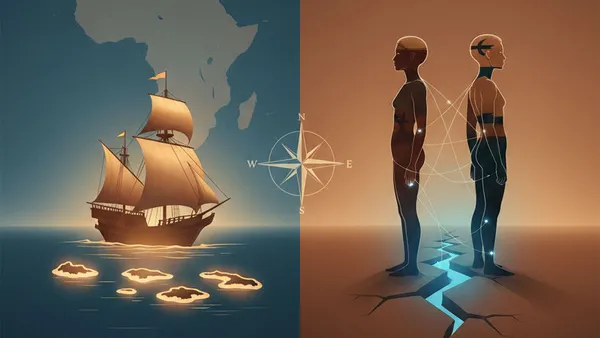
When European colonizers took over the Caribbean, they established massive sugar, tobacco, and coffee plantations. To maximize their profits, they needed a massive workforce. Over several centuries, millions of enslaved African people were violently taken from their homes—mostly in West and Central Africa—and shipped across the ocean.
Despite the horrific and inhumane conditions of slavery, these resilient people survived. They secretly held onto their humanity, bringing their rhythms, spices, languages, and spiritual practices with them.
Today, those beautiful, surviving African traditions have mixed with Indigenous and European influences to become the vibrant heartbeat of modern Afro-Caribbean culture!
Key Takeaway
Much of the modern Caribbean population has African roots due to the forced migration of the Transatlantic Slave Trade.
Test Your Knowledge
Why were millions of African people originally brought to the Caribbean?
To understand the relationship between African and Caribbean people today, we need to learn a very important word: the Diaspora.
Think of a diaspora like a dandelion blowing in the wind. The seeds all come from the exact same flower, but they are carried away to land and grow in entirely different gardens.
Black people worldwide share deep ancestral roots in the African continent, but history scattered them to the Caribbean, North America, South America, and Europe. Because they landed in different "gardens," they developed entirely different identities based on their new environments.
They share a massive, historical family tree, but their daily lives, languages, and cultures grew in very different directions over hundreds of years. The diaspora is connected by history, but beautifully diverse in its modern culture.
Key Takeaway
The African Diaspora refers to people of African descent scattered globally, who share ancestral roots but have developed unique cultures.
Test Your Knowledge
What is the best analogy for understanding the 'Diaspora'?
So, why do African and Caribbean folks sometimes clash, or have what people call 'beef'? A lot of it comes down to simple, everyday cultural misunderstandings.
Because of the historical scattering of the diaspora, a person from Jamaica and a person from Nigeria might look similar on the outside, but their everyday cultures are highly distinct. They might speak entirely different dialects, hold different traditional values, and have very different social rules around respect and communication.
Sometimes, when these two groups meet—especially as immigrants in places like the US, Canada, or the UK—they expect to instantly understand each other just because they share a racial identity.
When they suddenly realize they have completely different cultural habits, it can lead to confusion. This confusion sometimes turns into stereotyping, where one group assumes the other is 'rude' or 'snobby,' when in reality, they just have different cultural backgrounds!
Key Takeaway
Tensions often arise because people expect shared skin color to mean shared culture, which can lead to misunderstandings.
Test Your Knowledge
Which of the following is a common reason for cultural clashes between Caribbean and African people?
There is another big reason for the "beef": systemic pressure. When different immigrant groups move to Western countries, they are often placed in environments where they feel forced to compete for limited resources, jobs, and social acceptance.
Sociologists point out that the media and society sometimes play a role by promoting the "model minority" myth. This means society might praise one Black immigrant group while stereotyping another, creating jealousy, resentment, and a false sense of superiority.
Instead of seeing that they are both navigating an unfair system, the groups end up fighting each other in what the internet calls "Diaspora Wars."
Today, however, many younger people are recognizing this division as a trap. They are choosing unity by celebrating their shared African roots while deeply respecting the beautiful, distinct cultures they have built along the way!
Key Takeaway
External pressures, stereotypes, and competition for resources in Western countries often trick related communities into fighting one another.
Test Your Knowledge
What do sociologists suggest often worsens the tension between these groups in Western countries?
Track your progress, earn XP, and compete on leaderboards. Download NerdSip to start learning.