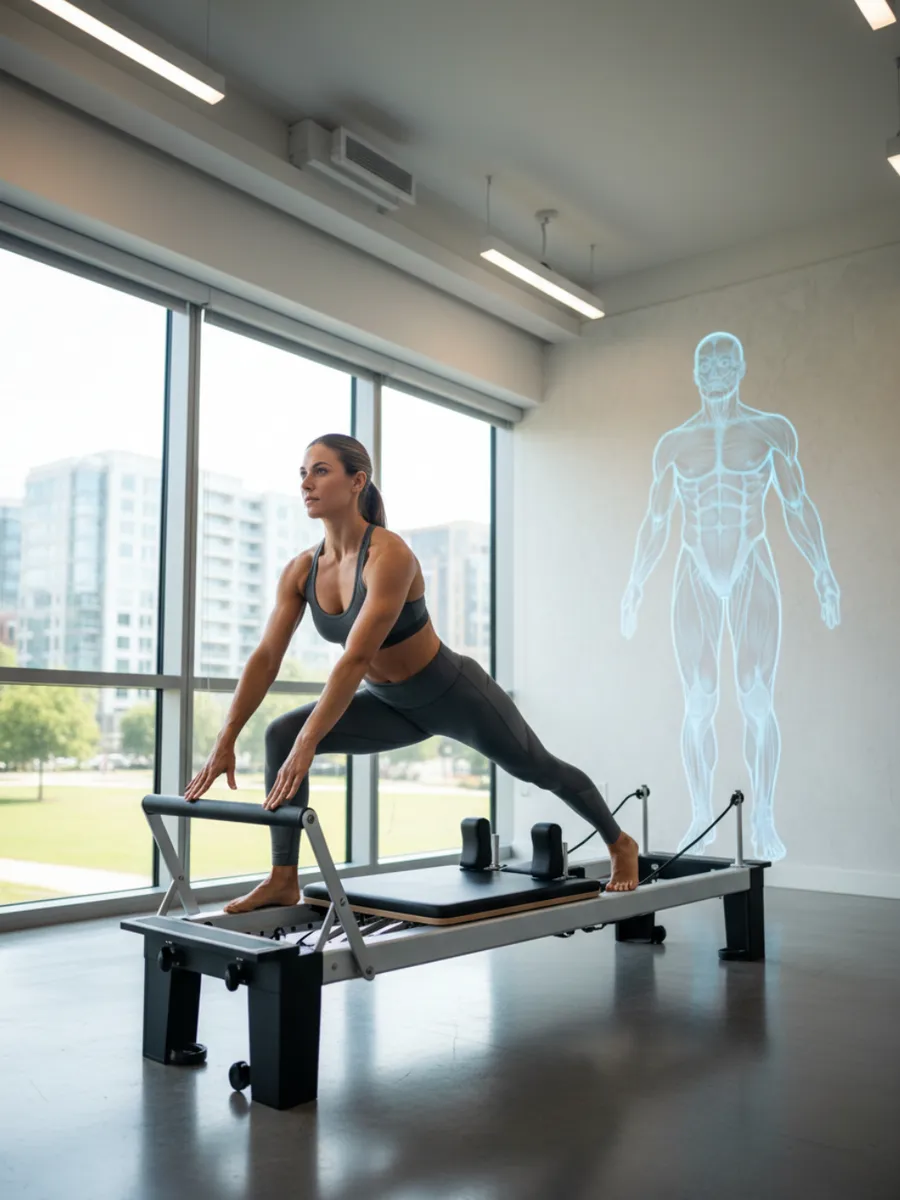
Ever seen a 'workout bed' with springs? Discover how this machine transforms your body.
Prompted by A NerdSip Learner
Master the fundamentals of Reformer mechanics and core control.
Welcome to the world of Reformer Pilates! At first glance, the Reformer looks a bit like a bed frame, but it’s actually a sophisticated piece of equipment designed to add resistance and support to your movements. The most important part is the carriage, the flat platform you sit, stand, or lie on.
The carriage is attached to a set of springs and slides back and forth on wheels within the frame. By using your own body weight and the tension of those springs, you create a workout that is low-impact but incredibly high-intensity. You’ll also find straps with loops for your hands or feet, which allow for a massive range of motion.
Because the carriage moves, your body has to work overtime to stay balanced. This engages those deep, tiny stabilizer muscles that you might miss in a traditional gym workout. It’s all about finding stability in the middle of the motion!
Key Takeaway
The Reformer uses a sliding carriage and adjustable springs to build strength and stability through controlled movement.
Test Your Knowledge
What is the name of the sliding platform that you sit or lie on during a Reformer workout?
The 'engine' of the Reformer is the spring system. Unlike gym machines where more weight always equals 'harder,' Pilates springs are color-coded to represent different levels of tension. A heavy spring (usually red) provides more resistance for leg work, helping you build powerful muscles.
However, here is the secret: lighter springs (usually blue or yellow) can actually be much harder for certain exercises! When the spring tension is light, the carriage becomes very 'tippy' and unstable. This forces your core to fire up immediately to keep you from sliding out of control. It’s a total brain-to-body connection.
Whether you are pushing against the footbar or pulling the straps, the springs provide constant tension. This means your muscles are working during both the 'push' and the 'return' phase of every single move, making your workout twice as efficient.
Key Takeaway
Spring tension provides both resistance to build muscle and a lack of stability to challenge your core.
Test Your Knowledge
Why might a Pilates instructor give you a 'lighter' spring for a core exercise?
In Pilates, everything starts from the Powerhouse. This isn't just your six-pack muscles; it includes your deep abdominals, lower back, pelvic floor, and hips. On the Reformer, we focus on eccentric contraction, which is a fancy way of saying we strengthen the muscle while it is lengthening.
Precision is more important than speed. Instead of doing 50 fast reps, you might do 10 very slow, controlled movements. You want to move with flow, transitioning smoothly from one exercise to the next without slamming the carriage into the 'home' position. This control protects your joints while creating long, lean muscle tone.
By focusing on your breath—exhaling on the exertion—you oxygenate your blood and keep your movements fluid. This mind-body connection is what makes Pilates different from just 'lifting weights.' You leave the session feeling taller, stronger, and more centered.
Key Takeaway
Pilates focuses on the 'Powerhouse' and controlled, lengthening movements rather than fast repetitions.
Test Your Knowledge
What does 'eccentric contraction' refer to in a Pilates workout?
Track your progress, earn XP, and compete on leaderboards. Download NerdSip to start learning.