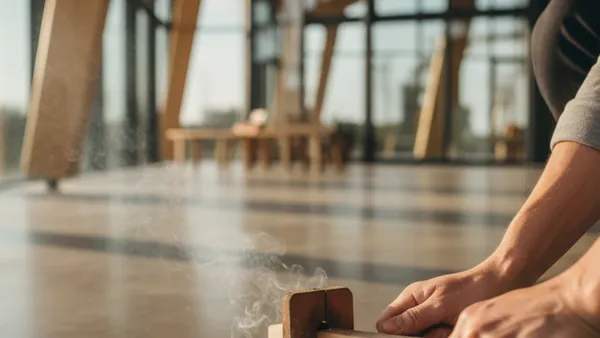
Could you survive a night in the cold using only the power of friction?
Prompted by A NerdSip Learner
Discover the physics and mechanics behind creating fire with nothing but wood and effort.
Start with the basics. Rubbing two sticks together sounds incredibly simple, but it relies on fundamental physics. When you aggressively rub wood against wood, you are converting kinetic energy (your physical movement) into thermal energy (heat) through the power of friction.
To create a fire, you need three elements: heat, fuel, and oxygen. This is commonly known as the fire triangle. In primitive fire-making, friction provides the initial heat. As the pieces of wood grind together, they break down and create a fine, dark wood dust. This dust acts as the perfect initial fuel.
The goal isn't to create a flame directly from rubbing—a common misconception. Instead, your objective is to generate enough heat to raise the temperature of the wood dust to its ignition point, which is typically around 800 degrees Fahrenheit (approx. 430 degrees Celsius) for most woods. Once that dust begins to smolder continuously, you have successfully birthed a coal!
Key Takeaway
Friction fire relies on converting kinetic energy into thermal energy to heat fine wood dust until it smolders into a coal.
Test Your Knowledge
What is the direct goal of rubbing wood together in friction fire making?
Not just any sticks will do. The secret to a successful friction fire lies heavily in selecting the perfect materials. You generally want to look for dead, dry softwood for both the spindle (the moving part) and the hearth board (the base).
Why softwood? Hardwoods like oak or maple are dense and require far too much energy to grind down and heat up. Softwoods, on the other hand, create friction dust much faster. Great choices in the wild include cedar, willow, cottonwood, and yucca.
A good rule of thumb in the field is the "thumbnail test." If you press your thumbnail firmly into the wood and it leaves a slight dent, it is likely soft enough. However, the wood must be bone dry. Even a small amount of internal moisture will absorb your hard-earned heat (as the energy goes into boiling the water rather than heating the dust), preventing ignition.
Key Takeaway
Successful friction fires require dead, dry softwoods that easily grind into combustible dust.
Test Your Knowledge
What is the primary purpose of the "thumbnail test" when selecting wood?
The hand drill is the most primitive and minimalist of all friction fire techniques. It requires only two pieces of wood: a long, straight spindle and a flat hearth board.
To use this method, you place the tip of the spindle into a small indentation on the hearth board. By rapidly rolling the spindle between your open palms and pressing downward, you generate friction at the base. As you press down, your hands will inevitably slide down the spindle. You must then quickly move them back to the top without letting the spindle stop, to avoid losing precious heat.
While mechanically simple, the hand drill is incredibly physically demanding. It requires massive endurance, tough hands, and excellent technique. Because you rely entirely on the downward pressure and speed of your bare hands, mastering the hand drill is widely considered a top-tier survival skill.
Key Takeaway
The hand drill uses just a spindle and hearth board, relying entirely on the user's hand speed and downward pressure.
Test Your Knowledge
Why is the hand drill considered highly demanding compared to other methods?
If the hand drill relies on brute endurance, the bow drill relies on mechanical advantage. This brilliant ancient invention allows you to spin the spindle much faster and with significantly greater downward pressure, saving your hands and your energy in the process.
The bow drill setup features four main components: the spindle, the hearth board, a bearing block (a piece of wood or stone used to hold the top of the spindle), and a bow with a taut string.
By wrapping the bowstring once around the spindle, you can push and pull the bow back and forth. This linear motion translates into rapid, continuous rotation of the spindle. The bearing block protects your hand while allowing you to apply heavy downward pressure onto the hearth board. This mechanical efficiency makes the bow drill one of the most reliable friction fire methods in survival situations.
Key Takeaway
The bow drill uses a bow and string to provide a mechanical advantage, allowing for faster spindle rotation and greater pressure.
Test Your Knowledge
Which component of the bow drill protects the user's hand while allowing them to apply downward pressure?
Not all friction fires involve spinning a stick. The fire plow, heavily associated with traditional Polynesian fire-making, uses linear friction to build heat rather than rotational friction.
Instead of a spinning spindle, the fire plow requires a blunt hardwood stick and a grooved softwood baseboard. The user grips the stick with both hands, places it into the groove at a sharp angle (roughly 45 degrees), and aggressively rubs it back and forth along the track.
As the stick plows through the groove, it sheds tiny fibers of wood that collect at the far end of the track. The rapid, continuous plowing creates intense heat in that expanding pile of dust. While it sounds conceptually straightforward, it requires immense upper-body strength, heavy pressure, and brief, explosive bursts of energy to reach ignition temperature.
Key Takeaway
The fire plow generates heat through aggressive, linear rubbing back and forth in a grooved baseboard.
Test Your Knowledge
How does the fire plow differ mechanically from the bow drill and hand drill?
No matter which friction method you use, the immediate goal is exactly the same: creating a hot coal. This magic happens through a carefully carved feature called the "notch."
On a hearth board, you cut a V-shaped notch directly into the side of the indentation where the friction occurs. As you drill or plow, the charred, super-heated wood dust falls into this notch. The notch acts as a crucial collection zone, keeping the dust tightly packed together so it can insulate itself and retain heat.
When the temperature reaches the critical ignition point, the pile of dark brown dust will begin to smoke continuously on its own, even after you stop rubbing. You have successfully created an ember! To protect it, survivalists often place a dry "catch leaf" or piece of bark under the notch to easily transport the fragile coal to the next stage.
Key Takeaway
A V-shaped notch collects the super-heated wood dust, allowing it to condense and reach its ignition point to form a coal.
Test Your Knowledge
What is the primary purpose of the V-shaped notch on a hearth board?
You have a glowing red coal, but you don't have a fire just yet. The final, crucial step is transferring that fragile ember into a prepared tinder bundle and nurturing it into a life-saving flame.
A tinder bundle is a nest made of the finest, driest, most flammable materials you can find—like crushed dry grass, shredded inner bark, or cattail fluff. You carefully drop the hot coal into the center of this nest and gently wrap the tinder around it, being careful not to crush the ember.
Now, you introduce the final element of the fire triangle: oxygen. By blowing smoothly and steadily into the bundle from your diaphragm, you feed oxygen to the coal, causing its heat to rapidly expand throughout the nest. The smoke will thicken and often turn a yellow-brown hue right before the bundle suddenly bursts into beautiful flames! You've successfully made fire from nothing but wood.
Key Takeaway
The final step of friction fire is transferring the coal into a dry tinder bundle and providing steady oxygen until it bursts into flames.
Test Your Knowledge
What visual cue often indicates that a tinder bundle is about to burst into flame?
Track your progress, earn XP, and compete on leaderboards. Download NerdSip to start learning.