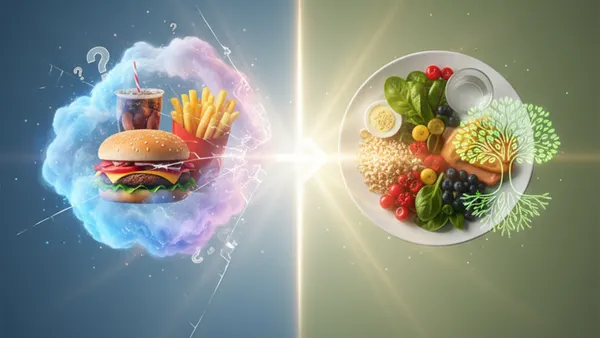
Is 'fat-free' just a sugar trap in disguise?
Prompted by NerdSip Explorer #3276
Master the biological truths about carbs, fats, and proteins for better health.
Welcome to your nutritional reality check! For decades, fat was painted as the ultimate enemy of a fit body. Suddenly, supermarket shelves were flooded with tempting "fat-free" or "low-fat" labels.
But here’s the catch: fat is a natural and essential flavor carrier. When you strip fat from yogurt or dressing, it often ends up tasting bland. To fix this, the food industry came up with a simple but sneaky solution. To compensate for the loss of flavor, they added massive amounts of sugar.
In reality, a "fat-free" product is often just a hidden sugar bomb. Biologically, fat doesn’t automatically make you fat. Weight gain is caused by a calorie surplus. When you eat hidden sugars, your insulin levels spike, signaling your body to store that extra energy as body fat immediately.
Key Takeaway
"Fat-free" usually means the fat was replaced with high amounts of sugar to maintain taste.
Test Your Knowledge
Why do "fat-free" processed foods often contain so much sugar?
Carbohydrates are your body’s preferred fuel source, especially for your brain and during high-intensity activity. However, not all carbs are created equal when they enter your system.
We generally distinguish between simple and complex carbohydrates. Simple carbs—found in sugar, white bread, or sweets—are broken down into glucose lightning-fast. They flood your blood, giving you a quick energy spike followed by a massive insulin release. The result? A sudden sugar crash and intense cravings.
Complex carbs, found in whole grains, oats, and vegetables, come with their own "brakes": fiber. This fiber ensures that carbs are digested slowly and released into the bloodstream gradually. Your blood sugar stays stable, providing long-lasting energy and keeping you feeling full for much longer.
Key Takeaway
Complex carbs provide steady energy through fiber, while simple carbs cause blood sugar crashes.
Test Your Knowledge
What ensures that energy from complex carbs is released slowly into the blood?
It’s time to apologize to dietary fats. Long demonized, we now know they are vital for our biology. In fact, nearly 60 percent of the human brain is actually made of fat!
Fats are incredibly energy-dense, providing about twice as many calories per gram as carbs or protein. But they serve critical roles: without fats, your body cannot absorb essential vitamins like A, D, E, and K. Moreover, fats are the building blocks for vital hormones, including testosterone and estrogen.
The key is quality. Unsaturated fats from olive oil, nuts, avocados, and fatty fish are excellent for your heart and arteries. You should be more cautious with artificial trans fats, often found in fried or highly processed foods, as these can promote inflammation throughout the body.
Key Takeaway
Fats are essential for hormone balance, brain health, and vitamin absorption.
Test Your Knowledge
Which vitamins strictly require fat to be absorbed by the body?
When people think of protein, they often picture bodybuilders and massive muscles. But proteins are essential for everyone, regardless of your fitness level or athletic goals.
Proteins consist of amino acids, which your body needs constantly to repair tissue, build new cells, and maintain a strong immune system. Even enzymes and hair are mostly made of protein. If you don't eat enough, your body might even break down its own muscle mass to access these vital building blocks.
Additionally, protein has a brilliant side effect: it is the most satiating macronutrient. Your body also uses a lot of energy just to digest it. A significant portion of protein calories is burned off immediately through a process called "dietary-induced thermogenesis."
Key Takeaway
Protein builds muscles and cells while keeping you full and boosting your metabolic rate.
Test Your Knowledge
Which macronutrient is the most filling and uses the most energy to digest?
"A calorie is a calorie"—you hear this often regarding weight loss. Physically speaking, it's true; a calorie is simply a unit of energy. However, our biology is not a simple furnace.
Imagine drinking 200 calories from a large sugary soda. These calories flood your system without any nutrients, spiking insulin and telling your body to store fat. Shortly after, the sugar crash triggers hunger again.
Now, take the same 200 calories in the form of almonds or broccoli. Something entirely different happens. Vitamins, minerals, and fiber are processed, blood sugar remains stable, and "fullness" signals are sent to your brain. Your body’s hormonal response to food determines how that energy is used or stored.
Key Takeaway
While a calorie is physically a calorie, different foods trigger vastly different hormonal responses.
Test Your Knowledge
Why do 200 calories of soda act differently than 200 calories of almonds?
A persistent myth claims that eating carbs after 6 PM makes you gain weight. Many believe the body shuts down digestion at night and immediately converts everything into fat.
The biological reality is different. Your metabolism doesn't have an alarm clock that switches to "fat storage mode" at 6 PM. Whether you gain or lose weight depends primarily on your total calorie balance over the day. If you are in a calorie surplus, you gain weight—no matter what time you ate.
So why does the myth persist? In practice, late-night eating often means sitting tired on the couch and mindlessly snacking on high-calorie treats like chips or chocolate. Skipping late meals often helps people cut out these extra calories, leading to weight loss.
Key Takeaway
Meal timing is less important for weight gain than the total amount of calories you consume.
Test Your Knowledge
What is the main reason avoiding late-night meals often helps with weight loss?
Low-carb, low-fat, Keto, Paleo—the list of diet trends is endless. Many promise to be the "one true way" to a perfect body. But looking at science and evolution, we see that our bodies are masters of adaptation.
There is no single perfect diet for everyone. Some people feel energized with more carbs, while others function better with a higher intake of healthy fats. The most important thing is that your body receives enough essential building blocks: proteins, healthy fats, vitamins, and minerals.
The biggest factor for success isn't a fancy name, but sustainability. The biologically best diet is always the one that doesn't feel like a chore—one you can integrate into your daily life with joy, balance, and consistency.
Key Takeaway
Long-term success comes from a nutrient-dense diet that fits your individual lifestyle.
Test Your Knowledge
Biologically, what is the most important factor for a successful diet?
Track your progress, earn XP, and compete on leaderboards. Download NerdSip to start learning.