How did a 1980s sci-fi movement predict the internet, AI, and corporate dystopia?
Prompted by NerdSip Explorer #6116
Trace the evolution of cyberpunk from rebellious fiction to our modern reality.
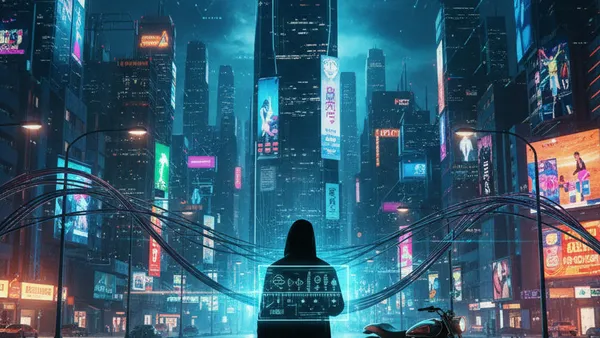
Welcome to the neon-drenched, rain-slicked streets of cyberpunk! As a subgenre of science fiction, cyberpunk explores a very specific vision of the future: one where advanced technology collides with societal collapse.
The golden rule of cyberpunk can be summarized in just four words: "High tech, low life." While humanity might have flying cars, artificial intelligence, and cybernetic limbs, society itself is deeply fractured. Wealth is hoarded by ruthless megacorporations, while ordinary people scrape by in gritty, overcrowded slums.
Unlike the shiny, optimistic utopias of early sci-fi, cyberpunk is deeply pessimistic. It asks a chilling question: What happens when technology evolves faster than our human morality?
Whether you're dodging corporate assassins or hacking into virtual mainframes, cyberpunk isn't just about cool aesthetics—it's a warning about unchecked corporate power and the loss of our shared humanity.
Key Takeaway
Cyberpunk is a sci-fi subgenre defined by the stark contrast between highly advanced technology and a decaying, oppressive society.
Test Your Knowledge
Which phrase best summarizes the core theme of cyberpunk?
Before "cyberpunk" was even a word, the seeds of the genre were planted by a visionary and deeply paranoid author named Philip K. Dick. Writing in the 1960s and 70s, Dick was obsessed with the fragile nature of reality and what it truly means to be human.
His 1968 novel, *Do Androids Dream of Electric Sheep?*, is widely considered the ultimate proto-cyberpunk text. It introduced readers to a post-apocalyptic Earth where humans are practically indistinguishable from synthetic androids.
Dick's work shifted science fiction away from distant galaxies and alien invasions. Instead, he turned the lens inward, focusing on mind-altering drugs, corporate control, and technological alienation.
While he didn't live to see the peak of the cyberpunk movement in the 1980s, his DNA is woven into everything from *The Truman Show* to *The Matrix*. He proved that the most terrifying dystopias are the ones happening right inside our own heads.
Key Takeaway
Philip K. Dick laid the philosophical foundation for cyberpunk by exploring themes of paranoia, artificial humanity, and fractured reality.
Test Your Knowledge
How did Philip K. Dick's writing differ from traditional early science fiction?
If Philip K. Dick provided the philosophical soul of cyberpunk, director Ridley Scott gave it its iconic visual aesthetic. In 1982, Scott adapted Dick's novel into the cinematic masterpiece, *Blade Runner*.
Starring Harrison Ford, the film introduced audiences to a dystopian, neon-lit Los Angeles in the futuristic year of... 2019. It combined the cynical, shadow-heavy style of classic film noir with futuristic elements like towering video billboards, endless acid rain, and synthetic humans called replicants.
At the time, *Blade Runner* was a box-office disappointment. Audiences were expecting a fun, action-packed space adventure, not a slow, brooding meditation on mortality and corporate greed!
However, its influence became inescapable. *Blade Runner* single-handedly established the "look" of cyberpunk. Every rain-swept sci-fi cityscape with glowing neon signs that you see today owes its existence to this cinematic pioneer.
Key Takeaway
The 1982 film Blade Runner established the definitive visual aesthetic of cyberpunk by blending futuristic technology with gritty film noir.
Test Your Knowledge
Which classic cinematic style heavily influenced the visual and thematic tone of Blade Runner?
By the early 1980s, a new generation of sci-fi writers was emerging. They were raised on computers, punk rock, and the anxieties of the Cold War. But this gritty new literary movement still didn't have a name.
Enter author Bruce Bethke. In 1980, he was writing a short story about a gang of rebellious, tech-savvy teenagers who hacked computers to cause trouble. When brainstorming a title, he wanted a word that mashed up the concepts of technology and youth rebellion.
Bethke took the prefix "cyber" (from cybernetics) and smashed it together with "punk." The story, simply titled *Cyberpunk*, was published in 1983.
While the story itself isn't the most famous work in the genre, the title caught on like wildfire. Editors and critics quickly began using the term to describe this entire wave of edgy, anti-authoritarian science fiction. The beast finally had a name!
Key Takeaway
Author Bruce Bethke coined the term "cyberpunk" in 1980 to describe the fusion of advanced technology and rebellious youth culture.
Test Your Knowledge
Why did Bruce Bethke create the word "cyberpunk"?
In 1984, the cyberpunk genre officially exploded into the mainstream with the publication of *Neuromancer* by William Gibson. It is widely regarded as the ultimate masterpiece of the movement.
The story follows Case, a washed-up, drug-addicted computer hacker hired for one last impossible heist. But what makes *Neuromancer* revolutionary isn't just the plot—it's the vocabulary.
Gibson, who famously wrote the book on a manual typewriter and knew very little about actual computers, coined the term "cyberspace." He envisioned it as a "consensual hallucination," a virtual reality data network that humans could literally plug their brains into.
*Neuromancer* practically predicted the modern internet long before it existed. It won the "Triple Crown" of science fiction awards and permanently cemented the tropes of hackers, rogue AI, and cyberspace in global pop culture.
Key Takeaway
William Gibson's 1984 novel Neuromancer popularized the genre and coined the term "cyberspace."
Test Your Knowledge
What groundbreaking concept did William Gibson name and define in Neuromancer?
As the 1980s progressed, cyberpunk went from a loose collection of novels to a unified literary movement. The man who arguably organized this rebellion was author and editor Bruce Sterling.
In 1986, Sterling edited *Mirrorshades: The Cyberpunk Anthology*, a collection of short stories by the genre's top writers. In his famous preface, Sterling acted as the movement's spokesperson, declaring that cyberpunk was the definitive voice of the 1980s.
The anthology's title came from the mirrored sunglasses that became the unofficial uniform of cyberpunk characters. Mirrorshades were highly symbolic: they reflected the glare of computer screens, hid the eyes (and emotions) of the wearer, and looked undeniably cool.
This era established cyberpunk as a legitimate cultural force. It wasn't just about predicting technology; it was a punk-rock critique of Reagan-era consumerism, globalization, and the dawn of the Information Age.
Key Takeaway
The 1986 Mirrorshades anthology united cyberpunk writers and solidified the genre as a cohesive, rebellious literary movement.
Test Your Knowledge
What did the "mirrorshades" symbolize for the cyberpunk movement?
While American authors were defining cyberpunk in literature, Japan was dominating the genre in visual media. In the 1980s and 90s, Japan was undergoing a massive economic and technological boom, making it the perfect incubator for cyberpunk anxieties.
In 1988, Katsuhiro Otomo released the anime film *Akira*. Set in a rebuilt "Neo-Tokyo" after a devastating explosion, the film featured biker gangs, government conspiracies, and mind-bending psychic powers. Its fluid animation and gritty aesthetic took the world by storm.
Following *Akira* came *Ghost in the Shell* (1995). This masterpiece explored the philosophical implications of replacing human body parts with cybernetics. If your brain is just data in a mechanical "shell," do you still have a soul (a "ghost")?
These Japanese works deeply influenced Western creators. They proved that animation could be a serious, adult medium capable of tackling complex cyberpunk themes.
Key Takeaway
Japanese anime like Akira and Ghost in the Shell expanded cyberpunk into visual media, adding deep philosophical questions about humanity.
Test Your Knowledge
What philosophical question is central to the anime Ghost in the Shell?
By the early 1990s, critics started declaring that cyberpunk was dead. The real world was catching up to the fiction! The internet was becoming a reality, and the genre needed a fresh injection of energy.
Enter Neal Stephenson and his 1992 novel, *Snow Crash*. This book took traditional cyberpunk tropes and pushed them to satirical, almost absurd extremes. In this world, the US government has collapsed, and society is run by pizza delivery mafias and corporate franchises.
More importantly, *Snow Crash* introduced the concept of the Metaverse—a massive, shared virtual reality environment where people interacted via digital avatars.
Stephenson's vision was so compelling that it directly influenced real-world tech billionaires. The creators of Google Earth, Second Life, and modern virtual reality all cite *Snow Crash* as a foundational inspiration for their real-world technology.
Key Takeaway
Neal Stephenson's Snow Crash revitalized cyberpunk by introducing satirical elements and popularizing the concept of the Metaverse.
Test Your Knowledge
What major virtual reality concept was introduced in Neal Stephenson's Snow Crash?
In 1999, the ultimate culmination of cyberpunk cinema hit the big screen: *The Matrix*. Directed by the Wachowskis, this film blended every major cyberpunk theme into an explosive pop-culture phenomenon.
*The Matrix* combined William Gibson's cyberspace, Philip K. Dick's reality-bending paranoia, and the breathtaking action of Japanese anime like *Ghost in the Shell*.
The film asks the ultimate cyberpunk question: What if our entire reality is just a computer simulation designed by machines to keep us docile? By choosing the "red pill," the protagonist Neo wakes up to the harsh, dystopian reality.
*The Matrix* brought cyberpunk aesthetics—leather trench coats, mirrored sunglasses, and green cascading computer code—into the global mainstream. It proved that the genre's themes of rebellion and virtual reality resonated deeply with millions of people entering the new millennium.
Key Takeaway
The Matrix successfully combined decades of cyberpunk literature and anime tropes into a massive pop-culture phenomenon.
Test Your Knowledge
In The Matrix, what does choosing the "red pill" symbolize?
Today, the line between cyberpunk fiction and reality has become terrifyingly blurred. As author William Gibson famously noted, "The future is already here—it's just not evenly distributed."
We now live in a world dominated by megacorporations that hold more data than governments. We carry powerful computers in our pockets, AI algorithms shape our reality, and billionaires are trying to build the Metaverse.
While the genre has evolved into offshoots like "post-cyberpunk" and "biopunk," the original aesthetic remains incredibly popular, as seen in the massive success of the video game *Cyberpunk 2077*.
Cyberpunk is no longer just a predictive sci-fi genre; it has become a mirror reflecting our current world. It reminds us that while technology will continue to advance at a breakneck pace, our most important fight is holding on to our humanity.
Key Takeaway
Cyberpunk is no longer just fiction; its predictions of corporate dominance, AI, and hyper-connectivity have become our modern reality.
Test Your Knowledge
According to the famous quote by William Gibson, what is true about the future?
Track your progress, earn XP, and compete on leaderboards. Download NerdSip to start learning.