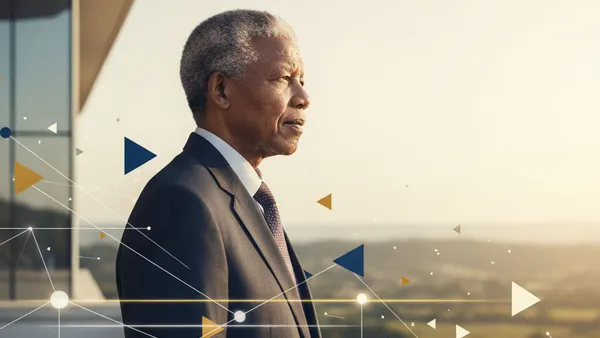
Who was the man who went from prisoner to president?
Prompted by NerdSip Explorer #5918
Understand Mandela's journey and enduring legacy.
Imagine a country where the law separates people by the color of their skin. This was apartheid in South Africa, a brutal system of institutionalized racial segregation. Into this world, Nelson Mandela was born. He wasn't born a revolutionary, but a young law student who witnessed injustice daily.
Seeing the deep inequality faced by Black South Africans, Mandela joined the African National Congress (ANC). This political party became the primary vehicle for opposing apartheid. At first, their methods were non-violent, inspired by leaders like Mahatma Gandhi.
However, as the government grew more violent and repressive, Mandela and the ANC began to believe that peaceful protest was not enough. This shift marked the beginning of a more intense and dangerous phase in his life, setting him on a direct collision course with the powerful apartheid state.
Key Takeaway
Nelson Mandela was a South African lawyer who became a leader in the fight against the racial segregation system known as apartheid.
Test Your Knowledge
What was the system of institutionalized racial segregation in South Africa that Mandela fought against?
For his activism against the government, Nelson Mandela was arrested. After a famous trial, he was sentenced to life in prison in 1964. He would spend the next 27 years behind bars, a period that would have broken most people, but only strengthened his resolve.
He spent 18 of those years at the infamous Robben Island prison, a harsh and isolated facility. Prisoners were forced into hard labor, like quarrying lime. Yet, even here, Mandela led. He organized political education classes for fellow inmates and became a symbol of defiance.
While he was locked away, his reputation grew. A massive international movement, with the slogan "Free Nelson Mandela!", put pressure on the South African government. Mandela had become the world's most famous political prisoner and a global symbol of the struggle for justice and human rights.
Key Takeaway
Mandela spent 27 years imprisoned for his anti-apartheid activities, becoming an international symbol of resistance during his incarceration.
Test Your Knowledge
Mandela's imprisonment became a global cause. What was the famous slogan of the movement to release him?
The world watched on February 11, 1990, as Nelson Mandela, then 71 years old, walked out of prison a free man. This incredible moment signaled that change was finally coming to South Africa. The apartheid government was buckling under the pressure of international sanctions and internal resistance.
But freedom from prison was just the beginning. Mandela immediately began the difficult work of negotiating an end to apartheid and creating a new, democratic South Africa. He worked with the country's last apartheid-era president, F.W. de Klerk, to dismantle the old system.
In 1994, South Africa held its first-ever democratic election in which all races could vote. The result was a landslide victory for the ANC, and Nelson Mandela became the country's first Black president. It was a triumphant moment, not just for South Africa, but for the entire world.
Key Takeaway
After his release, Mandela negotiated the end of apartheid and was elected South Africa's first democratic president in 1994.
Test Your Knowledge
What historic milestone did Nelson Mandela achieve in 1994?
After decades of oppression and suffering, many expected Mandela's government to seek revenge. Instead, he chose a radical and powerful path: reconciliation. His main goal was not to punish the white minority, but to unite a deeply divided nation.
One of his most significant initiatives was the Truth and Reconciliation Commission (TRC). This wasn't a court for revenge, but a place where victims of violence could share their stories and perpetrators could confess their crimes in exchange for amnesty. It was a painful but crucial process for national healing.
Mandela also cleverly used sports to foster unity. During the 1995 Rugby World Cup, he famously wore the jersey of the Springboks, the national team once beloved by white South Africans. By supporting the team, he sent a powerful message of forgiveness and shared national identity, helping to create a new "Rainbow Nation."
Key Takeaway
As president, Mandela prioritized forgiveness and reconciliation, using tools like the Truth and Reconciliation Commission to heal a divided South Africa.
Test Your Knowledge
What was the primary focus of Mandela's presidency?
Even after stepping down as president after one term, Mandela's work was far from over. Affectionately known as "Madiba" (a term of respect from his clan name), he became a global statesman and a moral compass for the world. He was a powerful voice for peace, human rights, and social justice.
He established the Nelson Mandela Foundation and dedicated his later years to philanthropy, focusing on rural development and the fight against HIV/AIDS, a major crisis in South Africa at the time. He continued to mediate conflicts and inspire leaders around the globe with his wisdom and humility.
For his incredible life's work, he was awarded the Nobel Peace Prize in 1993, alongside F.W. de Klerk. Today, his legacy endures as a powerful testament to the human spirit's capacity for forgiveness, resilience, and the relentless pursuit of freedom and equality for all.
Key Takeaway
Known affectionately as 'Madiba,' Mandela's influence continued globally after his presidency through philanthropy and peace advocacy.
Test Your Knowledge
What is the affectionate and respectful clan name often used for Nelson Mandela?
Track your progress, earn XP, and compete on leaderboards. Download NerdSip to start learning.