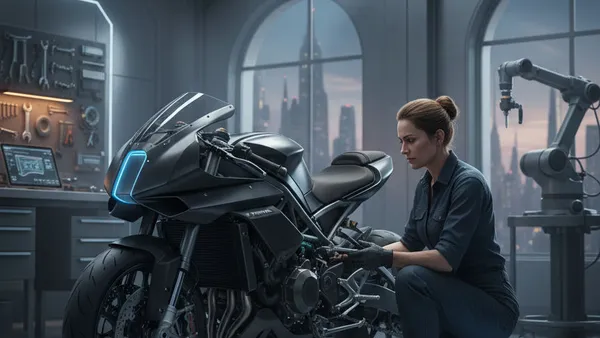
Ever wonder what's actually happening beneath your motorcycle seat?
Prompted by A NerdSip Learner
Understand the 5 core mechanical systems of motorcycles.
Most modern motorcycles use a four-stroke internal combustion engine. Think of it as an air pump that uses controlled explosions to generate power. The cycle consists of four distinct phases: Intake, Compression, Combustion, and Exhaust.
First, the piston moves down during the Intake stroke, pulling in a mixture of air and fuel. Next, the piston rises for the Compression stroke, squeezing that mixture into a tight, highly combustible space.
Then comes the magic: the spark plug fires, igniting the compressed gas. This explosion forces the piston down with immense pressure during the Combustion (or Power) stroke. This is the single stroke that actually generates your bike's forward momentum!
Finally, the piston rises again for the Exhaust stroke, pushing the burnt gases out through the exhaust pipe to make room for a fresh breath. This entire process happens thousands of times a minute inside the engine case.
Key Takeaway
A four-stroke engine generates power through a continuous cycle of intake, compression, combustion, and exhaust.
Test Your Knowledge
Which engine stroke is responsible for actually generating your motorcycle's forward momentum?
Before your engine can ignite anything, it needs the perfect ratio of air and fuel. For decades, this was handled by the carburetor, a mechanical device relying entirely on engine vacuum. As air rushes through a narrow tube in the carb, it creates a pressure drop that literally sucks fuel out of a bowl and into the engine.
However, carburetors can be finicky. They are sensitive to altitude, and temperature, and require manual tuning with small brass jets to get the mixture exactly right.
Today, most modern bikes use Electronic Fuel Injection (EFI). Instead of relying on mechanical vacuum, EFI uses a computer brain called the ECU (Electronic Control Unit). The ECU reads data from sensors monitoring air temperature, throttle position, and exhaust gases.
Based on these readings, the EFI system commands tiny, motorized injectors to spray the exact, mathematically perfect amount of fuel directly into the engine. This means smoother power, better efficiency, and reliable starting on cold mornings!
Key Takeaway
Carburetors use mechanical vacuum to mix air and fuel, while modern EFI uses computer-controlled sensors for highly precise fuel delivery.
Test Your Knowledge
What is the primary advantage of Electronic Fuel Injection (EFI) over older carburetors?
How does the violent energy of the engine reach the rear tire? It all starts at the clutch. The clutch is a pack of friction plates that connect and disconnect the engine from the transmission. When you pull the lever, you separate these plates, interrupting power so you can shift.
Next is the transmission, a gearbox filled with rotating cogs. Motorcycles typically use a sequential gearbox, meaning you have to click through the gears in a specific order (usually 1-N-2-3-4-5-6). Lower gears provide high torque for acceleration, while higher gears provide high speed at lower engine RPMs.
Finally, the power exits the transmission and hits the final drive. Most bikes use a chain and sprocket system—it's lightweight and efficient but requires regular cleaning and lubrication. Cruisers sometimes use a belt drive for a smoother, quieter ride, while heavy touring bikes often use an enclosed shaft drive, which is heavier but practically maintenance-free!
Key Takeaway
Power travels from the engine, through the clutch and sequential transmission, and finally reaches the rear wheel via a chain, belt, or shaft drive.
Test Your Knowledge
What is the mechanical purpose of pulling the clutch lever on your motorcycle?
Going fast is fun, but stopping reliably is what keeps you alive. Modern motorcycles rely on hydraulic disc brakes to scrub off speed. This system uses a special fluid to translate the pull of your lever into massive clamping force.
When you squeeze the front brake lever, it pushes a small piston inside the master cylinder. This forces brake fluid down through heavy-duty lines to the brake caliper mounted down by the wheel.
The fluid's pressure forces pistons inside the caliper to squeeze two friction pads against the brake rotor (the metal disc attached to the wheel). Because hydraulic fluid cannot be compressed, the physical force from your hand is multiplied exponentially, allowing you to stop a speeding, heavy machine with just two fingers!
Remember, the front brake provides roughly 70% of your total stopping power because the physics of deceleration shift the bike's weight drastically forward.
Key Takeaway
Hydraulic disc brakes use non-compressible fluid to multiply the force from your hand into massive clamping power at the wheel.
Test Your Knowledge
Why does a hydraulic braking system generate such immense clamping force?
A motorcycle's suspension does two critical jobs: it absorbs harsh bumps for a comfortable ride, and more importantly, it keeps the tires in constant contact with the road for vital traction.
The front suspension usually consists of telescopic forks, while the rear uses one or two shock absorbers. Both of these systems rely on two main components working together: springs and dampers.
The spring supports the bike's resting weight and absorbs the initial impact of a bump, compressing as the wheel goes up over a pothole. However, if you only had springs, the bike would bounce uncontrollably down the road like a pogo stick!
That's where the damper comes in. Damping uses internal oil forced through tiny valves to slow down and control the movement of the spring. It absorbs the kinetic energy of the bounce, ensuring the wheel returns to the pavement smoothly and stays firmly planted through tight corners.
Key Takeaway
Suspension systems use springs to absorb impacts and hydraulic damping to control the bouncing, keeping your tires glued to the asphalt.
Test Your Knowledge
What component of the suspension prevents the motorcycle from continually bouncing after hitting a bump?
Track your progress, earn XP, and compete on leaderboards. Download NerdSip to start learning.