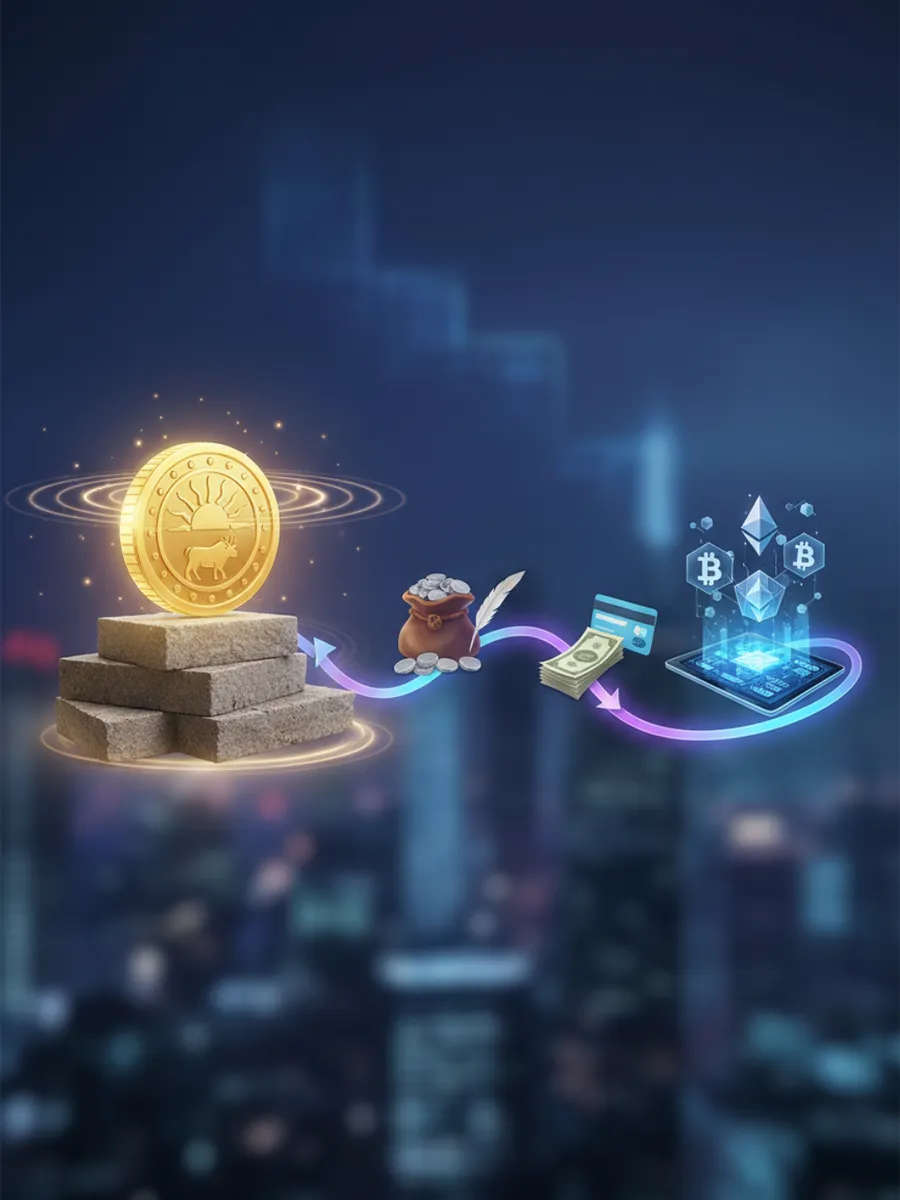
Is your money real, or just a collective historical illusion?
Prompted by A NerdSip Learner
Trace the evolution of value from gold to digital assets.
Imagine trying to buy a new house, but the seller only accepts live chickens as payment. You’d need a massive truck and a lot of patience! This was the problem with the barter system, where people traded goods directly. If the shoemaker didn't want your wheat, you couldn't get new boots. This is called the 'double coincidence of wants,' and it was a huge headache for early humans.
To solve this, society agreed on 'commodity money'—items that everyone valued, like salt, cattle, or cowrie shells. These were the first versions of currency. They were useful because they acted as a common language of value. Suddenly, you didn't need to find a shoemaker who loved wheat; you just needed to trade your wheat for shells, and then use those shells to buy your boots. Simple, right?
Key Takeaway
Money was invented to solve the logistical nightmare of trading distinct goods directly.
Test Your Knowledge
What was the main problem with the barter system described in the lesson?
As trade grew, carrying around bags of salt or shells became impractical. Enter metal coins! Gold and silver were durable, portable, and rare enough to hold value. But carrying heavy bags of metal was risky and exhausting. So, banks started a new system: you store your gold in a safe vault, and the bank gives you a paper receipt proving you own it.
This was the birth of the Gold Standard. For a long time, every paper dollar bill in your pocket was essentially a claim check. You could walk into a bank and swap that paper for a specific amount of actual gold. This gave people confidence because the paper money wasn't just paper; it represented a physical, shiny treasure locked away somewhere safe.
Key Takeaway
Under the Gold Standard, paper money was just a receipt that could be exchanged for actual gold.
Test Your Knowledge
Under the Gold Standard, what did paper money represent?
Fast forward to the 20th century. Economies were growing so fast that there literally wasn't enough gold in the world to back all the money needed for trade. It became a limit on growth. So, governments made a bold move: they severed the link between paper money and gold. We entered the age of Fiat Money.
'Fiat' is Latin for 'let it be done.' Basically, this money has value because the government says it does, and—crucially—because we all *trust* that it does. A $20 bill has no intrinsic value (it's just cotton and ink), but it works because the law says it must be accepted for debts. We moved from trusting shiny rocks to trusting the stability of our governments and economies.
Key Takeaway
Modern money (Fiat) has value based on government decree and public trust, not physical gold.
Test Your Knowledge
Why does Fiat money have value?
Once money wasn't tied to physical gold, it became much easier to turn it into pure information. In the last few decades, money has largely become digital. When you get paid, a truck doesn't dump cash at your house. Instead, a bank updates a database, moving numbers from your employer's column to yours.
This shift brought us credit cards, online banking, and instant transfers. It made buying things incredibly fast and convenient. Today, physical cash represents only a tiny fraction of the world's money. Most of your 'wealth' is actually just a secure entry on a bank's server. We trust these centralized institutions (banks) to keep the score correctly and not lose our data!
Key Takeaway
Most money today exists only as digital records managed by banks, not as physical cash.
Test Your Knowledge
In the modern digital era, what form does most money take?
We are now living through the next evolution: Cryptocurrency. Remember how we trust banks to keep our digital records straight? Cryptocurrencies like Bitcoin asked, 'What if we didn't need a bank?' Instead of a central company holding the ledger, crypto uses a technology called Blockchain.
Imagine a digital notebook that is shared by thousands of computers at once. Everyone can see the transactions, and once a page is written, it can never be erased or changed. This creates 'digital scarcity' without needing a middleman like a bank or government. While it can be volatile and risky, it represents a shift toward decentralized money—assets that live on the internet, controlled by code rather than corporations.
Key Takeaway
Cryptocurrency uses blockchain technology to create digital money that doesn't require a central bank.
Test Your Knowledge
What is the main difference between cryptocurrency and traditional digital banking?
Track your progress, earn XP, and compete on leaderboards. Download NerdSip to start learning.