Can you tell the difference between the Caribbean's hottest beats?
Prompted by NerdSip Explorer #5918
Master the origins and sounds of Soca and Dancehall.
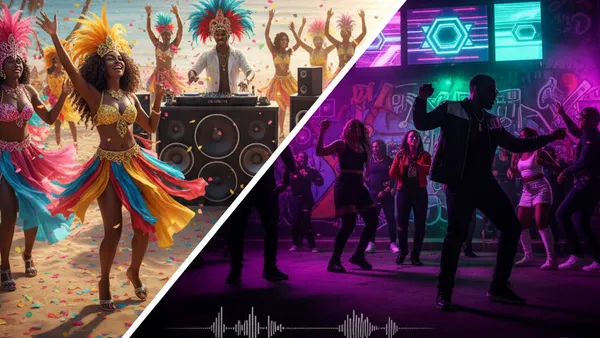
Imagine you are at a massive, vibrant party in the Caribbean. The tropical breeze is warm, the crowd is jumping, and the music is absolutely pumping. But depending on which island you are currently standing on, the heartbeat of that party might sound completely different!
Two of the absolute biggest musical exports from the Caribbean are Soca and Dancehall. While they both make you want to get up, grab a drink, and move your feet, they are essentially musical cousins from very different hometowns.
Soca music was born in the beautiful twin-island nation of Trinidad and Tobago. It is the ultimate festival music, carefully designed to fuel the massive, feather-filled street parades known as Carnival.
Dancehall, on the other hand, comes from the lush, mountainous island of Jamaica. It is deeply rooted in local street culture and underground dance clubs. Both of these incredible genres exploded onto the scene in the 1970s, but they took completely different paths to musical greatness!
Key Takeaway
Soca is the fast-paced Carnival music of Trinidad and Tobago, while Dancehall is the bass-heavy street music of Jamaica.
Test Your Knowledge
Where did Dancehall music originate?
Before Soca ever existed, there was Calypso—a rhythmic, heavily storytelling-based music famous in Trinidad and Tobago. But in the early 1970s, a visionary artist named Lord Shorty wanted to modernize the island's sound and unite its diverse populations.
Trinidad and Tobago has a deeply rich mix of African and East Indian heritage. Lord Shorty had a genius idea: he blended the classic Afro-Caribbean grooves of Calypso with traditional East Indian rhythms and instruments, like the *dholak* drum and the *sitar*.
He originally called this new, high-energy fusion the "Soul of Calypso," which was eventually shortened by the press to the catchy name Soca.
Today, Soca is incredibly fast-paced, often reaching upwards of 160 beats per minute! It is specifically engineered to make massive crowds jump, wave flags, and celebrate life. The lyrics almost always focus on pure joy, unity, and the magic of partying at Carnival.
Key Takeaway
Soca was invented by Lord Shorty in the 1970s by blending Afro-Caribbean Calypso with East Indian rhythms.
Test Your Knowledge
What does the word "Soca" originally stand for?
Meanwhile, over in Jamaica, the 1970s were largely dominated by the smooth, relaxed, and internationally famous vibes of Reggae music (think of the legendary Bob Marley). But as the decade came to a close, young people wanted something with a little more grit and a lot more bass.
Enter Dancehall. Named directly after the local community dance halls where people gathered to party, this new genre stripped away the large live bands. Instead, DJs played heavy, electronic beats while vocalists chanted, sang, or rapped over them in Jamaican Patois.
Compared to Soca's frantic, upbeat joy, Dancehall is generally slower, incredibly rhythmic, and intensely focused on the booming bassline.
While Soca lyrics are mostly about the joy of Carnival, Dancehall lyrics are raw and unfiltered. They act as a lyrical newspaper for the youth, covering everything from gritty street life and social issues to complex, show-stopping dance moves.
Key Takeaway
Dancehall evolved from reggae in Jamaica, featuring heavy basslines and raw lyrics about street culture.
Test Your Knowledge
How did Dancehall get its name?
Even though they sound quite different and come from islands hundreds of miles apart, Soca and Dancehall share some fascinating musical DNA!
First and foremost, they are both absolute pillars of Caribbean party culture. You simply cannot go to a Caribbean celebration, wedding, or club without hearing both genres booming from the speakers. They also both inspire their own unique, highly athletic dance styles.
But the absolute coolest similarity is how they are produced. Both of these genres rely heavily on a unique concept called the "riddim" (which is how the word "rhythm" is pronounced in the Caribbean, referring to the instrumental track).
In North America, one pop artist usually buys one beat. In the worlds of Soca and Dancehall, a producer will release a single catchy "riddim," and up to ten different famous artists will record their own unique song over that exact same instrumental background!
Key Takeaway
Both genres fuel Caribbean celebrations and uniquely share instrumental beats, known as "riddims," among multiple artists.
Test Your Knowledge
What is a "riddim" in Caribbean music?
If you want to start listening to Soca music right now, you need to know the modern heavy hitters who are taking the genre global!
The undisputed "King of Soca" is Machel Montano. He has been performing since he was a young child and continues to produce massive, stadium-filling hits that perfectly blend traditional Soca with global pop, hip-hop, and electronic dance music.
Another absolutely massive name is Kes (the charismatic frontman of Kes the Band). He is famous for pioneering "Groovy Soca," a slightly slower, incredibly catchy subgenre that feels exactly like a warm, relaxing Caribbean breeze.
You also cannot ignore the powerful women of Soca, who are often referred to as the Queens of Carnival! Superstar artists like Destra Garcia and Patrice Roberts dominate the airwaves year after year with powerhouse vocals, brilliant fashion, and unstoppable stage energy.
Key Takeaway
Superstars like Machel Montano, Kes, and Patrice Roberts are keeping the energy of Soca alive worldwide today.
Test Your Knowledge
Which modern artist is widely referred to as the "King of Soca"?
Track your progress, earn XP, and compete on leaderboards. Download NerdSip to start learning.