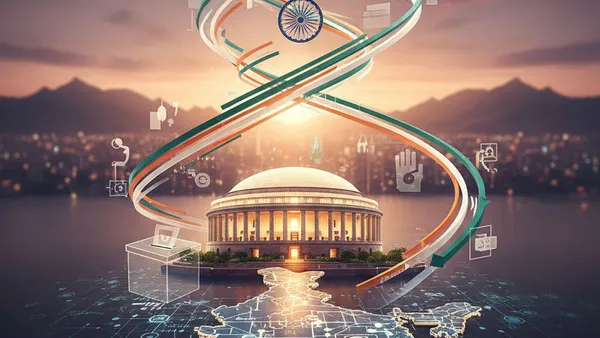
What invisible forces truly control the world's largest democracy?
Prompted by NerdSip Explorer #1206
Master India's complex constitutional mechanics.
Welcome back to the deep end of Indian democracy! You already know that the Parliament holds immense power. But what stops a majority government from rewriting the rulebook entirely? Enter the Basic Structure Doctrine.
In a landmark 1973 judgment known as the Kesavananda Bharati case, the Supreme Court of India drew a line in the sand. It ruled that while Parliament can amend the Constitution, it cannot destroy its fundamental identity—its 'basic structure.' This includes core principles like secularism, federalism, the rule of law, and the independence of the judiciary.
This doctrine acts as an invisible, invincible firewall. Even if a party wins every single seat in the Lok Sabha, they cannot legally dismantle the democratic framework. It is a uniquely Indian judicial innovation that keeps the immense power of the executive and legislative branches in check.
Key Takeaway
The Supreme Court acts as a constitutional shield against legislative overreach by protecting the 'Basic Structure' of the state.
Test Your Knowledge
What principle ensures Parliament cannot destroy the fundamental values of the Indian Constitution?
Have you ever wondered why Indian politicians sometimes get sequestered in luxury resorts right before a crucial legislative vote? Welcome to the high-stakes world of the Anti-Defection Law.
Added to the Constitution via the Tenth Schedule in 1985, this law was designed to cure the chaotic 'Aya Ram, Gaya Ram' culture of earlier decades, where lawmakers constantly switched allegiances for bribes or ministerial power. Under this law, if elected members defy their party whip or defect to another party, they can be instantly disqualified.
While it successfully curbed individual bribery, it created a new problem. It forces legislators to vote exactly as their party bosses demand, severely limiting individual dissent. Furthermore, because mass defections (mergers involving a large percentage of a party) are sometimes legally permissible, political engineers now orchestrate wholesale party splits, resulting in tense 'Floor Tests' where every single vote counts.
Key Takeaway
The Anti-Defection Law trades individual legislative freedom for party stability, heavily centralizing power in party leadership.
Test Your Knowledge
What is the primary consequence of the Anti-Defection Law (Tenth Schedule)?
Running the world's largest democracy is incredibly expensive. But where does the money come from? For years, campaign finance has been a fierce tug-of-war between pragmatism and transparency.
In 2017, the government introduced Electoral Bonds—bearer instruments that allowed individuals and corporations to donate unlimited, anonymous funds to political parties through official banking channels. The argument was that routing money through banks would clean up cash-based black money.
However, in a historic, unanimous verdict in February 2024, the Supreme Court struck down the entire scheme as unconstitutional. The Court ruled that corporate anonymity blatantly violated a voter's fundamental Right to Information. The ruling forced the disclosure of major corporate donors, throwing a spotlight on the intense, often opaque nexus between big capital and political machinery.
Key Takeaway
Transparency in political funding remains one of India's most fiercely contested legal and structural battlegrounds.
Test Your Knowledge
Why did the Supreme Court strike down the Electoral Bond scheme in 2024?
When discussing India's federal map, people often assume every state has the exact same constitutional relationship with the central government. This isn't quite true. India practices a nuanced system known as Asymmetric Federalism.
While the now-abrogated Article 370 dominated international headlines, the lesser-known Article 371 quietly grants specialized, tailored constitutional provisions to roughly a dozen states across the country.
For instance, Article 371A gives Nagaland special autonomy over customary law and land ownership, meaning national parliamentary laws on these specific issues do not apply there without the state assembly's consent. Similarly, special regional development boards are mandated for parts of Maharashtra and Gujarat. This flexibility allows the Indian Constitution to stretch and accommodate the incredibly diverse cultural, tribal, and economic realities of its regions without breaking.
Key Takeaway
India's federal structure is highly adaptable, granting tailored constitutional provisions to specific states to preserve diversity.
Test Your Knowledge
What does 'Asymmetric Federalism' refer to in the context of the Indian Constitution?
Perhaps the most explosive structural challenge looming over Indian politics is Delimitation—the redrawing of electoral boundaries and reallocation of parliamentary seats based on population.
Here is the ticking time bomb: The number of Lok Sabha seats per state has been frozen since the 1970s, based heavily on the 1971 census. This was done to prevent a bizarre incentive where states that successfully implemented family planning and controlled their population would accidentally *lose* political power at the national level.
This freeze is scheduled to be lifted after the first census post-2026. The tension is palpable. Southern states have successfully curbed their population growth, while Northern states have expanded massively. If seats are redistributed purely by current population data, the South faces a drastic reduction in its national political voice. How India resolves this demographic fault line will define the next century of its federation.
Key Takeaway
The upcoming unfreezing of electoral boundaries will severely test the balance of political power between North and South India.
Test Your Knowledge
Why was the allocation of parliamentary seats per state frozen based on historical census data?
Track your progress, earn XP, and compete on leaderboards. Download NerdSip to start learning.