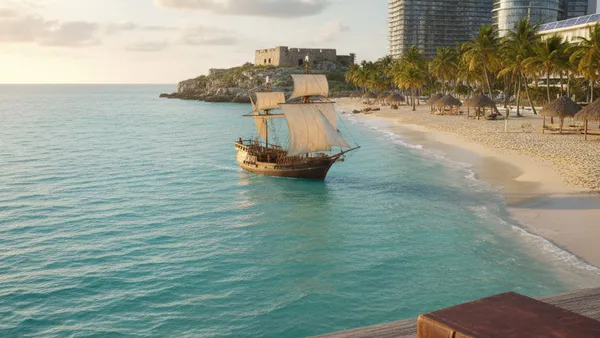
How did a pirate haven become a peaceful, independent island nation?
Prompted by NerdSip Explorer #6412
Grasp the key eras of Bahamian history.
Long before cruise ships and resorts, the Bahamas was home to the Lucayans, a peaceful branch of the Taino people. Arriving roughly around the year 500 AD, they journeyed across the ocean in large wooden canoes from South America.
The Lucayans were expert farmers and fishermen. They thrived in the warm climate, living in thatched-roof homes and cultivating crops like cassava, sweet potatoes, and cotton. Imagine a tight-knit, community-focused society living in total harmony with the sea.
By the time Europeans arrived, historians estimate there were tens of thousands of Lucayans spread across the islands. They had established a rich culture, completely unaware that their world was about to change forever. Their story is the true beginning of Bahamian history, laying the foundation for the island's deep connection to the ocean.
Key Takeaway
The original inhabitants of the Bahamas were the peaceful and resourceful Lucayan people.
Test Your Knowledge
Where did the Lucayans originally travel from before settling in the Bahamas?
In 1492, the world fundamentally shifted. Christopher Columbus made his first landfall in the Americas on a Bahamian island he called San Salvador. The Lucayans welcomed the newcomers, but this encounter marked the start of a tragic era.
The Spanish claimed the islands but decided not to build settlements there. Instead, they forced the Lucayans into harsh labor in the gold mines of Hispaniola (modern-day Haiti and the Dominican Republic) or into deep-sea pearl fisheries.
Tragically, within just a few decades, the entire Lucayan population was wiped out. A devastating combination of forced labor, exile, and exposure to new European diseases left the beautiful Bahamian islands completely unpopulated. For over a century after this, the islands sat virtually empty, waiting for the next chapter in their story to begin.
Key Takeaway
Columbus's arrival in 1492 led to the tragic exploitation and total disappearance of the native Lucayan population.
Test Your Knowledge
Why did the Spanish primarily remove the Lucayans from the Bahamas?
After sitting empty for over a century, the Bahamas welcomed new residents in 1648. A group of English Puritans called the Eleutheran Adventurers arrived in search of religious freedom. They faced harsh conditions and starvation, but they managed to establish the first permanent European settlement.
By the late 1600s, the islands' shallow waters and hidden coves attracted a very different crowd: Pirates. Nassau became the ultimate pirate haven! Famous outlaws like Blackbeard and Mary Read ruled the town, essentially creating a 'Republic of Pirates.' It was the wild west of the Caribbean.
This chaotic era finally ended in 1718 when Britain sent a former privateer named Woodes Rogers to serve as the first Royal Governor. He offered the pirates a simple choice: accept a royal pardon or hang. Order was restored, and the pirate era faded into legend.
Key Takeaway
The Bahamas transitioned from a struggling Puritan settlement to a notorious pirate haven before Britain restored order in 1718.
Test Your Knowledge
Who was Woodes Rogers?
The late 1700s brought another massive wave of change. Following the American Revolution, thousands of British Loyalists—colonists who had stayed loyal to the King—fled the newly formed United States and settled in the Bahamas.
These Loyalists didn't come alone. They brought their wealth, their plantation culture, and thousands of enslaved African people. This completely transformed the demographics of the islands. The African population quickly outnumbered the European settlers, bringing rich cultural traditions, music, and resilience that fundamentally shaped modern Bahamian identity.
The harsh reality of plantation slavery lasted for decades, but the rocky soil of the Bahamas meant large cotton plantations eventually failed. Finally, in 1834, slavery was officially abolished throughout the British Empire. Emancipation Day remains a deeply meaningful and joyous celebration in the Bahamas today.
Key Takeaway
American Loyalists brought thousands of enslaved Africans to the Bahamas, profoundly shaping its modern culture and demographics until emancipation in 1834.
Test Your Knowledge
What major event caused the Loyalists to flee to the Bahamas?
Entering the 20th century, the Bahamas was still a British colony, but it was beginning to find its own voice. During American Prohibition in the 1920s, the islands enjoyed a massive economic boom simply by smuggling rum into the US!
Soon after, the invention of modern air travel transformed the Bahamas into a premier tourist destination. People from all over the world flocked to enjoy the stunning beaches and vibrant local culture. But more importantly, the Bahamian people were ready to govern themselves.
Led by figures like Sir Lynden Pindling, the nation pursued self-rule. On July 10, 1973, the Bahamas peacefully gained full independence from Great Britain. Today, it remains a proud, sovereign nation within the Commonwealth, known globally not just for its breathtaking beauty, but for its resilient and joyful people.
Key Takeaway
The Bahamas evolved into a thriving tourist destination and peacefully gained its independence from Great Britain in 1973.
Test Your Knowledge
How did the Bahamas finally gain its independence?
Track your progress, earn XP, and compete on leaderboards. Download NerdSip to start learning.