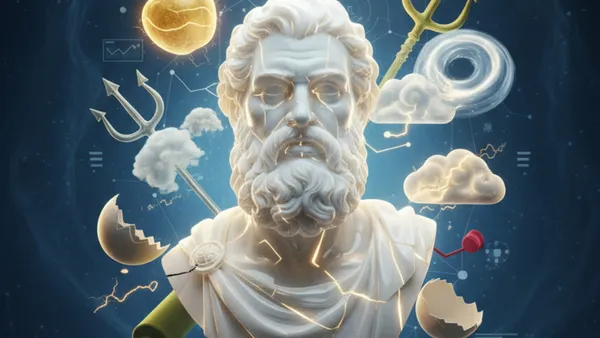
Did you know Zeus wasn't originally the top god, and his family tree is a tangled web of drama?
Prompted by NerdSip Explorer #3444
Dive into the chaotic family trees and unexpected origins of the Olympians.
The Greek universe didn't start with an all-powerful being saying 'let there be light.' It started with *Chaos*, which wasn't 'messiness' as we think of it today, but a gaping, infinite void. From this nothingness emerged the Primordial deities: Gaia (the Earth), Tartarus (the Underworld), and Eros (Desire).
These entities weren't human-like gods with personalities; they were literal building blocks of reality. Gaia didn't just *control* the earth; she *was* the earth. Without a partner, she gave birth to Ouranos (the Sky), who then covered her, beginning the very first chaotic family tree.
Ouranos and Gaia had children, but Ouranos hated them. He shoved his monstrous kids back inside the earth, causing Gaia immense pain. This set the stage for the first cosmic rebellion and proved that Greek mythology was going to be an endless cycle of terrible parenting.
Key Takeaway
Greek mythology began with a gaping void called Chaos, followed by literal manifestations of nature like Gaia (Earth) and Ouranos (Sky).
Test Your Knowledge
What did the word 'Chaos' originally mean in ancient Greek mythology?
Fed up with Ouranos shoving her children into the earth, Gaia plotted a gruesome revenge. She created a giant flint sickle and asked her children, the Titans, for help. Only the youngest, Cronus, was brave (or ambitious) enough to step up.
When Ouranos came down to cover the earth, Cronus ambushed his father and castrated him. He tossed the severed parts away, cementing his own position as the new ruler of the cosmos. But Cronus had inherited his father’s paranoia.
After marrying his sister Rhea, Cronus received a prophecy that his own child would overthrow him. His solution? Swallow his children whole as soon as they were born. Hestia, Demeter, Hera, Hades, and Poseidon all ended up trapped in their father's stomach, proving the apple didn't fall far from the primordial tree.
Key Takeaway
Cronus overthrew his father Ouranos but became a paranoid tyrant who swallowed his own children to prevent a prophecy.
Test Your Knowledge
How did Cronus attempt to prevent his children from overthrowing him?
Rhea, devastated by the loss of her children, hid her youngest son, Zeus, in a cave on the island of Crete. She tricked Cronus by handing him a rock wrapped in swaddling clothes, which he swallowed without a second thought.
Once grown, Zeus returned and poisoned Cronus, forcing him to vomit up his fully-grown siblings. This kicked off the *Titanomachy*, a brutal ten-year cosmic war between the new generation of gods (the Olympians) and the older Titans.
To gain the upper hand, Zeus freed the Cyclopes and the Hundred-Handers from the Underworld. In gratitude, the Cyclopes forged iconic weapons, including Zeus's famous thunderbolt. With this overwhelming firepower, the Olympians banished the Titans to Tartarus, and Zeus claimed the throne as the new king of the gods.
Key Takeaway
Zeus survived his father's cannibalism, freed his siblings, and won a 10-year war against the Titans with the help of the Cyclopes.
Test Your Knowledge
What did Rhea trick Cronus into swallowing instead of the infant Zeus?
If you read classical Greek myths, Zeus is unquestionably the big boss. But archaeological discoveries tell a completely different, mind-blowing story about the origins of these gods.
In the late Bronze Age, during the Mycenaean period (roughly 1600–1100 BCE), the ancient Greeks wrote on clay tablets using a script called Linear B. When historians translated these tablets, they found that *Poseidon*, not Zeus, was actually the chief deity!
In these ancient records, Poseidon is often referred to with the title *Wanax*, meaning 'King.' He wasn't just a sea god back then; he was a terrifying 'Earth-Shaker' connected to the underworld and earthquakes. Zeus appears on these tablets too, but as a secondary figure. It seems that as Greek culture shifted over the centuries, the little brother eventually stole the spotlight!
Key Takeaway
Archaeological evidence from Mycenaean Linear B tablets suggests Poseidon, not Zeus, was originally the chief god of the ancient Greeks.
Test Your Knowledge
What title was frequently given to Poseidon in Mycenaean Linear B tablets?
We often picture Aphrodite, the goddess of love and beauty, rising gracefully from a clam shell. But according to the poet Hesiod's *Theogony*, her origin story is more of a horror movie than a romantic comedy.
Remember when Cronus castrated his father Ouranos? He tossed those severed parts into the ocean. As they drifted through the water, a white foam began to gather around the immortal flesh. From this strange, bloody sea foam, Aphrodite was born!
In fact, the Greek word *aphros* literally means 'foam.' This violent origin highlights a core truth about how the ancient Greeks viewed love and passion: it wasn't just soft and sweet; it was a primal, uncontrollable force born from cosmic chaos and destruction.
Key Takeaway
According to Hesiod, Aphrodite was born from the sea foam created when Ouranos' severed parts were thrown into the ocean.
Test Your Knowledge
The Greek word 'aphros,' which inspired Aphrodite's name, translates to what?
Zeus learned from his father's mistakes, but he still inherited the family paranoia. When his first wife, Metis (goddess of wisdom), became pregnant, Zeus received a familiar prophecy: her second child would overthrow him.
Not wanting to repeat history by swallowing his kids, Zeus decided to swallow *Metis* instead, absorbing her wisdom entirely. Problem solved, right? Not quite. Months later, Zeus developed an agonizing headache.
The pain grew so unbearable that he ordered the smith god Hephaestus to crack his skull open with an axe. Out leaped Athena, fully grown and wearing battle armor. By absorbing Metis and giving birth to Athena himself, Zeus successfully broke the generational curse of sons overthrowing their fathers, cementing his eternal rule.
Key Takeaway
Zeus swallowed his pregnant wife Metis to avoid a prophecy, resulting in Athena being born fully armed from his cracked-open head.
Test Your Knowledge
Who cracked Zeus's skull open to relieve his headache, allowing Athena to be born?
If you thought the family tree couldn't get more tangled, enter Dionysus, the god of wine. His origins are so messy that he is often referred to as a 'twice-born' or even 'thrice-born' god, depending on which ancient tradition you follow.
In the Orphic mystery cults, Zeus first fathered a child named Zagreus with Persephone. Hera, insanely jealous, had the Titans tear the infant to pieces. Athena managed to save the child's heart, which Zeus then fed to a mortal woman named Semele.
Semele became pregnant, but after seeing Zeus in his true divine form, she burst into flames. To save the unborn baby, Zeus sewed the fetus into his own thigh, incubating him until he was ready to be born again as Dionysus. Thus, he survived dismemberment, incineration, and a thigh-pregnancy to become the life of the Olympian party!
Key Takeaway
Dionysus has the most chaotic origin of all, involving reincarnation from a preserved heart and being incubated inside Zeus's thigh.
Test Your Knowledge
To save the unborn Dionysus after his mother died, where did Zeus incubate him?
Track your progress, earn XP, and compete on leaderboards. Download NerdSip to start learning.