How did ancient African rhythms give birth to the world's most vibrant beats?
Prompted by NerdSip Explorer #5918
Understand the African roots of Caribbean music.
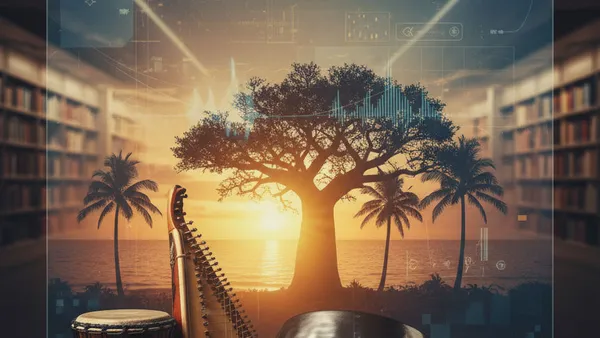
Imagine a lively conversation, but instead of words, people are speaking entirely through drums. This is how many traditional African musical styles were born! In many West African cultures, music wasn't just for background entertainment; it was a daily, living language.
At the heart of African music is a concept called polyrhythm. Think of it like a beautiful musical puzzle. Instead of everyone playing the exact same beat, different drum patterns are played at the exact same time, interlocking perfectly. It creates a deeply energetic groove that makes it almost impossible to stand still.
The most famous instrument used for this is the djembe, a goblet-shaped drum played with bare hands. There were also incredible 'talking drums' that could actually mimic the pitch of human speech!
Through these instruments, music was completely woven into community life. It was used to tell grand stories, celebrate successful harvests, pass down history, and unite the community.
Key Takeaway
Traditional African music is built on complex overlapping rhythms and served as a powerful tool for community communication.
Test Your Knowledge
What is the best way to describe a 'polyrhythm' in traditional African music?
Tragically, millions of Africans were forced across the ocean during the Transatlantic slave trade to the Caribbean and the Americas. But while people were taken from their homes, their vibrant music and inner rhythms could not be stolen.
When enslaved people were forbidden from using their traditional drums (because enslavers feared the drums were being used to communicate secret messages or coordinate rebellions), they had to get incredibly creative. They used clapping, stomping, singing, and even everyday wooden boxes to keep the beat alive.
This dark period in history marks a massive collision of cultures. African rhythms began to blend organically with the melodies, stringed guitars, and languages of the European colonists, such as the Spanish, French, and British.
This beautiful resilience gave birth to entirely new musical styles. Over time, the surviving rhythms of Africa transformed and became the unbreakable, pulsing heartbeat of the entire Caribbean region.
Key Takeaway
Enslaved Africans kept their musical traditions alive in the Caribbean by adapting them and blending them with European influences.
Test Your Knowledge
Why did enslaved Africans in the Caribbean often have to create music using clapping or everyday objects?
Let's travel to the sunny, vibrant islands of Trinidad and Tobago. Here, the fascinating blending of African rhythms and European melodies created Calypso music.
Originally, the roots of Calypso served as a way for enslaved Africans to communicate and even mock their masters without them knowing. It was essentially a secret code wrapped up in a wonderfully catchy, upbeat melody!
As the decades passed, Calypso evolved to become the 'news broadcast' of the island. Traveling singers, known proudly as *calypsonians*, would play acoustic guitars and sing about local gossip, political scandals, and daily life with incredible wit and sharp humor.
Later on, this exact same rich musical culture invented the steelpan. This amazing melodic drum was brilliantly crafted from discarded oil barrels left over from the oil industry. It remains one of the only major acoustic instruments invented in the 20th century!
Key Takeaway
Calypso started as a clever way to communicate and evolved into a catchy musical news system famous for its witty lyrics.
Test Your Knowledge
What unique acoustic instrument was invented in Trinidad and Tobago from discarded oil barrels?
Now, let's sail over to Cuba, where elegant Spanish guitars met powerful African drums to create an explosive dance music culture. The secret ingredient to this famous sound is something called the clave (pronounced KLAH-vay).
The clave is a specific, repeating rhythmic pattern. Think of it as the musical skeleton or the absolute core foundation—everything else in the song is built around it. It is usually played by striking two simple wooden sticks together.
When African drum rhythms wrapped around romantic Spanish melodies and poetic lyrics, a brand new style called Són was born. Són is widely considered the great-grandfather of modern Salsa music!
If you listen to any salsa music today, underneath the blaring horns, the passionate singing, and the fast piano, you will always hear that steady, driving clave rhythm keeping everyone on the dance floor perfectly in sync.
Key Takeaway
Cuban music famously blends Spanish melodies with African rhythms, completely anchored by a core repeating beat called the clave.
Test Your Knowledge
What is the 'clave' in traditional Cuban music?
Finally, we arrive in Jamaica, the home of one of the most famous and influential musical exports in history: Reggae.
In the 1950s and 60s, Jamaicans began mixing traditional Caribbean sounds with American R&B records they heard on the radio to create fast, upbeat dance styles called *Ska* and *Rocksteady*. But in the late 1960s, the music drastically slowed down to a laid-back, heavy, bass-driven groove. This was Reggae.
Reggae is highly famous for its 'offbeat' rhythm. Instead of emphasizing the 1st and 3rd beats like most pop music, the guitar or piano sharply plays on the 2nd and 4th beats (a technique often called the 'skank').
Led by global icons like Bob Marley, Reggae wasn't just meant for dancing. It carried powerful, worldwide messages of peace, resistance, and the spiritual beliefs of the Rastafari movement, continuing the ancient African tradition of music with a profound purpose.
Key Takeaway
Reggae music evolved from faster Jamaican styles, using a signature 'offbeat' rhythm to spread powerful messages of peace and resistance.
Test Your Knowledge
Which musical characteristic is a famous, defining feature of Reggae?
Track your progress, earn XP, and compete on leaderboards. Download NerdSip to start learning.