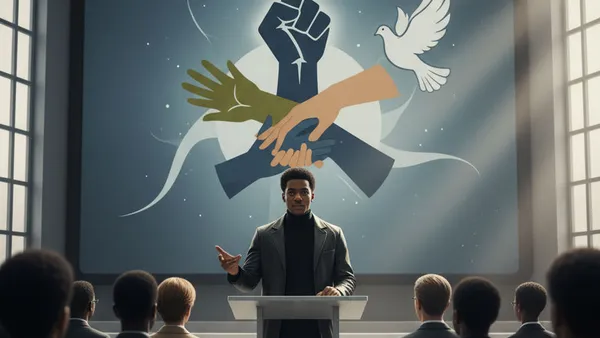
How did a 21-year-old Black Panther unite street gangs and working-class white youths?
Prompted by NerdSip Explorer #5918
Discover the unifying message of Fred Hampton.
Imagine being just 21 years old and leading a movement that changes the course of an entire city. That was Fred Hampton in late-1960s Chicago. As the charismatic leader of the Illinois Black Panther Party, he possessed an incredible gift for public speaking and grassroots organizing.
But Hampton wasn't just giving speeches—he was doing the hard, everyday work. At the time, marginalized communities faced extreme poverty, a severe lack of healthcare, and systemic police brutality. Hampton’s ultimate goal was to empower these communities to survive and thrive on their own terms.
To achieve this, he helped launch "Survival Programs." The most famous was the Free Breakfast for Children program, which ensured kids had healthy food before school. He also opened free medical clinics and boldly negotiated peace treaties between rival Chicago street gangs. For Hampton, true political power meant deeply caring for the people.
Key Takeaway
Fred Hampton was a young, deeply influential leader who focused on practical community care and ending poverty.
Test Your Knowledge
What was a key focus of Fred Hampton's activism in Chicago?
In the 1960s, America was deeply segregated, and racial tensions were at a boiling point. Many people believed the only way to survive was to stick strictly to their own racial groups. But Fred Hampton had a completely different, highly analytical philosophy.
He recognized that the root of much societal suffering wasn't just race—it was *class*. He strongly believed that poor and working-class people of all backgrounds were being oppressed by the exact same economic system.
Hampton famously told his audiences: "We say you don't fight fire with fire, you put fire out best with water. We say you don't fight racism with racism. We're gonna fight racism with solidarity." He argued that simply replacing a white oppressive system with a Black capitalist system wouldn't solve the core issue of poverty. The only genuine cure was multiracial teamwork.
Key Takeaway
Hampton believed that the best way to defeat racism and inequality was through multiracial solidarity, not further division.
Test Your Knowledge
Complete Fred Hampton's famous philosophy: "You don't fight racism with racism, you fight it with..."
Because Hampton viewed the world through the lens of class struggle, his relationship with white people was incredibly nuanced for the era. He absolutely did not view white Americans as a monolithic enemy. Instead, he saw working-class white people as essential, natural allies.
At the time, a large group of displaced, poor white Southerners had moved to Chicago looking for factory work. They formed a community organization called the Young Patriots. Many of them were rough around the edges and even prominently displayed Confederate flags as a symbol of Southern rebellion.
Instead of writing them off or fighting them, Hampton and his colleagues sat down with them. They discovered that the Young Patriots were dealing with the exact same issues: terrible living conditions, crushing poverty, and police harassment. By focusing on these shared economic struggles, Hampton built an unlikely, powerful bridge across a massive racial divide.
Key Takeaway
Hampton saw past cultural differences to recognize that working-class white people faced the same economic struggles as his own community.
Test Your Knowledge
Who were the Young Patriots?
By reaching across the aisle and finding common ground, Fred Hampton achieved something truly historic in 1969. He officially formed what he called the Rainbow Coalition.
This wasn't just a catchy name or an empty slogan. It was a formal, active political alliance that united the Black Panthers, the Young Patriots (the white Southerners), and the Young Lords (a passionate Puerto Rican activist group).
By joining forces, these groups exponentially multiplied their power. They actively attended each other's rallies, shared valuable community resources, and stood side-by-side to protest unfair housing evictions and police violence. The original Rainbow Coalition proved that when people strip away the artificial barriers of race and culture, they can build a massive, united front for fundamental human rights.
Key Takeaway
The Rainbow Coalition was a groundbreaking alliance of Black, white, and Puerto Rican groups fighting for common goals.
Test Your Knowledge
What was the main purpose of the Rainbow Coalition?
Fred Hampton's life was tragically cut short when he was killed during a police raid at just 21 years old. But why was a young man organizing free breakfasts and neighborhood alliances considered such a massive, urgent threat to the establishment?
Historians suggest it was exactly *because* of his unparalleled success in uniting disparate people. A divided, infighting public is relatively easy to manage, but a highly united coalition of Black, white, and Hispanic citizens demanding economic fairness is an unstoppable force for change.
Hampton's enduring legacy is a masterclass in empathy and community organizing. He taught the world that you don't have to look the same, talk the same, or come from the same background to fight for a better world together. His ultimate weapon wasn't violence or anger; it was the radical power of solidarity.
Key Takeaway
Hampton's greatest superpower—and the reason he was so influential—was his extraordinary ability to unite divided groups.
Test Your Knowledge
Why do historians believe Fred Hampton was seen as such a threat to the establishment?
Track your progress, earn XP, and compete on leaderboards. Download NerdSip to start learning.