What happens when history's greatest artistic titans clash in the same city?
Prompted by A NerdSip Learner
Uncover the fierce rivalry that shaped art forever.
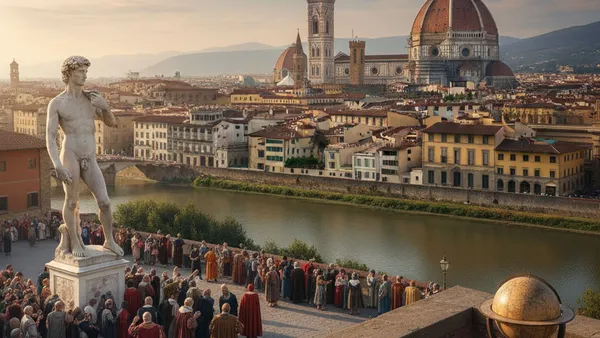
Early in 1504, a 29-year-old Michelangelo completed a sculptural feat that would echo through eternity: the *David*. Carved from a single, previously abandoned block of flawless white marble, the 17-foot colossus weighed over six tons.
But its sheer size created an immediate logistical nightmare. It was originally intended to sit high up on the roofline of the Florence Cathedral, but hoisting such a massive stone giant with 16th-century technology was practically impossible.
To solve this, the Florentine government convened a special committee of over thirty local artists and citizens to decide on a new location. Sitting quietly on this committee was none other than the 51-year-old Leonardo da Vinci.
Leonardo famously suggested tucking the masterpiece away in an obscure, covered corner. Art historians have long suspected this suggestion was driven by professional jealousy! Ultimately, the committee voted to place the *David* proudly in the main public square, where it became a symbol of the Republic of Florence.
Key Takeaway
Even the greatest masterpieces in history had to go through a frustrating committee approval process!
Test Your Knowledge
What practical problem did the 1504 committee have to solve regarding Michelangelo's David?
If you think modern sports rivalries are intense, they pale in comparison to Florence in 1504. Seeking to decorate a newly built council hall in the Palazzo Vecchio, the city's government orchestrated the ultimate artistic showdown.
They commissioned both Leonardo da Vinci and Michelangelo to paint massive, rival battle murals on opposite walls of the exact same room. Leonardo chose to depict the *Battle of Anghiari*, while Michelangelo focused on the *Battle of Cascina*.
The tension between the two was palpable. The elegant, older Leonardo thought Michelangelo's heavily muscled figures looked like "sacks of walnuts." The fiery, temperamental Michelangelo openly mocked Leonardo for his past failures to complete large-scale bronze statues.
In a twist of historical irony, neither man finished their mural. Leonardo experimented with a new oil-based technique that tragically melted off the wall, while Michelangelo was called away to Rome by the Pope. Yet, their brilliant preparatory sketches survived and changed art forever.
Key Takeaway
The Florentine government intentionally pitted the era's two greatest living geniuses against each other to fuel their competitive drive.
Test Your Knowledge
What was the ultimate fate of the rival battle murals commissioned from Leonardo and Michelangelo?
The sheer creative gravity of Florence in 1504 was undeniably magnetic. The dramatic, highly public rivalry between Leonardo and Michelangelo became the talk of the Italian peninsula, acting as a beacon for aspiring talent.
Learning of the extraordinary artistic innovations happening in the city, an ambitious 21-year-old prodigy named Raphael packed his bags and moved to Florence. He didn't come to compete; he came to learn.
Raphael meticulously studied both of the older masters. From Leonardo, he absorbed the technique of *sfumato*—the delicate, smoky blending of colors that gives human faces a lifelike softness. From Michelangelo, he studied human anatomy and dynamic, twisting body postures that conveyed raw physical emotion.
By harmonizing Leonardo's psychological depth with Michelangelo's muscular energy, Raphael developed a universally beloved style of his own. This brief window in 1504, when three of history's greatest names walked the exact same streets, marks the absolute summit of the High Renaissance.
Key Takeaway
Raphael used the bitter rivalry of his older peers as a masterclass, synthesizing their best techniques into his own legendary style.
Test Your Knowledge
How did the young Raphael react to the fierce rivalry between Leonardo and Michelangelo in Florence?
Track your progress, earn XP, and compete on leaderboards. Download NerdSip to start learning.