Why do men and women remember scary movies differently?
Prompted by A NerdSip Learner
Learn how sex shapes our fear memories.
Ever wonder what happens in your head when you jump at a sudden noise? Meet your brain's fear-processing team! The star player is the amygdala, your brain's tiny but powerful alarm system. It immediately shouts, "Danger!"
Next up is the hippocampus, the diligent librarian. It files away the memory of what happened: where you were, what you saw, and how you felt. It provides the context, so next time you're in a similar situation, you'll know to be on alert.
Finally, there's the prefrontal cortex, the calm CEO. This part of your brain helps you think logically. It analyzes the situation and decides if the fear is justified. It might say, "Relax, it was just the cat knocking something over." These three parts work together to create, store, and manage fear.
Key Takeaway
Your brain has a specialized team—the amygdala, hippocampus, and prefrontal cortex—that works together to process fear.
Test Your Knowledge
In the brain's fear-processing team, what is the role of the amygdala?
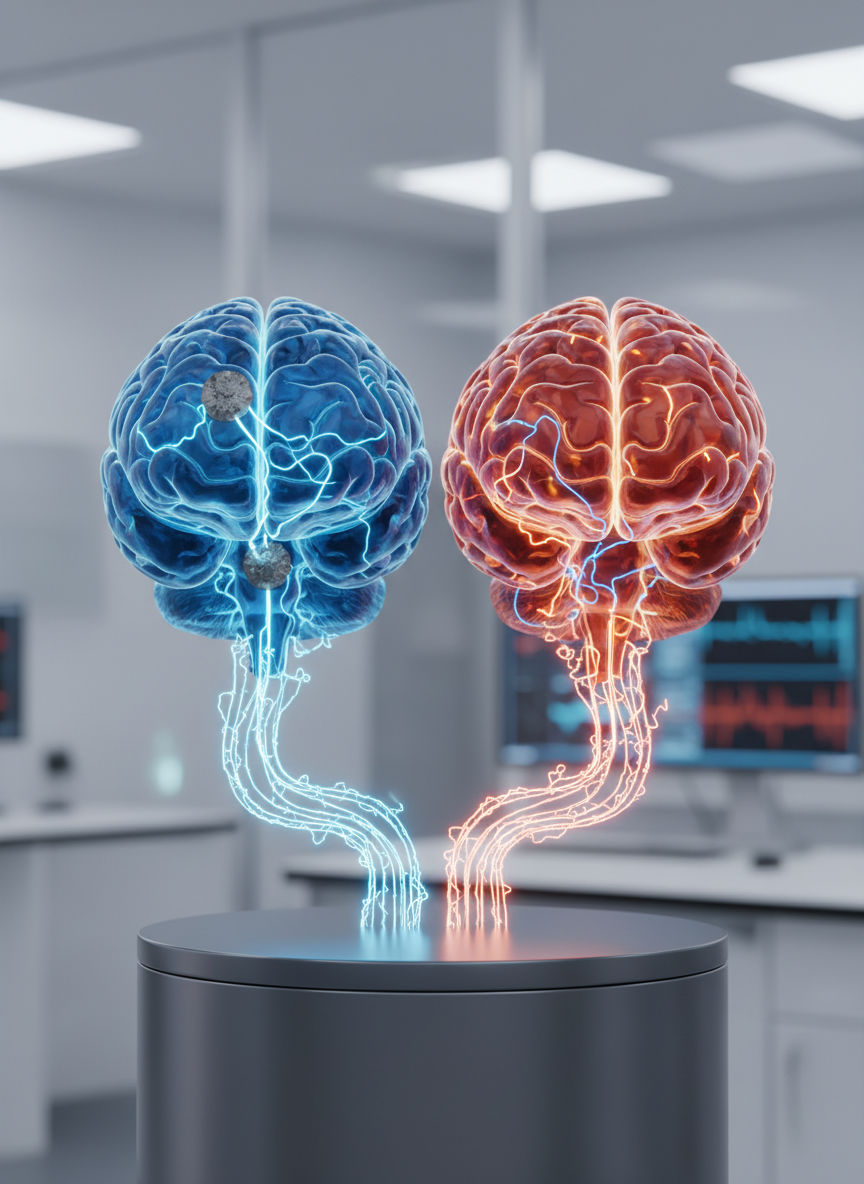
When it comes to managing fear, male and female brains seem to call on different departments. Research suggests that the prefrontal cortex—our logical CEO—gets involved differently based on sex.
In the male brain, the left hemisphere of the prefrontal cortex often shows more activity when recalling a scary memory. The left side is typically associated with processing details, specifics, and analytical thought. It's like focusing on the 'who, what, and where' of the event.
In the female brain, however, the right hemisphere tends to be the more active player. The right side is more linked to processing the 'gist' of an experience—the holistic, intuitive, and emotional feeling of the memory. This could mean the emotional tone of the memory is more central.
This doesn't mean one is better than the other; it's simply a different strategic approach to analyzing a threat. The outcome is the same—a processed fear memory—but the path to get there can vary.
Key Takeaway
Male and female brains often use different hemispheres of their prefrontal cortex to process and recall fear memories.
Test Your Knowledge
According to research, which part of the prefrontal cortex is often more active in the female brain when processing fear?
Brain wiring is only part of the story; our body's chemical messengers—hormones—are also major players. Specifically, estrogen and testosterone appear to fine-tune our fear responses.
In the female brain, estrogen can enhance fear memory consolidation. Think of it like a highlighter that makes the scary memory more vivid and easier to recall later. This is why fear responses in women can sometimes fluctuate with their menstrual cycle, as estrogen levels rise and fall.
In the male brain, testosterone might have a different effect. Some research suggests it can have a dampening or suppressive influence on the fear response, potentially making it easier to inhibit or move past a fearful event.
These hormonal influences add another layer of complexity, helping to explain why the intensity and persistence of fear can feel so different not just between men and women, but for the same person at different times.
Key Takeaway
Hormones like estrogen and testosterone can significantly influence how strongly a fear memory is stored and recalled.
Test Your Knowledge
Which hormone is thought to sometimes make fear memories more 'sticky' or vivid in the female brain?
Have you ever had one bad experience that made you wary of many similar situations? This is called fear generalization. It’s your brain’s attempt to be extra cautious, applying a specific fear to broader, related contexts.
Imagine getting a shock from a faulty blue lamp. A low level of generalization would be fearing only that specific lamp. A high level would be developing a fear of all lamps, or even all blue objects. It’s a survival mechanism, but sometimes it can go too far.
Interestingly, some studies suggest that females may have a greater tendency to generalize fear. This means a single negative event might be more likely to create a wider net of anxiety or caution in the female brain compared to the male brain.
This tendency could be a key factor in understanding why certain anxiety disorders, where fear becomes overgeneralized to safe situations, are more prevalent in women.
Key Takeaway
Fear generalization, the process of a specific fear spreading to safe but similar situations, may be more pronounced in the female brain.
Test Your Knowledge
What is 'fear generalization'?
So, we've seen differences in brain hemispheres, hormones, and fear generalization. But what's the real-world impact? This knowledge is crucial for understanding and treating mental health conditions.
Statistically, women are diagnosed with fear- and anxiety-related disorders, like Post-Traumatic Stress Disorder (PTSD), at a significantly higher rate than men. These brain differences are not a sign of weakness, but rather a biological predisposition that can make them more vulnerable to developing these conditions after a traumatic event.
From an evolutionary perspective, a more sensitive fear system in females may have been advantageous for protecting offspring from threats. In the modern world, however, this same system can sometimes become overactive.
By understanding the unique ways different brains process fear, scientists and doctors can develop more personalized and effective treatments. It’s not about a 'one-size-fits-all' approach, but about tailoring therapy to the individual's unique neurobiology.
Key Takeaway
Understanding these sex-based differences in fear processing is key to developing better, more personalized treatments for anxiety and PTSD.
Test Your Knowledge
What is a major real-world implication of understanding these brain differences?
Track your progress, earn XP, and compete on leaderboards. Download NerdSip to start learning.