Did you know 'race' was a legal invention to stop a rebellion?
Prompted by NerdSip Explorer #5918
Discover the hidden origins of racial division.
Imagine living in the early American colonies in the 1600s, specifically in places like Virginia. If you were poor, life was grueling and incredibly difficult, regardless of where you were originally born. The social divide back then wasn't based on skin color or what we now call race; it was almost entirely about class and wealth.
At this time, wealthy planters relied heavily on indentured servants for their labor force. These were poor people from places like England, Ireland, and various parts of Africa who worked side-by-side in the sweltering tobacco fields. They shared the same cramped living spaces, ate the same meager food, and dreamed of one day owning their own piece of land.
In this early colonial society, the concept of "race" as we understand it today didn't exist in the legal system. In fact, some people of African descent completed their servitude, bought land, and became respected, wealthy members of their communities.
What mattered most to the ruling elite was simply keeping the poor laborers working. But as available land became scarce and taxes rose, this diverse, frustrated group of workers began to realize they had a whole lot in common.
Key Takeaway
In early colonial America, society was divided by class and wealth, not by strict categories of race.
Test Your Knowledge
What was the primary social divide in the early Virginia colonies?
By the year 1676, tensions in the Virginia colony had finally reached a boiling point. Poor laborers—both European and African—were angry and exhausted. They were being heavily taxed by the government, they lacked access to good, farmable land, and they felt completely ignored by the wealthy colonial governor, William Berkeley.
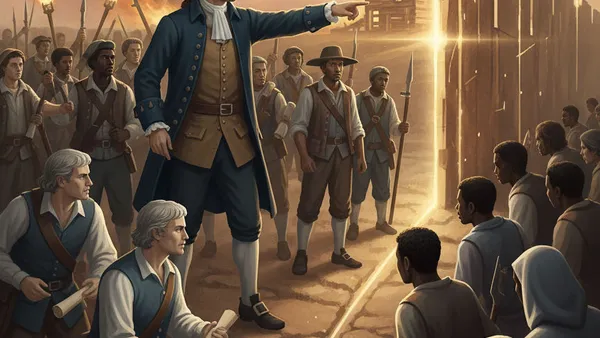
Enter Nathaniel Bacon, a relatively wealthy but highly rebellious landowner. He managed to tap into this widespread anger and formed a highly unlikely, unified army. This monumental event became known as Bacon's Rebellion.
His followers were a united front made up of poor white farmers, black enslaved people, and indentured servants of all backgrounds. They marched together in solidarity against the colonial government, aggressively demanding better working conditions and fair access to land.
Their unified, multi-racial force was so incredibly powerful that they actually chased the governor out of town and burned the capital city of Jamestown to the ground. Although Bacon died of dysentery shortly after and the rebellion collapsed, this massive multi-racial uprising absolutely terrified the colonial ruling class.
Key Takeaway
Bacon's Rebellion was a massive uprising where poor white and black laborers united against the wealthy elite.
Test Your Knowledge
Who made up the army that marched in Bacon's Rebellion?
Imagine being a wealthy plantation owner in 1676, standing on your porch and watching your capital city burn to the ground. The colonial elites realized almost immediately that they had a massive, existential problem on their hands.
The wealthy planters were vastly outnumbered by the poor laborers. Bacon’s Rebellion proved a terrifying reality: when poor white and black workers realized they shared the exact same economic struggles, they could easily overthrow the people in power.
The ruling class needed a permanent strategy to ensure this kind of cross-cultural, working-class unity never happened again. They had to figure out a clever way to break the natural alliance between the European and African workers forever.
Their ultimate solution was a classic political strategy: divide and conquer. If they could create an artificial wedge between these groups, the poor would fight each other instead of fighting the rich. This calculated political strategy would drastically alter the society they lived in and change the course of human history.
Key Takeaway
The wealthy elite realized that a united working class could overthrow them, so they devised a plan to divide them.
Test Your Knowledge
What was the main fear of the wealthy elite after Bacon's Rebellion?
To successfully break the alliance among the poor, colonial lawmakers began passing a series of highly targeted laws, which eventually culminated in the Virginia Slave Codes of 1705.
These new laws fundamentally shifted the structure of society. For the very first time, legal privileges were handed out based entirely on a person's physical appearance and ancestry. Poor Europeans were given small but meaningful benefits—like the legal right to own guns, acquire land, and avoid harsh physical punishments.
Simultaneously, the new laws stripped all basic human rights from people of African descent. They were legally defined as property, strictly forbidden from owning weapons, and locked into permanent, hereditary slavery.
By legally and physically separating these people, the elites essentially invented the modern concept of "race." They manufactured a brand new category called "white," ensuring that even the poorest European felt socially superior to an enslaved African. This successfully destroyed their previous alliance and kept the elite firmly in charge.
Key Takeaway
The Virginia Slave Codes created legal racial categories, giving poor whites privileges while permanently enslaving black people.
Test Your Knowledge
What was the primary purpose of the Virginia Slave Codes of 1705?
The legal invention of race was one of the most successful—and profoundly devastating—political strategies in human history. By drawing a hard, legal line based on skin color, the colonial elite successfully secured their wealth and power for centuries to come.
Before these specific colonial laws, the world certainly experienced prejudice based on religion, language, or nationality. However, the rigid, color-based racial hierarchy we instantly recognize today was legally engineered in the Americas specifically to prevent another uprising.
It was fundamentally a tool of social control. The newly created concept of "whiteness" was used as a psychological wage. It gave poor Europeans a false sense of superiority and belonging with the elite, even if they remained economically impoverished themselves.
Understanding Bacon's Rebellion shows us that racial division wasn't just a natural, unavoidable state of human existence. It was a deliberate, calculated choice made by those in power to protect their wealth—a heavy legacy that modern society continues to untangle and heal from today.
Key Takeaway
The modern concept of 'race' was legally engineered to protect the wealth of the elite, leaving a lasting legacy of division.
Test Your Knowledge
According to the lesson, the modern concept of race was primarily created for what reason?
Track your progress, earn XP, and compete on leaderboards. Download NerdSip to start learning.