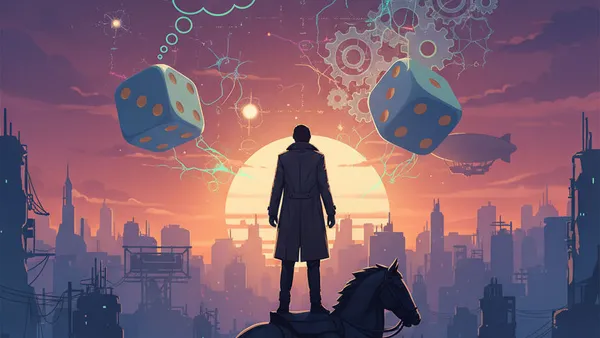
What lies beneath the political and psychological mechanics of Revachol?
Prompted by NerdSip Explorer #6214
Master the philosophical architecture of Disco Elysium.
The Pale is arguably the most brilliant sci-fi concept in modern gaming. It is not merely "dark matter" or a spatial anomaly; it is the physical manifestation of human information entropy. It is a psycho-reactive mist where the laws of physics degrade and history overwrites reality.
For an advanced player, the Pale represents the ontological limit of human existence. As human thought and memory accumulate, they begin to break down the fabric of the world. It operates as a profound metaphor for climate change and digital data saturation—our own historical byproducts consuming the habitable zone.
Understanding the Pale shifts *Disco Elysium* from a political detective game into a work of cosmic horror. The world of Elysium is a localized quarantine, surrounded by an expanding void of past memories that will eventually erase everything, rendering all political struggles utterly ephemeral.
Key Takeaway
The Pale is a psycho-reactive degradation of reality caused by the overwhelming accumulation of human thought and history.
Test Your Knowledge
What does the Pale fundamentally represent in the game's lore?
In literary theory, polyphony (a term coined by Mikhail Bakhtin) refers to a narrative featuring multiple distinct, independent voices. *Disco Elysium* weaponizes this concept through its 24 skills, turning the protagonist's mind into a chaotic, polyphonic chorus.
Unlike traditional RPGs where stats merely determine statistical success, these skills are active conversational partners. Inland Empire acts as an intuitive, Lynchian oracle, while Half-Light operates as a paranoid, reptilian survival mechanism. They do not just color the world; they actively argue, lie, and attempt to hijack your agency.
This creates a masterful simulation of a fractured consciousness. The player is not just solving a murder; they are mediating a continuous internal civil war. By decentralizing the "self," the game questions whether true individual agency even exists when we are merely a parliament of competing biological drives.
Key Takeaway
The game's skill system functions as a polyphonic narrative, breaking the protagonist's mind into 24 distinct, competing personalities.
Test Your Knowledge
How does the skill system fundamentally alter traditional RPG mechanics?
Mark Fisher's cultural theory of hauntology suggests that society is haunted by the "lost futures" that failed to materialize. Martinaise is the ultimate hauntological space, perpetually paralyzed by the ghost of the failed Antecentennial Revolution.
Every crumbling wall and cratered street in Revachol points to a communist utopia that was violently aborted by the Coalition. The characters are trapped in a state of historical melancholy, unable to envision a new future. They are, as Fisher would describe, living in the cultural ruins of the 20th century.
This hauntology extends to Harry himself. His amnesia is a desperate, violent rejection of his own failed past. The game suggests that both the city and the man must confront their lingering ghosts before any true progress can be made.
Key Takeaway
Revachol is paralyzed by "hauntology," structurally and emotionally haunted by the lost future of its failed communist revolution.
Test Your Knowledge
What is the central theme of "hauntology" as applied to Martinaise?
*Disco Elysium* refuses to treat political ideology as a mere cosmetic choice or a simple binary "morality meter." Instead, it approaches politics through dialectical materialism and systemic critique, exposing the inherent contradictions within every worldview.
Whether you choose Mazovian Socio-Economics (Communism), Ultraliberalism, Fascism, or Moralism, the game's systems mock your hypocrisy. Adopting these ideologies in the Thought Cabinet provides mechanical buffs, but also severe debuffs—often reflecting the real-world blind spots of those political theories.
The game forces the player to recognize that ideology is not a clean, heroic solution, but a messy, compromised lens through which to view a broken world. You are never the savior of Revachol; you are just a flawed cog struggling within its vast, unyielding political machinery.
Key Takeaway
The game critiques ideology by mechanically enforcing the contradictions and logical blind spots of your chosen political beliefs.
Test Your Knowledge
How does the Thought Cabinet mechanically represent the flaws in political ideologies?
The concept of psychogeography, introduced by Marxist theorist Guy Debord, explores how geographical environments influence the emotions and behavior of individuals. The skill Shivers is the ultimate mechanical expression of this theory.
When Shivers activates, the camera of Harry's mind detaches from his physical body. You receive poetic, omniscient glimpses of rain falling on distant smokestacks, teenagers dancing in abandoned buildings, and ships navigating the icy waters of the Isolde.
This skill elevates Revachol from a mere backdrop to a living, breathing entity. Harry's nervous system is literally intertwined with the city's concrete and history. By granting the player access to the supra-natural pulse of the metropolis, the game proves that individuals are inextricably bound to their environment.
Key Takeaway
The skill "Shivers" acts as a psychogeographical tool, linking the protagonist's nervous system to the living essence of the city.
Test Your Knowledge
What literary/philosophical concept best describes the function of the "Shivers" skill?
The Thought Cabinet is *Disco Elysium’s* most innovative contribution to RPG mechanics because it models the epistemology of the human mind. It demonstrates how ideas are not just abstract concepts, but tangible forces that alter material reality.
When Harry internalizes a thought—whether it's "Advanced Race Theory" or "Hobocop"—it takes in-game time to process. During this gestation, the thought often penalizes the player, mimicking the cognitive dissonance of wrestling with a new paradigm.
Once internalized, the thought permanently alters Harry's stats and dialogue options. This is a brilliant ludonarrative synthesis: the ideas you choose to entertain literally rewire the architecture of your brain, determining what you can and cannot perceive in the world around you.
Key Takeaway
The Thought Cabinet mechanically simulates how internalizing ideas permanently alters your perception of reality.
Test Your Knowledge
What happens mechanically while a thought is "gestating" in the Thought Cabinet?
Introduced in *The Final Cut*, the four Political Vision Quests are the ultimate culmination of Harry's ideological journey. However, true to the game's cynical tone, they do not result in saving the world.
If you pursue the communist quest, you literally try to build a matchbox tower of theory that collapses. The ultraliberal quest tasks you with bending the laws of reality to manipulate the stock market. Each quest pushes your chosen ideology to its most absurd, literal extreme.
Crucially, completing these quests does not affect the main murder investigation or the ending. This was a deliberate design choice: it reinforces the theme that massive structural realities cannot be overthrown by the isolated, often delusional actions of one erratic detective.
Key Takeaway
The Vision Quests push the player's ideology to absurd extremes, highlighting the inability of individuals to easily dismantle systemic structures.
Test Your Knowledge
Why do the Political Vision Quests intentionally avoid altering the game's final ending?
*Disco Elysium* cleverly uses "Copotypes" (like Sorry Cop, Superstar Cop, and Apocalypse Cop) as a meta-critique of standard RPG player behaviors. The game actively observes how you play and slaps a label on your psychological tics.
Do you constantly click the most self-deprecating dialogue option to avoid conflict? The game brands you a Sorry Cop, forcing you to confront your own people-pleasing tendencies. Do you demand outrageous rewards and act invincible? You become a Superstar Cop, a delusion the game happily mocks.
This mechanic bridges the gap between player and character. By diagnosing your playstyle as a psychological disorder, the game shatters the fourth wall, turning your predictable gaming habits into profound, often pathetic character flaws for Harry.
Key Takeaway
Copotypes act as a meta-commentary, diagnosing the player's predictable gaming habits as in-universe psychological flaws.
Test Your Knowledge
What is the primary meta-narrative purpose of the Copotypes?
The climax of *Disco Elysium* completely subverts the traditional RPG boss fight. Instead of a climactic battle, the game presents a quiet, devastating conversation with The Deserter, a man hollowed out by bitterness, toxic nostalgia, and ideological purity.
The Deserter is a dark mirror to Harry—a man who let the ghosts of the past destroy his present. But just as the narrative reaches its most cynical nadir, the Insulindian Phasmida appears. This cryptid, thought to be a delusion, represents pure, uncorrupted beauty and the miracle of existence.
The juxtaposition is masterful. The player must choose whether to dwell on the violent decay of human history (The Deserter) or find solace in the terrifying, magnificent unknown of the natural world (The Phasmida). It is a profoundly moving conclusion to a story about ruin.
Key Takeaway
The climax juxtaposes the toxic nostalgia of The Deserter with the miraculous, undeniable presence of the Insulindian Phasmida.
Test Your Knowledge
In the game's climax, what does the Insulindian Phasmida thematically represent?
At its core, *Disco Elysium* is a deep exploration of Jean-Paul Sartre’s existentialism and Albert Camus’s absurdism. Harry’s self-inflicted amnesia is not just a convenient plot device; it is a violent act of radical freedom.
By erasing his memory, Harry destroys his essence to return to pure existence. He is thrown into a deterministic, decaying world where he has no context, yet he is entirely responsible for the actions of his past self. He must push his boulder up the hill, much like Camus’s Sisyphus.
The game's brilliant dice-roll mechanic reinforces this absurdism. You can do everything right, maximize your stats, and still fail a 97% check. In *Disco Elysium*, as in life, you do not control the outcome; you only control the grace with which you face the absurdity of failure.
Key Takeaway
Harry's amnesia forces him into a state of radical existential freedom, where he must find meaning in an absurd and deterministic world.
Test Your Knowledge
How does the game's dice-rolling mechanic reinforce its themes of existential absurdism?
Track your progress, earn XP, and compete on leaderboards. Download NerdSip to start learning.