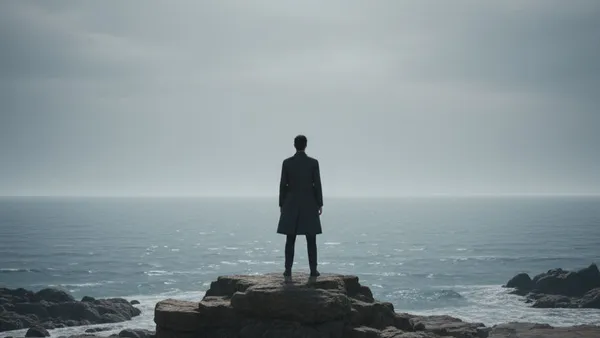
What if nothing matters? Discover why that might be the best news ever.
Prompted by NerdSip Explorer #6214
Understand nihilism and find freedom in a meaning-free world.
Have you ever stared at the night sky and thought, 'Wow, we are really small and nothing we do matters'? That is the starting point of nihilism.
At its core, nihilism is the philosophical belief that life has no objective, built-in meaning or purpose. Imagine buying a brand-new board game, opening the box, and finding out there are no rules, no point system, and no ultimate way to win.
For a lot of people, this sounds absolutely terrifying. From a young age, we are used to searching for a grand purpose, a calling, or a special destiny. Nihilism boldly claims that this destiny simply doesn't exist. There is no magical script written for us in the stars.
But don't worry! While this sounds a bit bleak at first glance, realizing that the universe doesn't have a strict plan for you is just the first step. It is simply an empty canvas waiting for you to figure out what to paint.
Key Takeaway
Nihilism is the belief that life has no pre-determined, objective meaning or purpose.
Test Your Knowledge
What is the best analogy for the core idea of nihilism?
When people talk about nihilism, the name Friedrich Nietzsche usually pops up. He was a brilliant 19th-century German philosopher, famous for his impressive mustache and his highly debated quote, 'God is dead.'
Despite what many people think, Nietzsche wasn't actually celebrating this idea. He was issuing an urgent warning! In his time, scientific discoveries were rapidly replacing traditional religious beliefs. He worried deeply that without a shared belief system, society would lose its moral compass and fall into absolute despair.
He viewed nihilism as a kind of cultural sickness. If people suddenly felt that their old, trusted values were entirely meaningless, they might just give up on life completely.
Nietzsche wanted humanity to boldly push *through* this meaningless phase. His ultimate goal was for us to invent our own strong, life-affirming values, rather than just sinking into sadness over the empty void of the universe.
Key Takeaway
Nietzsche warned that losing traditional belief systems could lead to despair, but he hoped we would eventually create our own values.
Test Your Knowledge
What did Nietzsche think about the rise of nihilism in society?
If you take nihilism to its logical extreme, you encounter what is sometimes called cosmic nihilism. This is the humbling realization that the universe is unimaginably vast, completely cold, and entirely indifferent to human existence.
Think about it for a second: Earth is just a tiny blue speck floating in a seemingly endless void. Our human lifespans are less than a blink of an eye compared to the billions of years the universe has been expanding.
In this viewpoint, every embarrassing mistake you've ever made, every bad day at work, and every awkward conversation will eventually be forgotten. The universe simply doesn't care about our daily struggles.
For some, this perspective can trigger a feeling of deep dread or meaninglessness. It can make getting out of bed feel entirely pointless, because if nothing lasts forever, what is the point of trying so hard right now?
Key Takeaway
Cosmic nihilism highlights human insignificance in a vast universe, which can sometimes lead to feelings of dread.
Test Your Knowledge
What does 'cosmic nihilism' primarily focus on?
Here is where the philosophical plot twists! What if the lack of built-in meaning isn't a dark curse, but actually the ultimate freedom? This highly popular, modern take is known as optimistic nihilism.
If the universe didn't give you a specific, pre-determined purpose, that means you aren't failing at anything. There is no grand cosmic checklist that you are falling behind on. You are entirely free to write your own script.
Optimistic nihilism flips the script on existential dread. Since our mistakes won't matter in a billion years, there is zero reason to obsess over them. You can just take a deep breath and let them go.
Instead of being paralyzed by the void, you can focus on what feels genuinely meaningful to *you* right now: enjoying a good cup of coffee, loving your family, or helping a neighbor. You become the joyful creator of your own universe's meaning.
Key Takeaway
Optimistic nihilism uses the lack of cosmic meaning as an excuse to freely enjoy life and create personal meaning.
Test Your Knowledge
How does optimistic nihilism view the lack of objective meaning in life?
How can a busy 30-something professional actually use nihilism in the real world? Surprisingly, it works as a truly fantastic tool for managing daily stress, burnout, and anxiety.
Let's say you accidentally send an important email with a glaring typo to your boss. Your heart drops into your stomach. But apply a quick dose of nihilistic perspective: in the grand scheme of the cosmos, does this typo actually matter? Absolutely not.
This is called the 'zooming out' technique. When everyday problems feel overwhelmingly large, reminding yourself of the vast, indifferent universe can instantly shrink your anxiety down to a highly manageable size.
Nihilism doesn't mean you stop caring about your job, your friends, or your life. It just helps you stop *over-caring* about the little, insignificant things. It takes the heavy pressure off, allowing you to live with a little more lightness and a lot more inner peace.
Key Takeaway
Zooming out and remembering that our small mistakes don't matter on a cosmic scale is a great way to relieve stress.
Test Your Knowledge
How can a nihilistic mindset be practically useful in your daily life?
Track your progress, earn XP, and compete on leaderboards. Download NerdSip to start learning.