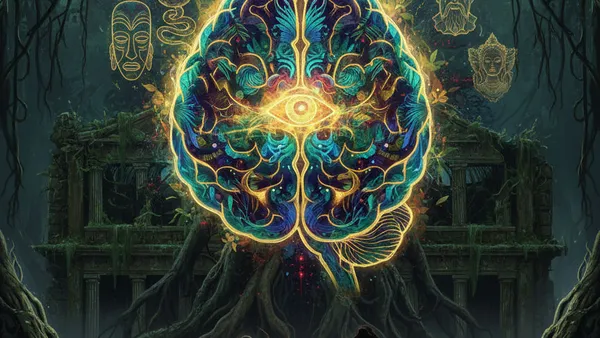
Can plant medicine truly decolonize the collective unconscious?
Prompted by NerdSip Explorer #2356
Integrate Jungian archetypes with Fanonian post-colonial psychoanalysis.
The phenomenological experience of Ayahuasca, an Amazonian entheogenic brew, frequently involves a profound ontological shift. Practitioners and psychonauts consistently report moving beyond their personal autobiographical memory and plunging into what feels like a vast repository of primordial, ancestral memory.
At a neurological level, the brew disrupts the brain's Default Mode Network, the system responsible for maintaining our rigid ego-structure. As this boundary dissolves, the user experiences a flood of non-linear psychic material. This is rarely experienced as a hallucination, but rather as a deeply resonant remembering of our phylogenic past.
For the advanced explorer of consciousness, this raises a crucial epistemological question: What is the nature of this primordial memory? Are we accessing an objective, shared psychic substrate of humanity, or are we encountering the deep, somatic archive of our specific ancestral lineage? Understanding this state requires a rigorous framework to map the geography of the deep psyche.
Key Takeaway
Ayahuasca dissolves ego boundaries, facilitating access to deeply rooted, non-linear ancestral memories.
Test Your Knowledge
Phenomenologically, how is the Ayahuasca experience of primordial memory typically described?
To map the profound depths accessed during an entheogenic state, we can turn to the analytical psychology of Carl Jung. Jung posited that beneath our personal unconscious lies the collective unconscious—a deep psychic stratum shared by all human beings, inherited rather than acquired.
Jung argued that this collective unconscious consists of pre-existent forms known as archetypes. These are not specific inherited memories, but rather innate psychic structures or blueprints. They shape how human beings perceive and emotionally respond to universal experiences like birth, death, power, and the mother figure.
When psychonauts encounter primordial memories under the influence of Ayahuasca, Jungian theory suggests they are navigating this collective unconscious. The visions of ancient serpents, maternal entities, and shadow figures are archetypal images—the conscious mind's attempt to translate these formless, ancient blueprints into a visual syntax the individual can comprehend.
Key Takeaway
Jung's collective unconscious provides a framework for understanding primordial memories as inherited, universal psychic blueprints.
Test Your Knowledge
In Jungian psychology, what exactly is an archetype?
While Jung offers a universalist map of the deep psyche, Frantz Fanon radically disrupts this model by introducing the concept of sociogeny. A Martinican psychiatrist and anti-colonial philosopher, Fanon argued that the psychological trauma of colonialism cannot be understood through traditional psychoanalysis alone.
In traditional psychoanalysis, trauma is traced to *phylogeny* (evolutionary development) and *ontogeny* (individual development). Fanon argued this is insufficient for the colonized subject. Sociogeny suggests that the structural, sociopolitical realities of oppression actively generate psychological complexes.
Colonialism does not merely steal land; it forcibly imposes an alien psychological architecture upon the colonized mind. Fanon brilliantly diagnosed how the colonial subject is forced to internalize the colonizer's gaze, leading to alienation from their own culture and self. If our psychic landscape is shaped by our social reality, then the deepest layers of our memory and identity are inevitably entangled with historical trauma.
Key Takeaway
Fanon's concept of sociogeny reveals that the psychological complexes of the colonized are rooted in structural, sociopolitical realities.
Test Your Knowledge
How does Fanon's concept of sociogeny differ from traditional psychoanalytical approaches?
Fanon offered a devastating, highly nuanced critique of Jung’s supposedly universal collective unconscious. In his seminal work, *Black Skin, White Masks*, Fanon argued that the collective unconscious is not a biological inheritance of innate archetypes, but rather a cultural acquisition imposed by the dominant society.
For the colonized subject, this creates a profound psychological crisis. Fanon asserted that European culture maps its own sociopolitical biases onto these archetypal structures. In this Eurocentric mythos, 'darkness' or the 'native' is historically mapped onto the archetype of the Shadow—representing evil, sin, or the untamed savage.
When a colonized person delves into their unconscious, they risk encountering a psychic landscape already colonized by European symbols. Fanon termed this the epidermalization of inferiority. The psychic basement is not inherently universal; it is heavily mediated by the sociopolitical realities of empire. This severely complicates the interpretation of deep entheogenic visions.
Key Takeaway
Fanon argued that Jung's collective unconscious is culturally acquired, forcing the colonized to internalize Eurocentric archetypes.
Test Your Knowledge
What is the core of Fanon's critique regarding Jung's collective unconscious?
If the traditional psychoanalytic map of the unconscious is tainted by colonial imposition, how do we access true, uncolonized primordial memory? For many indigenous populations and modern practitioners, Ayahuasca serves as a decolonial epistemology—a way of knowing that bypasses Western rationalism entirely.
Western psychology often demands that the unconscious be translated into the rational language of the analyst. Ayahuasca, conversely, asserts the primacy of the somatic and the deeply intuitive. It privileges indigenous cosmologies where plants possess agency, spirits are ontologically real, and knowledge is relational rather than purely cognitive.
By engaging with the plant medicine, the individual disrupts the Eurocentric psychological framework. The visions experienced do not conform to the colonized archetypes Fanon warned against; instead, they resurrect the suppressed symbols, animal spirits, and mythic structures of indigenous heritage, effectively short-circuiting the colonial narrative.
Key Takeaway
Ayahuasca offers a decolonial epistemology that bypasses Western rationalism and revives indigenous mythic structures.
Test Your Knowledge
In the context of this lesson, what makes Ayahuasca a 'decolonial epistemology'?
When we synthesize Ayahuasca's capacity to reveal primordial memory with Fanon's insights on structural trauma, we encounter the somatic archive. Primordial memory is not just a repository of mystical geometry and ancient animals; it is also the physical ledger of ancestral trauma.
Current understandings of epigenetics suggest that the physiological impacts of severe trauma—such as the violence of colonialism—can alter gene expression in subsequent generations. While Jung called this a psychic inheritance, we can now understand it as a deeply biological one.
During deep entheogenic states, individuals frequently report somatic purges—violent shaking, crying, or vomiting. From a decolonial perspective, this is not merely a reaction to the brew's alkaloids, but a cathartic excavation of historical trauma. The individual is not just purging their own neuroses; they are attempting to metabolize the ancestral, epigenetic pain stored within their very cells.
Key Takeaway
Primordial memories accessed via Ayahuasca often involve the somatic purging of epigenetic, ancestral trauma caused by historical violence.
Test Your Knowledge
How does the concept of the 'somatic archive' link Fanon's ideas with entheogenic experiences?
Both Fanon and the tradition of Ayahuasca recognize that true liberation is fundamentally disruptive. Fanon controversially argued in *The Wretched of the Earth* that decolonization is inherently a violent process, because the colonial structure is maintained by violence. To uproot it requires a forceful catharsis.
We can draw a direct parallel to the psychological landscape of the entheogenic journey. The process of ego dissolution is rarely peaceful. It is often experienced as a harrowing, terrifying psychic death. The rigid structures of the colonized ego—the internalized beliefs, the epidermalized inferiority—must be violently dismantled.
Just as Fanon believed a new humanity could only emerge after the absolute destruction of the colonial system, the Ayahuasca experience demands the complete surrender and breakdown of the conditioned self before true integration and healing of primordial memory can occur.
Key Takeaway
The harrowing ego-death in Ayahuasca parallels Fanon’s assertion that dismantling deeply ingrained colonial structures requires a disruptive, cathartic process.
Test Your Knowledge
What parallel is drawn between Fanon's theory of decolonization and the Ayahuasca experience?
If we accept Fanon’s critique that colonialism mapped 'darkness' and 'indigeneity' onto the Jungian Shadow, then the act of healing requires a radical reclamation of that shadow. In Jungian terms, shadow work involves confronting the repressed, hidden aspects of the psyche.
In a post-colonial context, shadow work takes on a profoundly political dimension. The colonized subject must delve into the deep unconscious to confront the internalized colonizer—the voice that diminishes their ancestral heritage.
Ayahuasca facilitates this confrontation masterfully. The plant often thrusts the individual into direct contact with terrifying visions or grotesque archetypes. By facing these visions without turning away, the psychonaut performs a dual function: they integrate their personal psychological trauma, while simultaneously refusing the colonial conditioning that taught them to fear their own indigenous depths.
Key Takeaway
Post-colonial shadow work involves confronting and dismantling the internalized colonizer to reclaim suppressed ancestral identity.
Test Your Knowledge
In a post-colonial context, what does Jungian 'shadow work' accomplish during an entheogenic journey?
As we integrate these complex frameworks, we find a powerful dialectic. Jung provides the *structure* of the deep mind (archetypes, the collective unconscious), Fanon exposes the *sociopolitical contamination* of that structure (sociogeny, epidermalization), and Ayahuasca provides the *methodology* for its excavation.
This dialectical approach requires epistemic humility. The psychonaut cannot naively assume that every vision of a serpent or a deity is an untainted, universal truth. They must remain critically aware that their psyche is a contested battleground, scarred by history.
Yet, they must also remain open to the profound, numinous reality of the plant medicine. The visions are not just historical artifacts; they possess an autonomous, healing intelligence. By holding Fanon's critique and Jung's structuralism simultaneously, the individual can navigate the entheogenic space with unprecedented rigor and depth.
Key Takeaway
A rigorous exploration of the deep psyche integrates Jung's structural framework, Fanon's sociopolitical critique, and Ayahuasca's healing methodology.
Test Your Knowledge
What is required of a psychonaut navigating the dialectic between Jungian universality and Fanonian critique?
The ultimate goal of intertwining Ayahuasca, Jungian archetypes, and Fanonian critique is the synthesis of a liberated mythology. If colonialism sought to write its own dominant myth over the primordial memories of humanity, decolonization is the act of authoring a new psychic reality.
This is not merely a return to a pre-colonial past—which Fanon heavily cautioned against as a romantic illusion—but the forging of a new consciousness. Through the crucible of the Ayahuasca experience, the inherited trauma stored within the collective unconscious is actively metabolized and transformed.
The resulting archetypes are neither purely the inherited biological forms of Jung, nor the sociogenic colonial scars of Fanon. They are resilient, integrated symbols of a psyche that has witnessed its own destruction and consciously rebuilt itself. This is the true power of decolonizing the unconscious: achieving a sovereign, self-determined mind.
Key Takeaway
Decolonizing the unconscious aims to synthesize a new, self-determined mythology rather than romantically retreating to a pre-colonial past.
Test Your Knowledge
According to Fanon, what is a potential danger when attempting to forge a liberated mythology?
Track your progress, earn XP, and compete on leaderboards. Download NerdSip to start learning.