How does a nation of 1.4 billion people actually govern itself?
Prompted by NerdSip Explorer #1206
Understand the structures and forces shaping Indian politics.
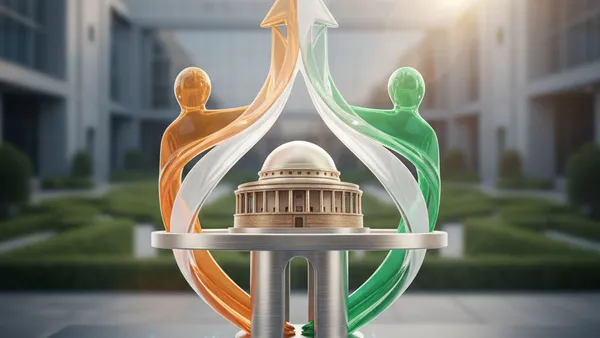
India operates as a parliamentary democratic republic. Think of it as a system where the head of state and the head of government are two distinct roles.
The President is the ceremonial head of state, somewhat similar to the British monarch. However, the real executive power lies with the Prime Minister and their Council of Ministers. The PM is usually the leader of the party or coalition that holds a majority in the lower house of parliament.
Speaking of parliament, it is bicameral (features two houses). The lower house is the Lok Sabha (House of the People), whose members are directly elected by citizens. The upper house is the Rajya Sabha (Council of States), where members are mostly elected by state legislatures.
To govern India, a party needs to control the Lok Sabha. The laws that shape the daily lives of over a billion people are debated and passed in these very halls!
Key Takeaway
Real political power in India's parliamentary system lies with the Prime Minister and the directly elected Lok Sabha.
Test Your Knowledge
Which house of the Indian Parliament is directly elected by the citizens?
Unlike the two-party system found in the US, India boasts a vibrant, highly competitive multi-party system. The landscape is filled with national parties, state-level parties, and regional splinter groups.
Historically, the Indian National Congress (INC) dominated post-independence politics, positioning itself as a broad, centrist, secular party. However, recent decades have seen the dramatic rise of the Bharatiya Janata Party (BJP), which leans right and emphasizes Hindu nationalism alongside economic development.
But the real flavor of Indian politics lies in its regional parties. Because India is incredibly diverse in language and culture, regional parties often champion local interests. Sometimes, no single national party wins an outright majority in the Lok Sabha.
When this happens, parties must form a coalition government, relying on the support of these regional players to stay in power. This makes regional leaders formidable kingmakers on the national stage!
Key Takeaway
India features a multi-party system where regional parties often play critical roles in forming national coalition governments.
Test Your Knowledge
What is a common outcome when no single party wins a majority in the Lok Sabha?
Conducting an election in India is the largest peacetime logistical exercise in human history. With hundreds of millions of eligible voters, the process takes weeks and requires staggering resources.
The body responsible for this monumental task is the Election Commission of India (ECI). The ECI is an independent, constitutional authority famous for its strict enforcement of a "Model Code of Conduct" to ensure fairness and prevent voter bribery.
India uses the First-Past-The-Post voting system. This means the candidate with the most votes in a given constituency wins the seat, even if they don't capture over 50% of the total vote.
Furthermore, India relies entirely on Electronic Voting Machines (EVMs) instead of paper ballots. To ensure no voter has to travel more than two kilometers, polling booths are set up everywhere—from high-altitude Himalayan villages to deep forest settlements!
Key Takeaway
Indian elections are overseen by the independent Election Commission and rely on the First-Past-The-Post system and Electronic Voting Machines.
Test Your Knowledge
Which voting system does India use for its general elections?
India is a union of states, functioning on the principle of federalism. This means power is divided between the central government in New Delhi and the individual state governments.
The Constitution organizes this power through three lists: The Union List (issues like defense and foreign affairs handled by the center), the State List (issues like police and public health handled by states), and the Concurrent List (shared areas like education).
However, India is often described as having a *strong center*. During national emergencies, the central government can assume extraordinary powers over the states. Additionally, the center controls a significant portion of tax revenues, which it then distributes to the states.
This dynamic creates a constant political tug-of-war. State Chief Ministers often demand more autonomy and funds, while the central government tries to maintain uniform national policies.
Key Takeaway
India has a federal structure dividing power between the center and states, though the central government retains significant overarching authority.
Test Your Knowledge
Which "list" in the Indian Constitution contains subjects managed exclusively by the central government?
What actually makes an Indian voter choose a specific candidate? The answer is a complex cocktail of identity, economics, and leadership appeal.
Caste and Religion have historically been deeply entrenched in voting behavior. Many parties actively build alliances by appealing to specific demographic groups, a practice often referred to as "vote bank" politics.
However, welfare and development are equally crucial. Voters reward governments that deliver tangible benefits—like subsidized food, rural housing, or direct cash transfers. In recent years, "welfare politics" has become a major election winner across various states.
Finally, there is the anti-incumbency factor. Indian voters are famously demanding. If a sitting government fails to deliver on its promises or struggles with inflation and unemployment, voters are generally quick to vote them out. This keeps politicians constantly on their toes!
Key Takeaway
Voting behavior in India is driven by a mix of identity politics, welfare delivery, and a strong tendency to punish underperforming incumbents.
Test Your Knowledge
What does the term 'anti-incumbency' mean in the context of Indian elections?
Track your progress, earn XP, and compete on leaderboards. Download NerdSip to start learning.