What is the core idea behind the world's largest religion?
Prompted by NerdSip Explorer #5918
Grasp the core beliefs of Christianity.
Christianity is the world's largest religion, but it all traces back to one person: Jesus of Nazareth. He lived in the Middle East roughly 2,000 years ago. To Christians, Jesus isn't just a historical teacher or prophet; they believe he is the Son of God.
Think of it like a king disguising himself to live among his subjects. Christians believe Jesus was both fully human and fully divine. He experienced hunger, sadness, and joy, just like us, but he also perfectly represented God's love to the world.
His public life lasted only a few years, filled with teaching and healing. His life ended in execution on a cross—an event called the crucifixion. But the foundational belief of Christianity is the resurrection: the belief that Jesus rose from the dead three days later, proving his divine nature and conquering death.
Key Takeaway
Christians believe Jesus is the Son of God who died and rose again to save humanity.
Test Your Knowledge
What does the term 'resurrection' refer to in Christianity?
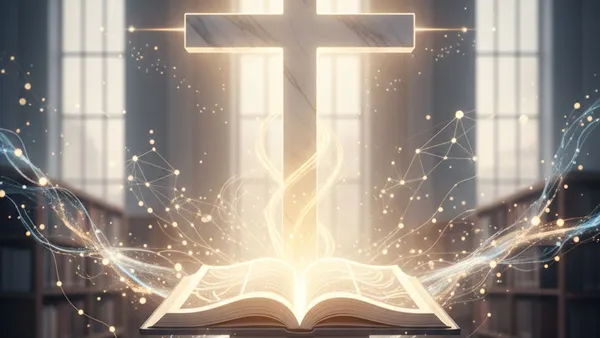
To understand Christianity, you need to know about its holy text: the Bible. It isn't just a single book, but a massive library of over 60 different books written by various authors over thousands of years!
The Bible is split into two main sections. The Old Testament tells the ancient history of the Jewish people, containing poetry, laws, and prophecies. It sets the stage, showing humanity's struggle to be good and their deep need for help.
Then comes the New Testament. Think of this as 'Part Two' of an epic story. It focuses entirely on the life of Jesus, his teachings, and the letters written by his early followers. For Christians, the New Testament is the ultimate guide on how to live, love, and understand God's promises.
Key Takeaway
The Bible is a collection of books divided into the Old Testament (before Jesus) and the New Testament (the life of Jesus and early followers).
Test Your Knowledge
What is the primary focus of the New Testament?
The most famous word in Christianity might be grace. To understand grace, we first have to talk about sin. In Christian terms, sin isn't just 'doing bad things'—it's a spiritual separation from God caused by human imperfection.
Because humans aren't perfect, they can't bridge that gap on their own. That is where grace comes in. Grace is like receiving a million-dollar gift to pay a debt when your bank account is totally empty. It is unearned love, forgiveness, and favor from God.
Christians believe that Jesus’s death on the cross paid the 'debt' for human sin. This rescue mission is called salvation. You don't have to be perfect to earn it; you simply have to accept it through faith. This idea of a completely free gift is what makes Christianity unique among many world philosophies.
Key Takeaway
Grace is God's free, unearned forgiveness and love, offering salvation to imperfect people.
Test Your Knowledge
In Christian teaching, how does a person receive 'grace'?
Christianity isn't meant to be a solo journey. The worldwide community of believers is called the Church. When Christians talk about the 'Church,' they usually don't mean a building with stained glass windows; they mean the *people* themselves.
Believers gather together to worship, learn, and support one another. These gatherings usually happen on Sundays, celebrating the day Jesus is believed to have risen from the dead.
There are two special actions, often called sacraments, that almost all Christians share. The first is Baptism, a symbolic washing with water that represents starting a clean, new life with God. The second is Communion (or the Eucharist), where they share bread and wine to remember Jesus’s sacrifice. These rituals help keep the community connected to their roots and to each other.
Key Takeaway
The Church is the community of believers, not just a building, who share practices like Baptism and Communion.
Test Your Knowledge
When Christians refer to the 'Church' in a broad sense, what are they primarily talking about?
If you look around today, you'll notice many different types of Christian churches. Why are there so many? Imagine Christianity as a massive family tree that has grown over 2,000 years.
Initially, the early church was mostly unified. But over time, geographic, political, and cultural differences led to splits. Today, there are three main 'branches' in this family tree.
First is the Catholic Church, the largest branch, which traces its leadership back to the apostle Peter and is led by the Pope. Second is the Eastern Orthodox Church, which split from Catholicism about 1,000 years ago and is rich in ancient traditions. Third is Protestantism, which started in the 1500s when reformers wanted to change the Catholic Church. This branch includes Baptists, Methodists, Lutherans, and many more. Despite their different styles, all three branches share the same core belief in Jesus!
Key Takeaway
Christianity has three main branches—Catholic, Orthodox, and Protestant—that share core beliefs but have different traditions.
Test Your Knowledge
Which of the following is considered one of the three main branches of Christianity?
Track your progress, earn XP, and compete on leaderboards. Download NerdSip to start learning.