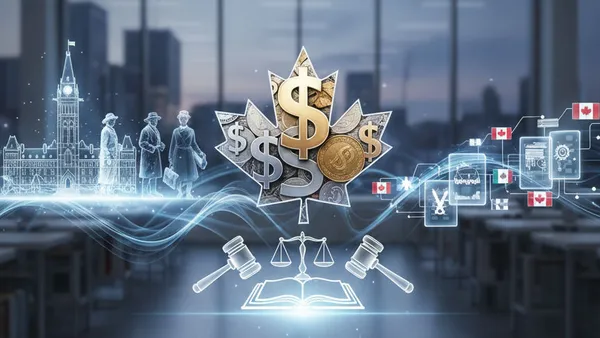
Ever wondered why Canadian money is plastic and who actually runs the country?
Prompted by NerdSip Explorer #5918
Master the basics of Canada's government, history, and laws.
Welcome to Canada 101! Let's start with who is actually in charge. Canada has a unique political setup: it is both a democracy and a constitutional monarchy.
What does that mean? It means the official Head of State is a Monarch (a King or Queen shared with the United Kingdom). However, their role is mostly symbolic and ceremonial.
Think of the Monarch as the hands-off founder of a massive company. They hold the prestigious title, but they don't make the daily business decisions or tell the workers what to do.
The real boss running the day-to-day operations is the elected Prime Minister, who serves as the Head of Government. Along with a group of elected officials, the Prime Minister makes the laws, decides on budgets, and leads the country forward. So, while you might see a royal face on the money, the true power rests in the hands of everyday elected Canadians!
Key Takeaway
Canada shares a Monarch with the UK, but an elected Prime Minister actually runs the country.
Test Your Knowledge
Who handles the day-to-day operations of running the Canadian government?
Long before it was called Canada, this incredibly vast land was home to diverse Indigenous peoples for thousands of years. Their rich cultures and deep connection to the land form the foundational roots of the country.
Later on, French and British explorers arrived and set up colonies. For a long time, these areas were completely separate and were ruled directly by Britain.
But in 1867, a massive team-up happened! Several of these British colonies realized they would be much stronger together. They joined forces to create a brand new, self-governing country. This historic merger is known as Confederation.
Initially, this new version of Canada was quite small, consisting of just four provinces. Over the next century, more provinces and territories signed on, eventually expanding the nation all the way from the Atlantic Ocean to the Pacific Ocean, making it the second-largest country in the world!
Key Takeaway
Canada officially became a unified country in 1867 through a partnership called Confederation.
Test Your Knowledge
What is the historical event called when colonies joined together in 1867 to form Canada?
If you ever hold Canadian money, you will immediately notice something special: it feels completely different! That is because Canada uses polymer, a highly durable type of plastic, instead of traditional paper for its bills.
These colourful polymer notes are practically indestructible. They are waterproof, incredibly hard to tear, and feature see-through holographic windows to stop counterfeiters. You could accidentally run a $20 bill through the washing machine, and it would come out perfectly fine!
Canada also has a quirky, friendly naming system for its coins. The golden one-dollar coin features a loon, a famous Canadian waterbird. Naturally, Canadians nicknamed it the Loonie.
When a two-dollar coin with a golden center and silver ring was introduced a few years later, the public enthusiastically combined 'two' and 'Loonie' to create a brand new word: the Toonie! This playful approach to currency perfectly captures the practical spirit of the country.
Key Takeaway
Canada uses durable, waterproof plastic bills and uniquely named coins like the Loonie and Toonie.
Test Your Knowledge
What material are modern Canadian bills made of?
Every country needs a master rulebook, and in Canada, the most important set of rules is called the Charter of Rights and Freedoms.
Officially added to the constitution in 1982, the Charter is the ultimate protective shield for everyone living in Canada. It legally guarantees fundamental human rights, such as freedom of speech, freedom of religion, and the right to vote in democratic elections.
Think of the Charter as the strongest superhero in the legal universe. If the government ever tries to pass a new law that violates the basic rights laid out in the Charter, that new law will not survive. The courts have the power to step in and strike it down completely!
Because it protects equality and human rights so fiercely, the Charter is widely considered one of the most beloved and important documents in Canadian history, ensuring the country remains a fair and welcoming place.
Key Takeaway
The Charter of Rights and Freedoms is Canada's supreme law, designed to protect the fundamental rights of all citizens.
Test Your Knowledge
What happens if a newly passed law violates the Charter of Rights and Freedoms?
Canada is mind-bogglingly huge—it spans over 9.9 million square kilometers! Because the country is so massive, having just one single government trying to manage everything from coast to coast would be a total nightmare.
To solve this, Canada uses a system called federalism. This simply means the power to make laws and run the country is split into different levels of teamwork.
The Federal Government located in the capital city of Ottawa handles big-picture issues that affect the entire nation. This includes things like the military, printing money, and the postal service.
Meanwhile, the 10 Provincial Governments and 3 Territorial Governments manage things that require a local, tailored touch, such as schools, hospitals, and highways. By splitting the chores up this way, Canada ensures that whether you live in a snowy mountain town or a bustling city, your needs are met efficiently!
Key Takeaway
Canada uses a system called federalism to divide responsibilities between the national government and local provinces.
Test Your Knowledge
Under Canada's system of federalism, which level of government typically handles local services like schools and hospitals?
Track your progress, earn XP, and compete on leaderboards. Download NerdSip to start learning.