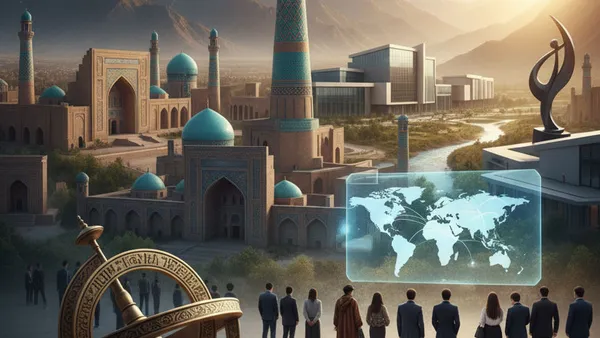
Who really pulled the strings in ancient and modern Central Asia?
Prompted by A NerdSip Learner
Decode the hidden empires, border disputes, and ecology of the region.
While we often imagine grand empires controlling the Silk Road, the real power brokers were the Sogdians. Hailing from regions in modern-day Uzbekistan and Tajikistan, they were not conquerors but the ultimate ancient merchants.
The Sogdian language became the indisputable *lingua franca* of trans-Eurasian trade. If you were negotiating a silk contract in 6th-century China, or bartering for spices in Persia, you almost certainly spoke Sogdian. They established merchant colonies stretching from Crimea to the Chinese capital of Chang'an.
More importantly, they weren't just moving physical goods; they were moving ideas. The Sogdians introduced Middle Eastern glassmaking techniques to China and facilitated the spread of Buddhism, Manichaeism, and Nestorian Christianity across the steppes. Archaeologists have uncovered Sogdian cities filled with brilliant murals depicting Zoroastrian deities alongside Indian folklore, highlighting their unique historical role as the great cultural translators of the ancient world.
Key Takeaway
The Sogdians were the essential middlemen and cultural brokers who truly operated the ancient Silk Road.
Test Your Knowledge
What was the primary role of the Sogdians on the ancient Silk Road?
Central Asia wasn't merely a dusty highway for goods; it was a beacon of unparalleled intellectual output. During the Islamic Golden Age, cities like Bukhara, Merv, and Khiva evolved into thriving hubs of learning, equipped with massive libraries and advanced observatories.
Consider the mathematician Al-Khwarizmi, a 9th-century scholar from the Khwarezm region. His pioneering book *Al-Jabr* formalized the rules of algebra, and his very name was Latinized to give us the modern mathematical term "algorithm."
Similarly, Ibn Sina (widely known in the West as Avicenna), born near Bukhara, was a polymath whose crowning achievement was *The Canon of Medicine*. This monumental encyclopedia set the absolute standard for medical training in both Europe and the Islamic world for nearly six centuries. Instead of just passing knowledge along trade routes, Central Asian scholars were actively generating the science that would shape the modern world.
Key Takeaway
Medieval Central Asia was an intellectual powerhouse that fundamentally shaped modern mathematics, astronomy, and medicine.
Test Your Knowledge
Which modern mathematical term is directly derived from the name of a prominent Central Asian scholar?
Fast forward to the 19th century, and Central Asia became the high-stakes chessboard for a geopolitical rivalry known as the Great Game.
The British Empire, expanding aggressively upward from India, and the Russian Empire, pushing steadily southward across the steppes, engaged in a multi-decade shadow war. Both superpowers feared the other would seize control of the Asian heartland. Rather than large-scale, open warfare, it was a battle of espionage, mapping, and aggressive diplomacy.
Military officers disguised as holy men or merchants snuck through the Hindu Kush to map uncharted territories, while spies courted powerful local emirs with gold and modern rifles. The rivalry largely concluded at the end of the 19th century when both empires agreed on the borders of modern-day Afghanistan. They intentionally designed it as a physical "buffer state" to ensure their respective imperial armies would never directly touch.
Key Takeaway
The Great Game was a 19th-century shadow war between Britain and Russia for strategic influence over Central Asia.
Test Your Knowledge
What was a major geopolitical result of the Great Game rivalry?
When Soviet mapmakers delineated the modern borders of the Central Asian republics in the 1920s and 30s, they created incredibly complex, jagged lines—most notably in the highly fertile Fergana Valley.
Shared today by Uzbekistan, Tajikistan, and Kyrgyzstan, the valley's borders resemble an interlocking jigsaw puzzle. This cartography famously created several *enclaves* (sovereign territories entirely surrounded by another country). For example, the territory of Sokh is populated mostly by ethnic Tajiks, officially belongs to Uzbekistan, but is entirely surrounded by Kyrgyzstan.
Historians continue to debate the exact motives behind these borders. Some argue they were drawn maliciously to intentionally divide ethnic groups, preventing any unified resistance against Moscow. Others suggest they were simply a flawed attempt to map highly integrated, nomadic communities into static nation-states. Regardless of intent, these convoluted borders create immense logistical hurdles and remain a modern geopolitical flashpoint.
Key Takeaway
The Fergana Valley features complex, interwoven borders and enclaves that remain a challenging legacy of Soviet mapmaking.
Test Your Knowledge
What is a defining geographical feature of the political borders within the Fergana Valley?
In the mid-20th century, Soviet planners launched an ambitious agricultural initiative to transform the arid steppes of Central Asia into a leading global producer of cotton, a highly water-intensive crop dubbed "white gold."
To irrigate the vast new cotton fields, engineers diverted the Amu Darya and Syr Darya—the two massive rivers that traditionally fed the Aral Sea. Once the fourth-largest inland body of water in the world, the Aral Sea began to rapidly shrink as its water supply was cut off.
The consequences went far beyond lost water. The regional fishing industry collapsed overnight, stranding fleets of rust-covered ships in a newly formed desert. The exposed seabed, laced with decades of agricultural pesticides and salts, now generates toxic dust storms that severely impact public health across the region. It stands globally as one of the starkest, most devastating examples of human-induced ecological catastrophe.
Key Takeaway
Soviet agricultural policies prioritizing cotton caused the Aral Sea to dry up, triggering a massive regional ecological disaster.
Test Your Knowledge
What agricultural product was primarily responsible for the diversion of rivers away from the Aral Sea?
Track your progress, earn XP, and compete on leaderboards. Download NerdSip to start learning.