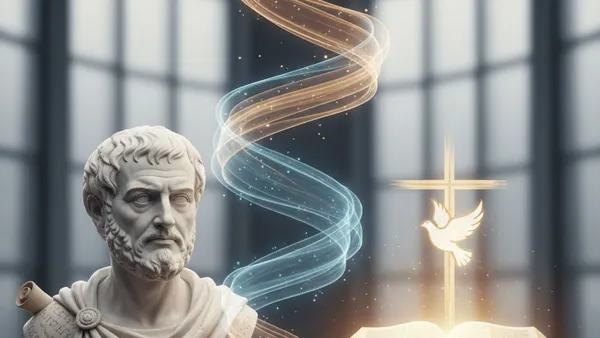
Can a Christian be radically self-reliant while depending entirely on grace?
Prompted by A NerdSip Learner
Master the deep theological tensions between Stoicism and Christianity.
Stoics believed in Pronoia, a deterministic, rational order governing the universe. It is an impersonal system where everything happens out of logical necessity. As a Stoic, your goal is to align your mind with this fate (Amor Fati). You don't ask the universe to change; you change your expectations to match reality.
Evangelicals embrace a robust view of God’s Sovereignty, which includes a highly *personal* Providence. While both philosophies call for radical acceptance of present circumstances, the underlying mechanics are vastly different.
Stoic acceptance is about yielding to a cold, rational cosmos because fighting it is illogical. Christian acceptance is grounded in trusting a loving, omniscient Father who actively works all things together for the good of those who love Him (Romans 8:28). This completely shifts the emotional response to severe adversity. It moves the believer from a gritty, solitary resignation to a relational, dependent trust. We accept our circumstances not because they are blindly necessary, but because they are filtered through the hands of a sovereign God.
Key Takeaway
Stoic fate asks for resignation to cosmic logic; Christian providence invites trust in a loving Father.
Test Your Knowledge
How does the Stoic concept of Pronoia primarily differ from Evangelical Providence?
Epictetus famously established the Dichotomy of Control: we should only concern ourselves with our own thoughts, choices, and actions, as they alone are truly up to us. This breeds a philosophy of radical self-reliance. As Epictetus argued, 'If you want any good, get it from yourself.'
Evangelical theology introduces a profound, paradoxical tension to this idea: the doctrine of Grace. While Christians are heavily exhorted toward moral effort and righteous living, their ultimate sanctification (growing in holiness) is impossible without the indwelling power of the Holy Spirit. We cannot simply willpower our way out of deep-seated sin.
Reconciling these two frameworks requires immense nuance. A mature Christian can utilize the dichotomy of control to stop suffering over external circumstances they cannot change (like the economy or other people's opinions). Yet, they must simultaneously humble themselves, acknowledging that even their internal control—their renewed mind and affections—is an ongoing gift of divine grace, not an achievement of raw human grit.
Key Takeaway
Stoicism demands absolute self-reliance for virtue, whereas Christianity insists our inner transformation ultimately relies on God's grace.
Test Your Knowledge
Why does strict Stoic self-reliance conflict with Evangelical theology?
In Stoic philosophy, things like health, wealth, and social reputation are classified as Adiaphora—meaning they are morally indifferent. They are neither inherently good nor bad; only virtue is good. A Stoic might consider physical health a 'preferred indifferent,' but losing it shouldn't disturb a true Sage's tranquility.
Evangelicalism offers a different ontological view. It affirms the physical world as fundamentally 'good' because God created it. Health, wealth, and relationships aren't completely neutral or indifferent; they are active gifts from God meant to be stewarded for His glory and the good of our neighbors.
However, both traditions fiercely agree on a crucial practical application: these external things must never become our ultimate hope or idols. We are called to hold the things of this world with open hands. By integrating Stoic detachment with Christian stewardship, believers can enjoy God's blessings deeply without letting the sudden loss of those blessings dictate their spiritual joy or peace.
Key Takeaway
While Stoics view external blessings as morally neutral 'indifferents', Christians view them as intentional gifts to be responsibly stewarded without idolizing them.
Test Your Knowledge
What does the Stoic term 'Adiaphora' refer to?
For a practicing Stoic, suffering is an entirely natural feature of the cosmos. It is the 'gymnasium' where virtue is tested, refined, and strengthened. In this view, the obstacle becomes the way; adversity is merely raw material for practicing courage and endurance.
Evangelicals certainly agree that suffering produces endurance and refines character (Romans 5:3). However, they absolutely do not view suffering and death as 'natural.' According to orthodox theology, suffering is an alien intrusion—a tragic result of the Fall that fractures God's original design.
This leads to the Theologia Crucis (Theology of the Cross). Christians believe that God Himself enters into human suffering to redeem it. Therefore, a believer doesn't just stoically grin and bear tragedy. We are explicitly permitted to lament. Jesus Himself wept at the tomb of Lazarus before raising him. We can deeply grieve the brokenness of the world, knowing that God suffers alongside us and promises to ultimately eradicate it.
Key Takeaway
Stoics see suffering as a natural tool for self-mastery, while Christians see it as an unnatural tragedy that God actively redeems.
Test Your Knowledge
How does the Christian view of suffering nuance the Stoic idea that 'the obstacle is the way'?
In philosophy, Teleology is the study of ultimate purpose or design. The Stoic telos (end goal) is Eudaimonia: a state of human flourishing and tranquility achieved by living a life of perfect rational virtue. In this framework, you are the central architect of your own moral project.
The Evangelical telos is beautifully captured by historic confessions like the Westminster Shorter Catechism: 'Man's chief end is to glorify God, and to enjoy him forever.'
Here is where the two paths ultimately diverge at the deepest level. Stoicism is designed to build an indestructible, self-sufficient ego through sheer self-mastery. Christianity, conversely, calls for the death of the ego so that Christ may live within (Galatians 2:20). The mature Christian doesn't seek virtue for the sake of their own personal flourishing or philosophical tranquility; they seek holiness out of profound gratitude and love for their Creator. Virtue isn't the finish line; union with God is.
Key Takeaway
The ultimate goal of Stoicism is self-actualized human flourishing, whereas the Christian goal is glorifying and enjoying God.
Test Your Knowledge
What is the ultimate goal (telos) of human life according to historic Evangelical theology, contrasting with Stoic Eudaimonia?
Track your progress, earn XP, and compete on leaderboards. Download NerdSip to start learning.