Can we ever truly move beyond the labels society forces upon us?
Prompted by NerdSip Explorer #5918
Discover Fanon's path from reclaiming identity to a new shared humanity.
Frantz Fanon, a brilliant psychiatrist and philosopher from Martinique, noticed something deeply troubling about how society operated. He realized that the concept of a rigid "Black identity" wasn't simply a natural fact, but a label heavily constructed by colonial European powers.
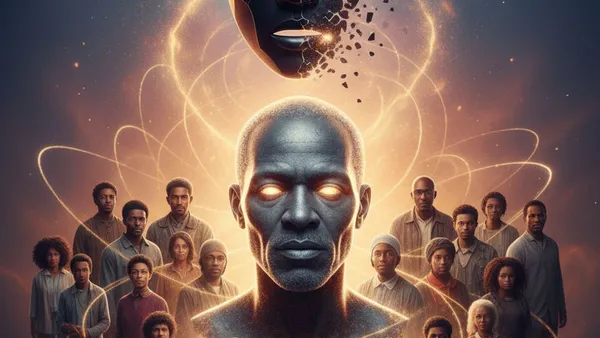
He explored this through what we can call the white gaze. Imagine walking into a room and being forced to view yourself exclusively through the eyes of someone who judges you. People of color were forced into this position, adopting a metaphorical "white mask" to survive in a world that judged them based on skin color.
Fanon argued that this intense external pressure crushed a person's natural, spontaneous sense of self. To be human is to be uniquely free. However, the system of colonialism had trapped everyone inside artificial boxes that stripped away their true individuality.
Key Takeaway
Racial labels were largely created by colonial systems to enforce a hierarchy, not to reflect true human nature.
Test Your Knowledge
What is the core idea behind the concept of the 'white gaze' in Fanon's work?
Before you can break out of a restrictive box, you first have to reclaim your own inner power. For Fanon, an important stepping stone in this journey was engaging with a cultural movement called Négritude.
Created by brilliant thinkers and poets of his era, Négritude was all about embracing Black history, culture, and identity with immense pride. It was a loud, beautiful, and artistic rejection of the widespread idea that European culture was the only valid standard.
Fanon saw this celebration as a crucial psychological medicine. When society constantly tells you that your heritage is a flaw, proudly and loudly celebrating it acts as a powerful antidote. It helps restore the deep self-respect and psychological balance that systemic racism actively tried to erase.
Key Takeaway
Proudly reclaiming one's cultural identity is a vital step in healing from systemic oppression and regaining self-worth.
Test Your Knowledge
How did Fanon view the Négritude movement?
Despite his deep appreciation for the power of reclaiming Black pride, Fanon eventually had a radical realization: he didn't want to be permanently trapped in history. He famously expressed that he did not want to be a prisoner of his past.
Fanon believed that obsessing over a romanticized, "pure" Black past could eventually become just another restrictive box. If you only look backward to find your worth, you limit who you can become today. He believed that no one should sing the praises of the past to the detriment of their present and future.
He forcefully argued that humans are beautifully dynamic. While acknowledging and respecting history is incredibly important, our primary duty is to the present. We must actively invent ourselves every single day.
Key Takeaway
While heritage is important, we shouldn't let an idealized version of the past dictate who we can become in the future.
Test Your Knowledge
Why was Fanon cautious about focusing too heavily on a 'pure' historical identity?
Fanon reached a deeply profound, almost shocking conclusion for his time: the ultimate goal of liberation isn't just to flip the power dynamics of race. Instead, the true goal is to completely dismantle and destroy the concept of race itself.
He passionately argued that racial categories are essentially social fictions. They only exist because unequal societies continue to keep them alive to maintain divisions and power.
Fanon challenged his readers to stop identifying with the superficial "masks" handed down by colonial thought. True freedom means rejecting the script entirely. It means refusing to be categorized by something as arbitrary as skin color, and instead demanding the absolute right to be seen as a complex, individual human being.
Key Takeaway
Fanon believed true liberation requires dismantling the artificial racial categories that divide us.
Test Your Knowledge
What did Fanon mean when he suggested that rigid racial categories like the 'white man' or the 'Black man' are an illusion?
If we finally strip away all the historical masks and the societal labels, what is left? For Fanon, the answer was beautifully simple and incredibly powerful: Our shared humanity.
His ultimate vision was a concept often referred to as "New Humanism." This is a vision of a world where people interact simply as human beings, demanding mutual respect and dignity above all else. He beautifully noted that his one absolute right was demanding human behavior from others.
Fanon didn't want a world where one group dominated another, nor did he want people permanently separated into their own racial corners. He fought fiercely for a future where we instantly recognize the human in each other—a global community built on genuine equality and deep empathy.
Key Takeaway
Fanon's final goal was a 'New Humanism' where people shed racial labels and connect through shared human dignity.
Test Your Knowledge
What is the core idea of Fanon's 'New Humanism'?
Track your progress, earn XP, and compete on leaderboards. Download NerdSip to start learning.