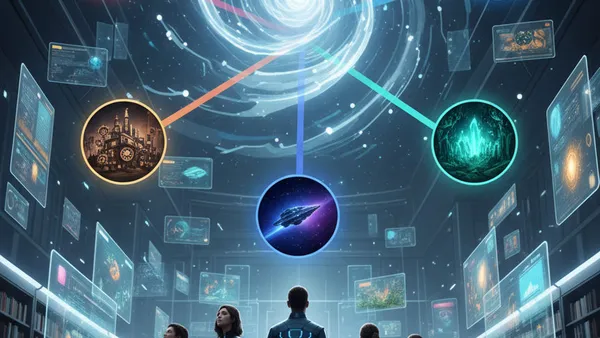
What happens when you bend the rules of reality just a little bit?
Prompted by NerdSip Explorer #6116
Identify the 10 core speculative fiction subgenres.
Welcome to the incredible world of speculative fiction! Think of this as the ultimate umbrella term for any story that asks the question, "What if?" It is a broad category encompassing any fiction that departs from the rules of our known, consensus reality.
If a story contains elements that do not exist in the real world—like magic, faster-than-light travel, or alternate histories—it falls securely under this umbrella. It is the literary home for dreamers, rebels, and visionaries who want to explore beyond the mundane limits of everyday life, blending reality with imagination.
Rather than being a single, narrow genre, speculative fiction is a massive family tree. Underneath its wide canopy, you will find sturdy branches like science fiction, fantasy, horror, and countless bizarre, beautiful blends in between. In this course, we are going to explore the most fascinating and popular branches of this literary tree!
Key Takeaway
Speculative fiction is a broad umbrella term for stories featuring elements that do not exist in our real world.
Test Your Knowledge
Which of these best defines speculative fiction?
When we talk about fantasy, we often divide it into two main camps based heavily on the setting. The first is High Fantasy. These are epic tales set in completely invented, secondary worlds. Think of sprawling maps, unique constructed languages, and world-shaking quests to defeat dark lords.
In contrast, Low Fantasy takes place in a primary world—usually our own, real Earth. In these stories, magic is either hidden in the shadows, kept secret from the general public, or introduces a sudden disruption to a normal, historical setting.
The key difference lies in the scale of the world-building. High Fantasy asks you to step through a portal into an entirely new universe with its own rules of nature. Low Fantasy asks you to imagine what would happen if a dragon suddenly landed on your neighbor's roof. Both offer magic, but their environmental foundations are completely different.
Key Takeaway
High fantasy takes place in a completely invented world, while low fantasy introduces magic into our normal, real world.
Test Your Knowledge
A story about a completely fictional kingdom populated by elves, dwarves, and dragons is considered what?
Just as fantasy has high and low, science fiction is famously divided into hard and soft categories. Hard Science Fiction is all about scientific rigor and accuracy. The plot is deeply rooted in natural sciences like physics, astronomy, and chemistry. The authors strive to make the technology and space travel theoretically possible based on our current understanding of the universe.
On the flip side, Soft Science Fiction focuses more on the "soft" sciences—sociology, psychology, anthropology, and politics. Rather than obsessing over the exact mechanics of a warp drive, these stories explore how that warp drive fundamentally changes human society, relationships, and culture.
Neither approach is inherently better than the other. Hard Sci-Fi appeals to our logical curiosity and desire for strict realism, while Soft Sci-Fi uses futuristic settings to deeply analyze the human condition and our evolving social structures.
Key Takeaway
Hard sci-fi prioritizes scientific accuracy and physics, whereas soft sci-fi focuses more on sociology, psychology, and societal impact.
Test Your Knowledge
Which field of study would be the primary focus of a Hard Sci-Fi novel?
Welcome to a dark, rain-slicked future illuminated by neon lights. This is Cyberpunk, a wildly popular sci-fi subgenre defined by the iconic phrase: *High Tech, Low Life*.
In a Cyberpunk world, technology has advanced exponentially. You will find brilliant artificial intelligence, radical cybernetic body modifications, and vast, immersive virtual reality networks. However, this technology has not saved humanity. Instead, society has decayed. Wealth is hoarded by ruthless, all-powerful megacorporations, while everyday people struggle to survive in gritty, polluted urban sprawls.
The heroes of these stories are rarely clean-cut soldiers. They are usually marginalized antiheroes, rebellious hackers, or corporate defectors living on the fringes of society. By blending advanced tech with moody film noir aesthetics, Cyberpunk forces us to question whether unbridled technological progress actually leads to a better world.
Key Takeaway
Cyberpunk explores a gritty, dystopian future characterized by advanced technology, corporate greed, and societal decay.
Test Your Knowledge
What is the defining conceptual motto of the cyberpunk subgenre?
If cyberpunk is a gritty vision of the future, Steampunk is a highly imaginative reimagining of the past. This subgenre takes the aesthetic and romanticism of the 19th-century Victorian era and supercharges it with retro-futuristic technology.
In a Steampunk world, the digital microchip was never invented. Instead, advanced technology is powered entirely by steam, intricate clockwork, and heavy brass gears. You will find massive airships soaring through the skies, complex mechanical analytical engines, and daring inventors sporting iconic brass goggles and top hats.
Beyond just a cool visual aesthetic, Steampunk often explores fascinating alternate history. It asks us to imagine a timeline where the Industrial Revolution evolved in wildly different, fantastical directions. It captures an era of unbridled optimism about physical invention, exploration, and the raw power of steam engineering.
Key Takeaway
Steampunk reimagines history by combining 19th-century Victorian aesthetics with advanced, steam-powered technology.
Test Your Knowledge
What historical era's aesthetic is most commonly associated with steampunk?
If you want intimate character studies confined to a single room, look elsewhere. If you want massive interstellar armadas, alien empires, and melodramatic stakes, you are looking for a Space Opera.
The term originally started as a slightly derogatory nod to daytime soap operas, but today, Space Opera is celebrated as the home of the grand sci-fi epic. These stories emphasize sweeping romance, adventurous quests, and larger-than-life conflicts spread out across entire galaxies.
While they take place in outer space, these stories rarely get bogged down in the strict mathematical physics of space travel. Instead, the cosmos serves as a breathtaking, limitless backdrop for classic tales of good versus evil, political intrigue, and heroic destiny. Space Opera prioritizes the thrill of the adventure and the sheer, awe-inspiring scale of the universe over scientific realism.
Key Takeaway
Space Opera focuses on epic, melodramatic adventures, grand romances, and sweeping conflicts set across the cosmos.
Test Your Knowledge
What is a key characteristic of a Space Opera?
Utopias are perfect, idealized societies where everyone is supposedly happy. A Dystopia is the exact opposite. Dystopian Fiction explores imagined societies characterized by extreme oppression, dehumanization, and suffering, usually disguised at first glance as a perfect world.
In these stories, a powerful authority—like a totalitarian government, an extreme religious order, or a sinister corporation—maintains total control over the populace. They might use constant surveillance, strict class systems, or environmental deprivation to keep citizens in line. Individuality is usually crushed, and the protagonist is often someone who slowly wakes up to the horrors of their reality.
Dystopian Fiction is powerful because it serves as a funhouse mirror for our own world. These stories are cautionary tales, taking modern anxieties about politics, technology, or the environment and turning the dial all the way up to ten.
Key Takeaway
Dystopian fiction serves as a cautionary tale by portraying a deeply flawed, highly oppressive, and dehumanizing future society.
Test Your Knowledge
What is the primary purpose of most dystopian fiction?
Imagine walking down a busy, noisy street in New York or London, completely unaware that a werewolf is grabbing a coffee right next to you. This is the core, thrilling appeal of Urban Fantasy.
As the name suggests, Urban Fantasy places magical elements, mythical creatures, and ancient folklore directly into a contemporary, modern-day urban setting. Unlike High Fantasy, where you have to learn the geography of a completely new world, this genre grounds the fantastical in the highly familiar grit of city life.
In these stories, the city itself often feels like a living, breathing character. The narrative tension comes from the clash between the mundane world (traffic jams, paying rent, cell phones) and the hidden magical underworld (vampire courts, secret wizarding schools). It feeds our secret desire that magic is real and hiding right around the corner.
Key Takeaway
Urban fantasy blends the gritty realism of modern, contemporary city life with hidden supernatural and magical elements.
Test Your Knowledge
Where does an Urban Fantasy story primarily take place?
Magical Realism is a fascinating and entirely unique literary subgenre. While traditional fantasy treats magic as something extraordinary, a tool to be wielded, or a disruption to reality, Magical Realism treats the supernatural as completely, utterly mundane.
Originating largely from Latin American literature, this subgenre presents a deeply realistic, often highly detailed view of the real world while adding casual, magical elements. A character might live in a normal village but be followed everywhere by a cloud of yellow butterflies, or it might rain delicate flowers for three days straight.
The defining trait is the characters' reactions: they do not freak out or seek scientific explanations for the magic. The magic is just accepted as a normal, everyday fact of life. By blending the marvels of magic with everyday struggles, Magical Realism reveals the hidden poetry in our ordinary existence.
Key Takeaway
In magical realism, supernatural elements are accepted as a normal, everyday part of an otherwise deeply realistic world.
Test Your Knowledge
How do characters in magical realism typically react to magical events?
We often fear what we do not understand, and no subgenre captures this quite like Cosmic Horror. Sometimes known as Lovecraftian horror, this genre bypasses traditional monsters like vampires, ghosts, or slashers to target our deepest, most profound existential dread.
The central theme of Cosmic Horror is that the universe is vast, ancient, and entirely indifferent to human existence. In these stories, protagonists often stumble upon ancient, incomprehensible cosmic entities or slumbering, ancient gods. Just gazing upon these beings is often enough to drive a normal person entirely insane, as the human mind cannot process their existence.
The terror in these stories does not come from cheap gore or sudden jump scares, but from the horrifying realization of our own cosmic insignificance. Cosmic Horror teaches us that humanity is not the center of the universe—we are just a tiny speck in a dark, terrifying, and fundamentally unknowable cosmos.
Key Takeaway
Cosmic horror evokes fear by highlighting humanity's utter insignificance and fragility in a vast, indifferent universe.
Test Your Knowledge
What is the primary source of fear in cosmic horror?
Track your progress, earn XP, and compete on leaderboards. Download NerdSip to start learning.