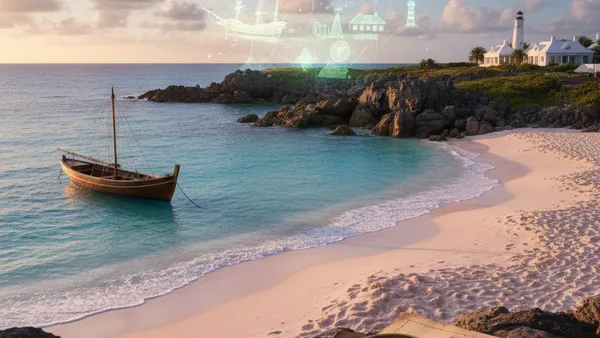
Why did a devastating shipwreck lead to a pastel island paradise?
Prompted by NerdSip Explorer #4704
Master the vibrant history of Bermuda.
In 1505, Spanish explorer Juan de Bermúdez spotted a hook-shaped island in the Atlantic, but he wisely chose not to land. For decades, sailors actively avoided the area, nicknaming it the Isle of Devils. They were terrified by strange, shrieking sounds carrying over the water and the treacherous, invisible reefs that lay just beneath the surface. (The "devils" were actually just the native Cahow birds, which have a uniquely eerie call!)
Bermuda's human story truly began by accident in 1609. The British ship *Sea Venture*, commanded by Sir George Somers, was bound for the new colony of Jamestown, Virginia. Caught in a brutal hurricane, the ship began taking on water. To prevent sinking, Somers deliberately steered the ship into Bermuda's protective coral reefs.
Miraculously, all 150 passengers and one dog survived the wreck. They waded ashore to find an island paradise teeming with food and resources. This dramatic shipwreck directly inspired William Shakespeare's play *The Tempest* and marked the beginning of Bermuda's permanent human settlement.
Key Takeaway
Bermuda was unintentionally settled in 1609 by British shipwreck survivors escaping a hurricane.
Test Your Knowledge
What event caused the initial British settlement of Bermuda in 1609?
Founded in 1612, just three years after the *Sea Venture* shipwreck, the Town of St. George is a recognized UNESCO World Heritage site. It holds the prestigious title of being the oldest continuously inhabited English town in the New World. Walking its narrow, winding cobblestone streets—with quirky, historical names like "Old Maid’s Lane" and "Needle and Thread Alley"—feels exactly like stepping back into the 17th century.
Unlike many other early colonial settlements in North America that were hastily built of wood and inevitably burned down, St. George's was largely constructed using durable local limestone. This architectural choice allowed the town to survive centuries of fierce Atlantic hurricanes and potential fires.
Today, you can still visit St. Peter's Church in the heart of the town. Established in 1612, it is the oldest surviving Anglican church in continuous use outside the British Isles. The town remains a living museum, where residents go about their daily lives inside beautifully preserved centuries-old structures.
Key Takeaway
St. George's is a remarkably preserved 17th-century town that survived due to its durable limestone construction.
Test Your Knowledge
Why did St. George's survive intact better than many other early colonial towns?
Bermuda is globally famous for its stunning pink sand beaches, with Horseshoe Bay being the most photographed of them all. But this beautiful hue isn't an optical illusion or the result of changing light—it's a fascinating biological phenomenon!
The signature pink color actually comes from microscopic marine organisms called foraminifera. These tiny, single-celled creatures thrive in the coral reefs surrounding the island, and they possess vibrant, reddish-pink shells. When the organisms die, their colorful shells detach and fall to the ocean floor.
Over time, the relentless action of the ocean waves crushes these tiny red shells. The fragments are then washed ashore, where they mix with the pristine white remains of crushed coral, clams, and calcium carbonate. The combination of the bright white and vivid red materials creates the perfect pastel pink coastline that stretches across the island's southern shore. The contrast against the crystal-clear turquoise waters is truly breathtaking.
Key Takeaway
Bermuda's pink sand is caused by the crushed red shells of microscopic marine organisms mixing with white coral.
Test Your Knowledge
What gives Bermuda's beaches their signature pink color?
Look at almost any house in Bermuda, and you will immediately notice a distinct, stair-stepped white roof. This iconic design isn't just a stylistic choice or a nod to island aesthetics—it is a brilliant and necessary survival mechanism!
Geographically, Bermuda has absolutely no fresh water springs, rivers, or lakes. Surrounded by salt water, the early settlers had to find a creative way to secure drinking water. Their solution was to turn every home into its own water treatment facility. The roofs are carefully angled and stepped to catch every drop of rainfall, while slowing down the water during heavy tropical storms.
The roofs are traditionally painted with a thick, limestone-based white wash. This bright paint reflects the hot sun to keep homes cool, but more importantly, it naturally purifies the rainwater as it funnels down into massive underground storage cisterns. To this day, Bermudians rely on these ingenious roofs for their daily water supply.
Key Takeaway
Bermuda's iconic stepped white roofs are uniquely designed to catch and purify rainwater for drinking.
Test Your Knowledge
Why are Bermuda's roofs designed with painted white steps?
The rhythmic heartbeat of Bermuda's culture is undoubtedly the Gombey. This vibrant, deeply symbolic folk tradition emerged in the early 1800s, blending African, Caribbean, and Indigenous drumming and dancing styles.
Historically, enslaved people in Bermuda were only permitted to gather and dance once a year, usually around Christmas or Easter. Because of these restrictions, Gombey performances became a powerful, veiled expression of resistance, storytelling, and cultural identity. The dancers wore masks to hide their identities from slave masters, ensuring their freedom of expression.
Today, Gombey troupes are highly respected. They wear intricate, ritualized costumes featuring tall headdresses adorned with peacock feathers, brilliantly colored capes, and small mirrors to ward off evil spirits. Led by the hypnotic, driving beat of snare and bass drums, the troupes dance through the streets. A captain controls the rhythm with a whistle, and the complex footwork commands massive crowds that follow the dancers for miles.
Key Takeaway
The Gombey is a vibrant dance and drumming tradition rooted in African and Caribbean resistance.
Test Your Knowledge
The Bermuda Gombey tradition originally served as a form of what?
You simply cannot talk about Bermuda without mentioning the infamous Bermuda Triangle. This legendary region of the North Atlantic Ocean is bounded by Bermuda, Florida, and Puerto Rico. For decades, it has been the subject of wild conspiracy theories about vanishing ships, missing airplanes, and paranormal activity.
However, the reality of the Bermuda Triangle is far more grounded in nature than science fiction. The real culprit behind many historical shipwrecks was Bermuda's incredible geography. The island is surrounded by an incredibly dense, razor-sharp coral reef system that extends for miles out to sea.
Before the invention of modern sonar and GPS navigation, these hidden reefs were practically invisible from the surface. They tore the wooden hulls of countless approaching ships to shreds, sending them to the bottom of the ocean. Today, the area is one of the most heavily traveled shipping lanes in the world. With modern technology mapping the ocean floor, the waters surrounding Bermuda are perfectly safe.
Key Takeaway
The true danger of the 'Bermuda Triangle' historically came from the island's hidden, razor-sharp coral reefs.
Test Your Knowledge
What is the most realistic historical explanation for many shipwrecks near Bermuda?
Following the American Revolution, Britain lost its primary naval bases on the east coast of the United States. Needing a strategic fallback to maintain control of the Atlantic trade routes, they looked to Bermuda.
In 1809, they began construction on the massive Royal Naval Dockyard at the far western tip of the island. Dubbed the "Gibraltar of the West," it was built over decades by thousands of convicts shipped over from England. The Dockyard became an impenetrable fortress and a vital strategic stronghold for the British Royal Navy during the War of 1812, and later in both World Wars.
Today, the sprawling complex has been completely transformed. While the imposing stone walls remain intact, the Dockyard is now a premier entertainment and cultural hub. It houses the National Museum of Bermuda, bustling glassblowing and craft studios, local pubs, and serves as the primary port for the massive cruise ships that visit the island.
Key Takeaway
The Royal Naval Dockyard was a massive British fortress built to maintain naval power in the Atlantic.
Test Your Knowledge
Why did Britain originally construct the Royal Naval Dockyard in Bermuda?
As you explore the island's lush botanical gardens and historic estates, you will likely stumble upon freestanding, circular stone arches. These are known as Moongates.
Though they look like ancient European relics, moongates were actually introduced to Bermuda relatively recently, in the 1920s. A local sea captain had traveled to China and was deeply inspired by the circular archways he saw in traditional Asian gardens. He brought the blueprints back home, and Bermudians quickly adopted the design, recreating it with native coral limestone.
The moongate perfectly blended into Bermuda's architectural aesthetic, but it also birthed a beloved local superstition. According to island lore, if newlyweds walk through a moongate while holding hands, they will be blessed with a long, prosperous, and happy life together. Because of this charming tradition, you will often spot newlyweds posing for photos inside these beautiful stone circles all across the island.
Key Takeaway
Moongates are circular stone arches inspired by Chinese architecture that symbolize good luck for couples.
Test Your Knowledge
According to local tradition, who is meant to walk through a Bermuda Moongate for good luck?
Between 1931 and 1948, the primary mode of transportation across the island was the affectionately named "Old Rattle and Shake." This was the Bermuda Railway, a single-track train that ran 22 miles from St. George's in the east to Somerset in the west.
Constructing the railway was an incredibly expensive engineering marvel, requiring dozens of massive wooden and steel bridges to connect the various islands of the archipelago. However, the train's lifespan was remarkably short. The relentless salty ocean air quickly rusted the tracks and decaying bridges made maintenance unviable. Furthermore, the introduction of the private automobile to Bermuda in 1946 rendered the slow-moving train entirely obsolete.
Instead of abandoning the infrastructure, the government eventually transformed the old tracks. Today, it is known as the Bermuda Railway Trail. This 18-mile continuous scenic pathway is completely restricted to walkers and cyclists, winding through some of the island's most peaceful, untouched natural landscapes.
Key Takeaway
Bermuda's short-lived railway system was converted into an 18-mile scenic trail for walkers and cyclists.
Test Your Knowledge
What ultimately led to the demise of the Bermuda Railway?
For two centuries, the historic town of St. George's served as Bermuda's capital. However, as trade expanded and ships grew larger, the town's harbor became inadequate. In 1815, the capital was officially moved to the more centrally located City of Hamilton.
Situated perfectly in the middle of the island on a deep, highly sheltered harbor, Hamilton quickly became the epicenter of commerce. Ships could easily dock to offload goods directly onto Front Street, the city's iconic main promenade. Today, Front Street remains famous for its row of brightly painted, pastel-colored colonial buildings, boutique shops, and bustling waterfront dining.
Beyond its scenic charm, Hamilton has driven Bermuda's modern economy. It has transformed the tiny island into a global financial powerhouse. Hamilton is recognized worldwide as a premier hub for the reinsurance industry and international business, proving that this small, mid-Atlantic city punches well above its weight on the global stage.
Key Takeaway
Hamilton replaced St. George's as the capital in 1815 due to its central harbor and is now a global business center.
Test Your Knowledge
Why was the capital of Bermuda moved to Hamilton in 1815?
Track your progress, earn XP, and compete on leaderboards. Download NerdSip to start learning.