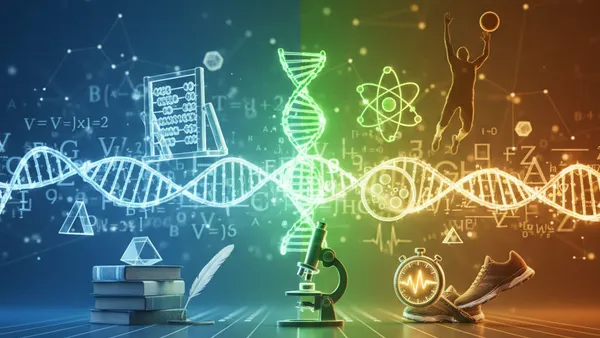
Why did we learn Math, English, Science, and PE in school?
Prompted by A NerdSip Learner
Apply school's core subjects to your adult life.
Ever wonder why you spent years studying Math, English, Science, and PE? As a kid, it often felt like an arbitrary set of rules and tests. But as a 30-year-old, you'll find these four subjects form the ultimate survival kit for adulthood!
Think of them like a four-legged stool. If one leg is missing, the stool wobbles and falls over. Math represents your personal finance and daily logic. English is how you negotiate a raise, send a thoughtful text, or communicate boundaries. Science is understanding how your body works and learning how to spot a scam. PE is the daily maintenance required to keep your physical body running smoothly.
In this course, we are going to re-introduce you to these core four subjects. Forget the stressful standardized tests and surprise pop quizzes. We will look at them strictly through the lens of your everyday adult life. Whether you are navigating a career change, starting a family, or simply trying to figure out how to be an adult, these foundational subjects are everywhere. Welcome to your ultimate refresher course!
Key Takeaway
The four core school subjects are actually highly practical tools for navigating everyday adult life.
Test Your Knowledge
What is the main purpose of the "core four" subjects as explained in this lesson?
Many of us carry "math trauma" from our school days. We tend to think of math as confusing formulas, solving for "x", or reciting multiplication tables under immense pressure. But at its heart, math is simply the study of patterns, structures, and basic logic.
As an adult, math is your best friend when it comes to money. Whether you are calculating a 20% tip at a restaurant, comparing grocery prices per ounce, or figuring out how much interest your credit card truly charges, basic math keeps you from being taken advantage of.
You do not need advanced calculus to succeed. If you can add, subtract, multiply, divide, and understand simple percentages, you have all the tools you need to manage a budget and make smart life choices. Math doesn't have to be scary. When you reframe it as a tool for personal empowerment, numbers become your allies. Embracing basic math helps you build long-term wealth and avoid incredibly expensive mistakes.
Key Takeaway
Adult math is mainly about practical logic and managing your personal finances effectively.
Test Your Knowledge
According to the lesson, what is basic math most useful for in everyday adult life?
In school, English class usually meant reading dusty old novels and writing strict five-paragraph essays. Because of this, it might have felt completely disconnected from reality. But English is actually about mastering the most powerful tool humanity has: communication.
Every time you write a clear email to your boss, express your personal boundaries to a partner, or craft a hilarious text message to a friend, you are using the skills taught in English class. It is fundamentally about organizing your thoughts so others can understand exactly what you mean and how you feel.
Good communication builds deep relationships and rapidly advances careers. When you know how to tell a good story or persuade an audience, you hold the keys to influence. You don't need a massive, complicated vocabulary; you just need clarity and empathy. Reading also plays a massive role here. Exposing yourself to different types of writing helps you understand diverse perspectives, making you a more empathetic and connected human being.
Key Takeaway
English is about clear communication, which is essential for building relationships and advancing your career.
Test Your Knowledge
What is the primary focus of English skills for adults?
Science isn't just a bunch of people in white lab coats mixing colorful, bubbling liquids. Science is a specific method for asking questions and finding the truth. It is a way of looking at the world with a sense of deep curiosity and healthy skepticism.
In the modern digital world, we are bombarded with wild claims. An internet ad says a new pill will make you lose 10 pounds in a single day. A sensational headline claims the earth is flat. Thinking like a scientist simply means asking, "Where is the evidence?" before you believe something you read online.
Understanding basic science also helps you make sense of the physical world. It explains why we need vaccines, how the weather changes, and why leaving food out makes it spoil. Think of the scientific method as your ultimate life hack for problem-solving. You make a guess, test it out, and see what happens. Embrace your inner scientist to navigate a complex world safely and wisely.
Key Takeaway
Scientific thinking helps you question wild claims and make decisions based on solid evidence.
Test Your Knowledge
How does thinking like a scientist help you in daily adult life?
Remember Physical Education (PE)? For some, it was a really fun break; for others, it was the absolute dread of dodging a heavy red ball or running the mile in the heat. But the real lesson of PE isn't about being an elite, competitive athlete. It is about basic maintenance for your body.
You only get one physical body to carry you through your entire life. At age 30, you might start noticing little aches and pains that simply weren't there before! PE principles teach you that consistent movement is medicine.
Stretching keeps your joints mobile and fluid. Walking or jogging strengthens your heart muscles. Lifting a few weights keeps your bones dense and strong. Think of your body like a car. If you never drive it, the battery dies. If you never change the oil, the engine seizes up. Regular physical activity is simply your preventative maintenance routine. Keep moving, and your body will thank you for decades to come.
Key Takeaway
The true goal of PE is to keep your body moving regularly to maintain your long-term health and independence.
Test Your Knowledge
What is the true purpose of Physical Education for an adult?
Track your progress, earn XP, and compete on leaderboards. Download NerdSip to start learning.