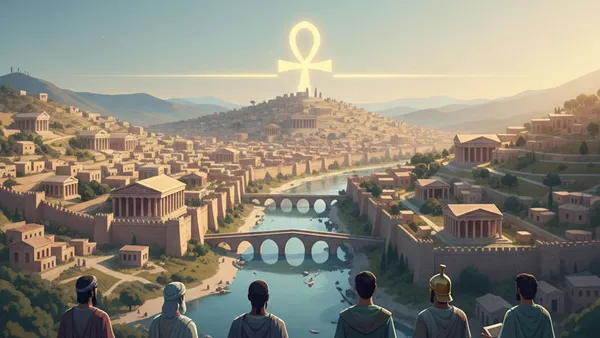
How did one general's ancient gamble create a Mediterranean megacity?
Prompted by A NerdSip Learner
Uncover the rise of ancient Antioch.
When Alexander the Great died in 323 BC, his massive empire fractured almost immediately. His top generals, famously known as the Diadochi, ruthlessly carved up the newly conquered lands. One of the most brilliant and successful of these commanders was Seleucus I Nicator.
To secure his vast new eastern territory, Seleucus ordered the creation of a brand-new metropolis around 300 BC. He named it Antioch, a tribute honoring his father, Antiochus, and a powerful symbol of his own new dynasty.
Seleucus didn't just pick a spot on a map at random. He chose a highly strategic location along the Orontes River in the region of modern-day southeastern Turkey. It was a fertile lowland valley uniquely positioned to link the Mediterranean Sea with the highly lucrative caravan trade routes stretching deep into Asia.
Almost overnight, Antioch was designed to project power, wealth, and Greek culture across the Middle East. It was the ambitious birth of a city that would actively shape world history for centuries.
Key Takeaway
Antioch was founded around 300 BC by a former general of Alexander the Great to control vital trade and territory.
Test Your Knowledge
Why did Seleucus I Nicator build Antioch in its specific location?
Antioch was originally designed as a classic Greek city, but it quickly evolved into a spectacular cultural melting pot. Because of its prime location at the literal crossroads of the ancient world, it naturally drew ambitious people from across the map.
Hellenistic (Greek) elites who ruled the city mingled daily with local Syrian populations, traveling Persians, and a massive, thriving Jewish community. This unique fusion created a vibrant, cosmopolitan atmosphere where new ideas, languages, and exotic goods flowed freely in bustling street markets.
The city was internationally famed for its physical beauty and unapologetic luxury. Just a few miles outside the main city limits was Daphne, a stunning ancient resort area. Known for its cascading waterfalls, lush cypress gardens, and grand temples, it was an ancient playground where the wealthy went to escape city life.
Thanks to booming global trade and an incredibly diverse population, Antioch would eventually grow to be recognized as the "Queen of the East," a megacity rivaling even Rome and Alexandria in sheer splendor.
Key Takeaway
Antioch thrived as a cosmopolitan hub, blending Greek, Syrian, and Eastern cultures into a wealthy, diverse society.
Test Your Knowledge
What was Daphne in relation to ancient Antioch?
What started as a single general's colonial outpost in 300 BC quickly transformed into the beating heart of the Seleucid Empire. This was a massive, sprawling realm that at its height stretched all the way from modern-day Turkey to the borders of India.
Antioch officially served as the empire's capital and housed the royal mint. Kings were confidently crowned here, and rival generals frequently fought bloody battles to control its wealthy, strategic streets. But the city's incredible story didn't end when the Seleucid Empire eventually faded.
When the Romans absorbed the territory in 64 BC, they didn't destroy Antioch; they actively upgraded it. It became the wealthy capital of the Roman province of Syria, eventually housing an estimated half a million people at its absolute peak. Later, it even became a pivotal, defining center for early Christianity.
Today, the ancient ruins of Antioch lie mostly buried beneath the bustling modern Turkish city of Antakya. Despite devastating ancient earthquakes and shifting empires, the legacy of Seleucus’s grand gamble endures.
Key Takeaway
Antioch began as the capital of the vast Seleucid Empire and seamlessly transitioned into a crucial Roman megacity.
Test Your Knowledge
What modern-day country currently encompasses the site of ancient Antioch?
Track your progress, earn XP, and compete on leaderboards. Download NerdSip to start learning.